
Chef Juliette
Various Almond Preparations
Five almond preparations, one discipline: remove the skins cleanly, dry every kernel through, then cut, toast, or cloak it in pale caramel without letting its fragrant oils escape.
A cooking platform built around craft, culture, and the stories behind what we eat.
Created by Chef Juliette
Based on No. 2859, Bombe Grande Duchesse, from Le Guide Culinaire (1907) by Auguste Escoffier
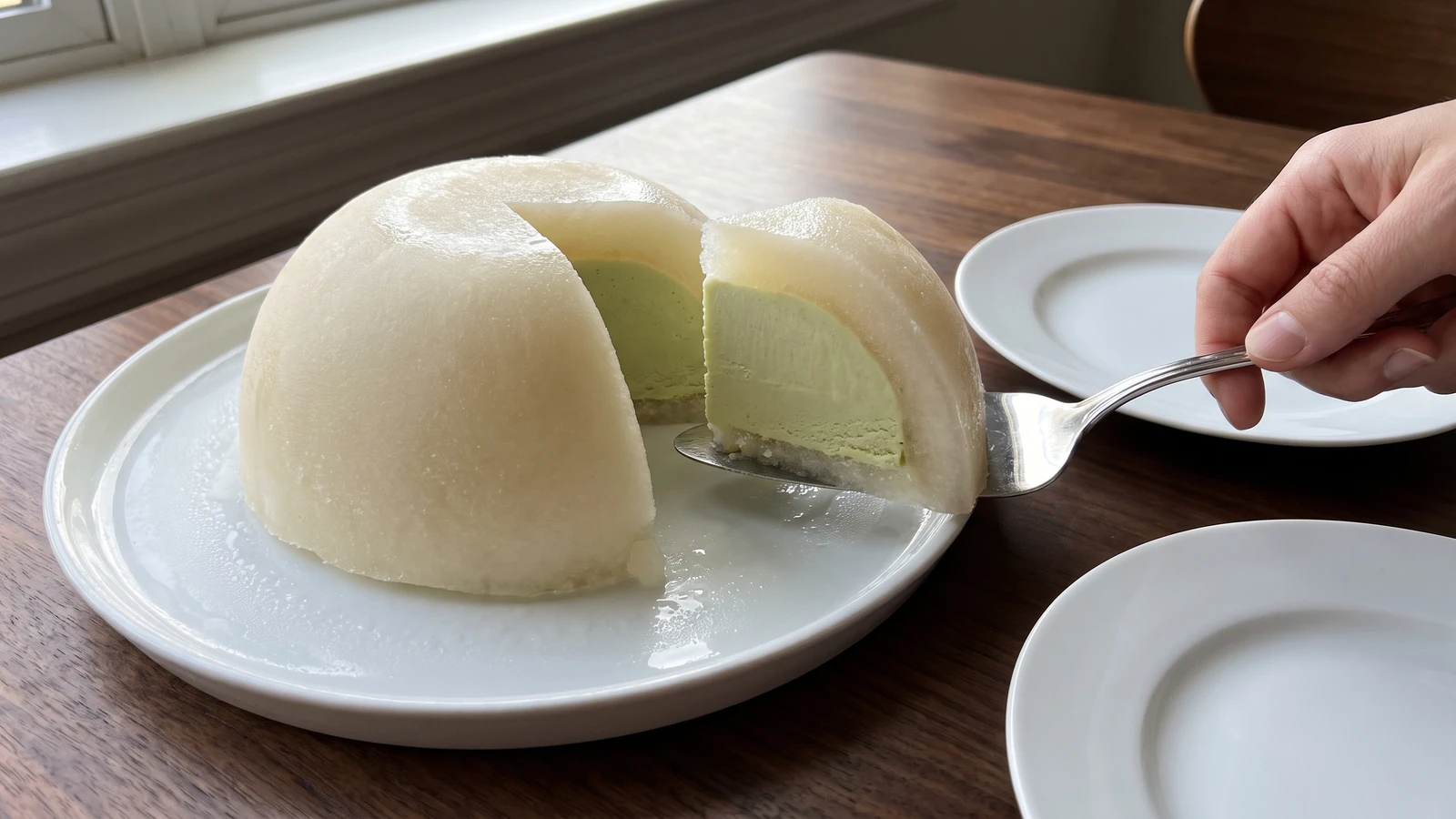
Pear ice becomes the mould itself, holding a silken Chartreuse pâte à bombe whose herbal sweetness is measured, not guessed. The reward is a clean-cut dome of fruit, cream, and cold.
Bombe Grande Duchesse (a pear ice dome with Chartreuse cream) teaches that cold builds structure as surely as heat does. The pear ice must form a complete frozen shell before the Chartreuse pâte à bombe enters it; if that shell is thin, soft, or patchy, the clean dome and its two distinct textures disappear together.
The original formula assumed pear ice and Chartreuse bombe preparation arrived from separate stations, while a metal bombe mould waited in a freezing chest packed and repacked with salted ice. At home, a smooth metal bowl, an ordinary freezer, and either an ice cream machine or food processor do the same work honestly. What changes is the scale and the source of the cold, not the composition: pear ice outside, Chartreuse filling within. One cook, one stove, one evening of work, then the freezer keeps watch.
Repeated packing in salted ice was brigade scaffolding and can go. Clothing the mould cannot, because it is the dish. Spread the pear ice evenly and freeze it until hard before making the filling; that is the one step that decides whether the Bombe Grande Duchesse stands proudly or slumps into a very expensive pudding.
Bombe Grande Duchesse belongs to the Parisian grand-kitchen repertoire of moulded ices, where a bombe took its name from the rounded metal form packed in salted ice and turned out whole at the celebration table. Grande Duchesse is a repertoire title, not a claim that the dessert came from a duchess's household: in this formula it means pear ice enclosing a Chartreuse bombe preparation, joining orchard fruit to the Alpine liqueur of the Dauphiné. The cross-reference to a sole aspic is deliberate, because clothing a mould was shared cold-kitchen grammar; jelly performed the work in the savory kitchen and pear ice performs it here.
Quantity
3 large, yielding 3 cups (720 ml / 450 g)
peeled, cored, and diced
Quantity
1/2 cup (120 ml / 100 g)
Quantity
scant 1/2 cup (100 ml / 100 g)
Quantity
1 1/2 tablespoons (22 ml / 22 g)
Quantity
6
Quantity
1/2 cup (120 ml / 100 g)
Quantity
1/4 cup (60 ml / 60 g)
Quantity
2 tablespoons (30 ml / 28 g)
Quantity
1 1/2 cups (360 ml / 360 g)
Quantity
Method reference only (No. 916); no ingredient quantity
consulted for clothing the mould, not added to the dessert
| Ingredient | Quantity |
|---|---|
| ripe Bartlett or Comice pearspeeled, cored, and diced | 3 large, yielding 3 cups (720 ml / 450 g) |
| granulated sugar for the pear ice | 1/2 cup (120 ml / 100 g) |
| water for the pear ice | scant 1/2 cup (100 ml / 100 g) |
| fresh lemon juice | 1 1/2 tablespoons (22 ml / 22 g) |
| large egg yolks | 6 |
| granulated sugar for the pâte à bombe | 1/2 cup (120 ml / 100 g) |
| water for the pâte à bombe | 1/4 cup (60 ml / 60 g) |
| Chartreuse liqueur | 2 tablespoons (30 ml / 28 g) |
| cold heavy cream | 1 1/2 cups (360 ml / 360 g) |
| Another Method of Preparing Aspics de Filets de Solesconsulted for clothing the mould, not added to the dessert | Method reference only (No. 916); no ingredient quantity |
Set a smooth 1 1/2-quart (1.4-liter) metal bombe mould or deep bowl in the freezer, along with the platter on which you will serve the dessert. Make certain the mould stands level. Cold is structure here, so every component must be properly chilled before it meets the next.
Combine the 100 g sugar and 100 ml water in a small saucepan. Bring to a boil, stirring only until the sugar dissolves, then simmer for 2 minutes and cool for 10 minutes. Blend the pears, syrup, and lemon juice until perfectly smooth, then press the purée through a fine sieve. Chill it until thoroughly cold, at least 1 hour. The lemon sharpens the pear and checks browning; it must not announce itself as lemon.
Churn the cold pear base in an ice cream machine until dense, smooth, and spreadable, about 20 to 25 minutes. Without a machine, freeze it in a shallow metal tray for about 90 minutes, break the half-frozen mixture into pieces, process until smooth, and freeze again for 30 minutes. Reserve a generous 1 cup of pear ice for sealing the base of the bombe. The rest should hold a ridge from the spoon without becoming hard.
Pack the pear ice across the bottom and up the sides of the frozen mould in an even layer about 1/2 inch (1.25 cm) thick. This is clothing the mould, the operation cross-referenced by the book through Another Method of Preparing Aspics de Filets de Soles (No. 916). Inspect the shell against the light and patch every thin place, then freeze it for 1 hour, until completely firm. If the ice slides toward the bottom, return the mould to the freezer for 10 minutes and continue in two passes. Ça se rattrape. The salted-ice packing of a brigade is scaffolding the home freezer can discard; this even, hard shell is the dish and must stay.
Begin beating the yolks at medium speed until pale and slightly thickened. Put the 100 g sugar and 60 ml water in a clean saucepan, bring them to a boil without stirring, and cook the syrup to 118°C (244°F). If crystals form around the edge, cover the pan for 1 minute so condensation washes them down, then uncover and continue. With the mixer running, pour the syrup into the yolks in a narrow stream between the whisk and the side of the bowl. Beat at high speed for 6 to 8 minutes, until the pâte à bombe, a cooked-yolk foam, has tripled in volume, holds a thick ribbon, and feels cool rather than warm.
Reserve 1 tablespoon of the cold cream, then whip the rest to soft peaks. Measure the Chartreuse exactly and whisk it gently into the cooled pâte à bombe. Fold in one-third of the whipped cream to lighten the base, then fold in the remainder with broad strokes until no white streaks remain. If the whipped cream begins to look grainy, stop and fold in the reserved liquid cream to relax it. A warm yolk base will melt the cream, so if the bowl still carries heat, wait before folding. Chartreuse is all herb and sugar here; a heavy hand masks the pear and prevents a firm freeze.
Spoon the Chartreuse filling into the frozen pear shell, pressing gently into the curve so no air pockets remain. Leave about 1/2 inch (1.25 cm) below the rim and level the filling. Let the reserved pear ice soften just enough to spread, then pack it across the top and press its edge firmly into the frozen wall. This seal becomes the flat base when the bombe is turned out.
Press a round of parchment directly against the pear ice, cover the mould tightly, and freeze at 0°F (-18°C) or colder for at least 6 hours, preferably overnight. The Chartreuse center will remain softer than the pear shell because alcohol and sugar resist freezing. If the center yields deeply when tested through the base, give it more time; cold cannot be hurried by lowering the temperature for one frantic hour.
Remove the covering and wrap the mould for 5 to 8 seconds in a towel wrung from warm water. Invert it onto the chilled platter and lift gently. If it clings, repeat with the towel for another 2 seconds rather than forcing it. Should the outer pear ice soften, return the unmoulded bombe to the freezer for 15 minutes. Cut with a long knife dipped in warm water and wiped dry between slices. The shell should cut cleanly around the creamy, faintly herbal center. À table!
1 serving (about 160g)
Culinary guides, cultural storytelling, and the editorial depth that makes cooking meaningful.
Discover Culinary ExplorerChef Juliette
Five almond preparations, one discipline: remove the skins cleanly, dry every kernel through, then cut, toast, or cloak it in pale caramel without letting its fragrant oils escape.

Chef Juliette
A pastry pantry lesson in one tray: filberts warmed only until their red skins release, rubbed clean, cooled, and chopped into a fragrant mise-en-place for cakes, creams, pralines, and petits fours.

Chef Juliette
The smallest pâtisserie discipline decides whether a cake leaves its mould intact: clarified butter in every corner, followed by the lightest veil of dry flour or fécule.

Chef Juliette
Four whites, one spotless bowl, and a patient change of speed: whisk gently until loosened, then briskly to glossy stiffness, with powdered sugar waiting if the foam begins to granulate.