
Chef Juliette
Various Almond Preparations
Five almond preparations, one discipline: remove the skins cleanly, dry every kernel through, then cut, toast, or cloak it in pale caramel without letting its fragrant oils escape.
A cooking platform built around craft, culture, and the stories behind what we eat.
Created by Chef Juliette
Based on No. 2858, Bombe Frou-Frou, from Le Guide Culinaire (1907) by Auguste Escoffier
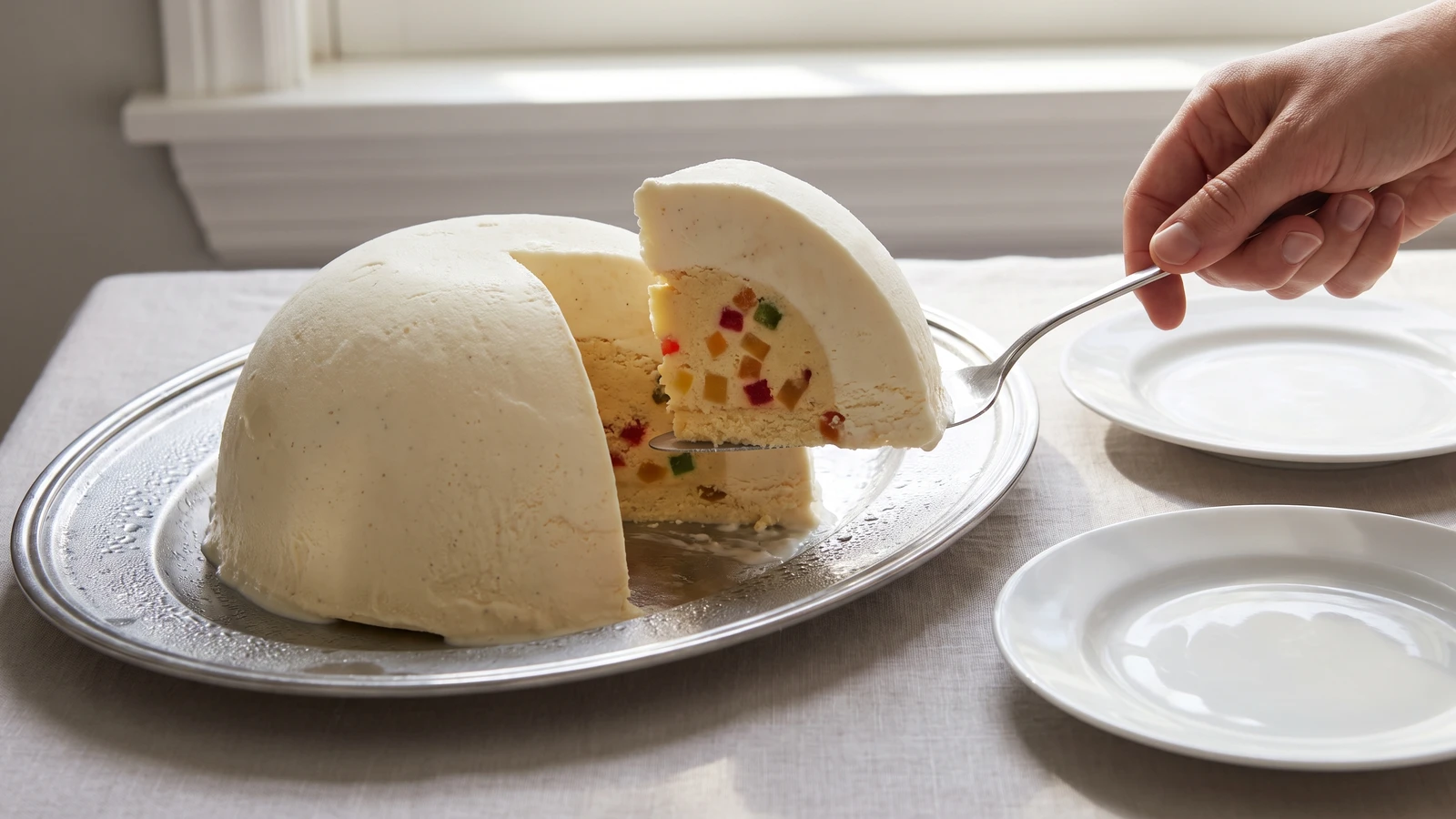
A domed shell of vanilla ice cream hides a light rum pâte à bombe jeweled with candied fruit, built on one discipline: drain the fruit until no syrup follows it into the cream.
Bombe Frou-Frou (a domed frozen dessert of vanilla ice cream, rum-lightened yolk cream, and candied fruit) teaches the architecture of a bombe glacée: one firm frozen layer enclosing a softer one. The true thing to know before touching a pan is that liquid decides whether the center sets. Soak the candied fruit in rum, certainly, but drain and blot it thoroughly; the syrup it sheds would slacken the cream.
The original entry assumed a pastry station holding vanilla ice cream and a separate bombe preparation, a purpose-made metal mould, and salted ice ready for freezing between operations. At home, good bought ice cream replaces a second churn, a chilled stainless-steel bowl replaces the bombe mould, and your freezer replaces the packed ice. That repeated brigade handling was scaffolding and can go. Chemiser le moule, clothing the mould with an even vanilla shell, and making a proper pâte à bombe, egg yolks expanded with hot sugar syrup, are the dish and must stay. One cook, one stove, one evening, then a night's freezing.
Cut it and you should see a smooth ivory shell around a pale gold center, with candied fruit running through it like small bright windows. Before you make the syrup, give the drained fruit twenty quiet minutes in its sieve and blot away every wet gleam. That step decides the cut.
Bombe Frou-Frou belongs to the Parisian family of bombes glacées, moulded frozen desserts assembled in metal domes by pastry kitchens and carried whole to the celebration table. The word bombe names the rounded mould, while Frou-Frou is one of the playful menu names given to compositions distinguished by their lining, frozen center, and garnish, not a regional recipe. Here vanilla ice cream supplies the pale shell and rum bombe with candied fruit supplies the softer heart; the home freezer changes the equipment, not that architecture.
Quantity
3½ cups (840 ml / 575 g)
softened just until spreadable
Quantity
¾ cup (180 ml / 140 g)
cut into small dice
Quantity
5 tablespoons (75 ml / 70 g)
4 tablespoons for soaking and 1 tablespoon for the pâte à bombe
Quantity
5 large (about 90 g)
Quantity
½ cup (120 ml / 100 g)
Quantity
¼ cup (60 ml / 60 g)
Quantity
1 cup (240 ml / 240 g)
very cold
Quantity
1 technique reference (No. 916)
consulted only for the mould-clothing principle; no savory component enters the dessert
| Ingredient | Quantity |
|---|---|
| good vanilla ice creamsoftened just until spreadable | 3½ cups (840 ml / 575 g) |
| mixed candied fruitcut into small dice | ¾ cup (180 ml / 140 g) |
| dark rum4 tablespoons for soaking and 1 tablespoon for the pâte à bombe | 5 tablespoons (75 ml / 70 g) |
| pasteurized egg yolks | 5 large (about 90 g) |
| granulated sugar | ½ cup (120 ml / 100 g) |
| water | ¼ cup (60 ml / 60 g) |
| heavy creamvery cold | 1 cup (240 ml / 240 g) |
| Another Method of Preparing Aspics de Filets de Solesconsulted only for the mould-clothing principle; no savory component enters the dessert | 1 technique reference (No. 916) |
Combine the diced candied fruit with 4 tablespoons (60 ml) of the rum and leave it for at least 2 hours, stirring once or twice. Tip everything into a fine-mesh sieve and drain for 20 minutes, then spread the fruit on a clean towel and blot it gently until the pieces remain supple but no longer glisten wet. Do not return the drained syrup to the filling. It carries dissolved sugar as well as rum, and either would keep the center loose.
Chill a 1½-liter metal bombe mould or hemispherical bowl for 20 minutes. Reserve about ¾ cup (180 ml) of the softened vanilla ice cream for the lid, then press the remainder over the bottom and sides in an even layer about ½ inch (1.25 cm) thick. This is chemiser le moule, using the coating principle cross-referenced in Another Method of Preparing Aspics de Filets de Soles (No. 916); that savory preparation remains in its own entry, and only its mould-clothing operation belongs here. Freeze the lined mould for 45 minutes, until the shell is hard. If you see a thin patch, press in another spoonful of ice cream and freeze again. Ça se rattrape.
Whip the very cold cream to soft peaks, stopping when it holds a rounded fold but still looks smooth and supple. Firm peaks are too far because the cream must survive folding and freezing without turning grainy. Keep it cold while you make the pâte à bombe.
Beat the yolks in a heatproof bowl until pale and slightly thickened. Put the sugar and water in a small heavy saucepan, stir only until every grain is moistened, then boil without stirring to 244°F (118°C). With the mixer running at medium speed, pour the syrup in a thin stream down the inside of the bowl, safely clear of the beaters. Continue beating for 7 to 10 minutes, until the pâte à bombe is thick enough to fall in a ribbon and the bowl feels barely cool. Beat in the remaining 1 tablespoon (15 ml) rum. If the syrup crystallizes in the pan before reaching temperature, add 1 tablespoon (15 ml) water and melt it again gently. If the yolk mixture remains warm, set the bowl over ice and keep beating; warm pâte à bombe would melt the whipped cream.
Whisk one-third of the whipped cream into the pâte à bombe to lighten it, then fold in the rest with a broad spatula, turning the bowl as you work. Fold in the drained candied fruit last, distributing it without crushing the cream. The mixture should mound softly. If it runs like sauce, set the bowl over ice for 10 minutes and fold it twice more; do not add more sugar or cream.
Spoon the rum and candied-fruit filling into the frozen vanilla shell, pressing gently into the curve so no large air pockets remain. Stop about ½ inch (1.25 cm) below the rim. Spread the reserved vanilla ice cream over the filling to seal it completely, smoothing the surface level with the mould. Cover closely with reusable wrap or parchment followed by foil.
Freeze the bombe on a level shelf for at least 8 hours, preferably overnight. Chill the serving platter before unmoulding. Dip only the outside of the mould into warm water for 5 to 8 seconds, dry it, invert it over the platter, and lift. If it clings, wrap the mould briefly in a warm towel rather than soaking it again. Should the surface soften, return the unmoulded bombe to the freezer for 10 minutes.
Let the bombe stand in the refrigerator for 10 minutes before serving. Cut it with a long knife dipped in hot water and wiped dry between slices. The vanilla shell should cut firmly while the rum center yields more softly, with the fruit held cleanly inside rather than leaking syrup onto the plate. À table!
1 serving (about 160g)
Culinary guides, cultural storytelling, and the editorial depth that makes cooking meaningful.
Discover Culinary ExplorerChef Juliette
Five almond preparations, one discipline: remove the skins cleanly, dry every kernel through, then cut, toast, or cloak it in pale caramel without letting its fragrant oils escape.

Chef Juliette
A pastry pantry lesson in one tray: filberts warmed only until their red skins release, rubbed clean, cooled, and chopped into a fragrant mise-en-place for cakes, creams, pralines, and petits fours.

Chef Juliette
The smallest pâtisserie discipline decides whether a cake leaves its mould intact: clarified butter in every corner, followed by the lightest veil of dry flour or fécule.

Chef Juliette
Four whites, one spotless bowl, and a patient change of speed: whisk gently until loosened, then briskly to glossy stiffness, with powdered sugar waiting if the foam begins to granulate.