
Chef Juliette
Bombe Aboukir
Bombe Aboukir sets a pale pistachio ice shell around pralined pâte à bombe, cool, nutty, and cleanly sliceable, with chopped pistachios held in a centre as light as frozen mousse.
A cooking platform built around craft, culture, and the stories behind what we eat.
Created by Chef Juliette
Based on No. 2855, Bombe Florentine, from Le Guide Culinaire (1907) by Auguste Escoffier
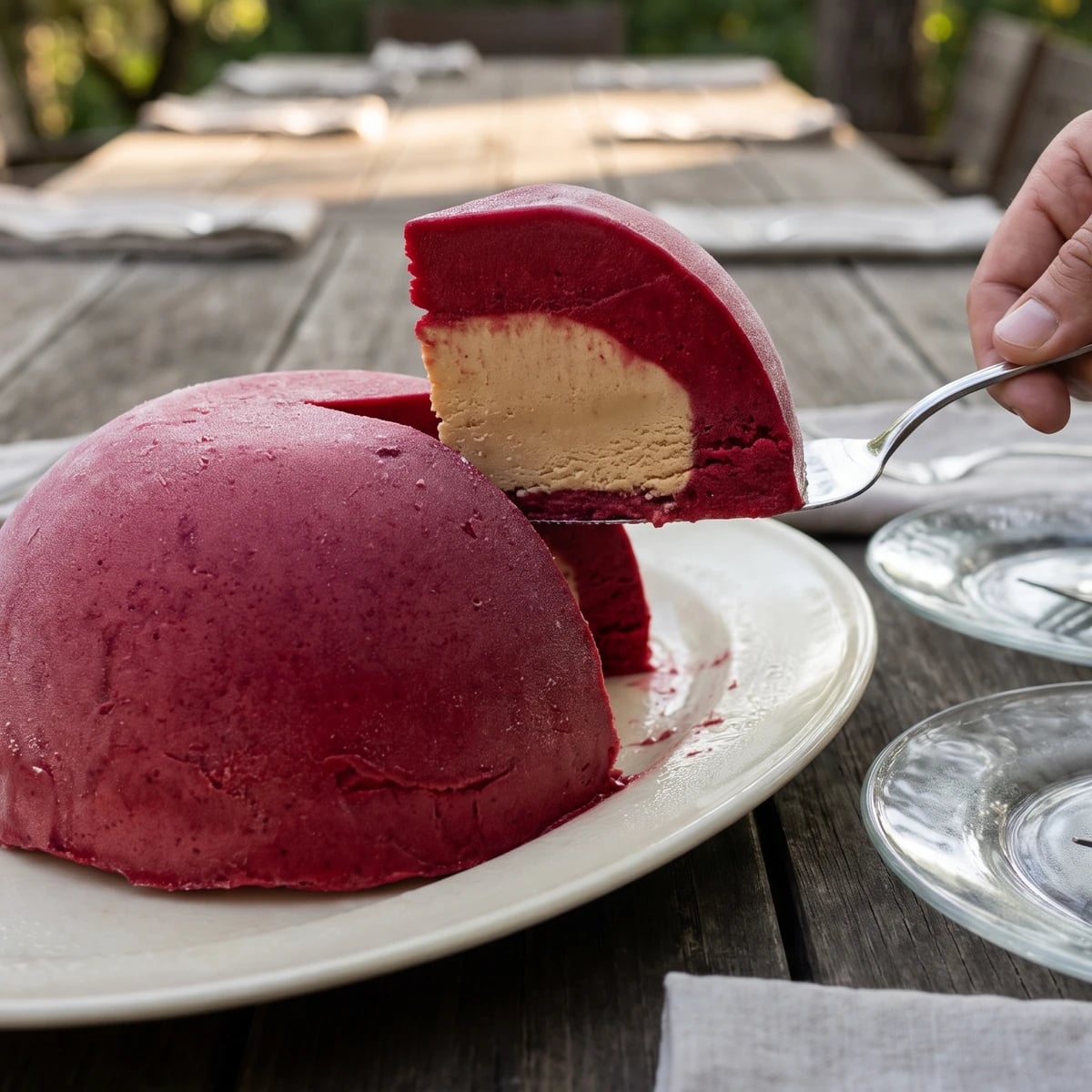
A vivid shell of raw raspberry ice gives way to praline pâte à bombe and softly whipped cream, a frozen French centerpiece built by patient layering, not complicated equipment.
Bombe Florentine (a raspberry-and-praline frozen bombe) teaches one clean principle: a molded ice is only as good as the shell that holds it. Before you touch a pan, know this: the raspberries must stay raw for fragrance, then freeze in a smooth, even coat, because this bright shell has nowhere to hide dull fruit or a thin patch.
The original note assumed a pastry section with churned ice ready, a metal bombe mould packed in salt and ice, and enough hands to turn and tend it. Here, a 1.5-liter metal bowl, a countertop ice-cream maker, an electric mixer, and an ordinary freezer do the same work. The entry gives no household quantity, so the bombe is scaled to eight generous slices. What changed is the scale, the source of cold, and the labor, not the sequence: raspberry ice outside, pralined bombe preparation within.
Packing and turning the mould in salted ice was brigade scaffolding, so it can go. Chemisage (clothing the mould) must stay, as must the pâte à bombe and real cream that give the center its satin texture. One cook, one stove, one evening of work, then six quiet hours in the freezer. The step that matters most is clothing the mould evenly before the filling goes anywhere near it.
Bombe glacée belongs to the Parisian grand-kitchen repertoire of molded ices; its rounded metal mould recalled a cannonball, which gave the form its name. Pastry sections froze successive layers in salt and ice, often pairing a vivid fruit ice with a richer bombe center before unmoulding the whole for the dining room. In this canonical entry, Florentine names the raspberry-and-praline composition rather than a Tuscan household dessert, and the savory aspic cross-reference appears because clothing a cold mould evenly is the same grammar in both kitchens.
Quantity
5 cups (1.2 liters / 600 g)
thawed completely if frozen
Quantity
3/4 cup (180 ml / 150 g)
Quantity
1/2 cup (120 ml / 120 g)
Quantity
1 tablespoon (15 ml / 15 g)
Quantity
1 procedural use (No. 916)
use only the clothing-the-mould operation; no part of the fish preparation enters the dessert
Quantity
6 (about 108 g)
Quantity
2/3 cup (160 ml / 135 g)
Quantity
1/4 cup (60 ml / 60 g)
Quantity
2/3 cup (160 ml / 180 g)
Quantity
2 cups (480 ml / 475 g)
Quantity
2 tablespoons (30 ml / 30 g)
| Ingredient | Quantity |
|---|---|
| fresh raspberries, or unsweetened frozen raspberriesthawed completely if frozen | 5 cups (1.2 liters / 600 g) |
| caster sugar for the raspberry ice | 3/4 cup (180 ml / 150 g) |
| water for the raspberry ice | 1/2 cup (120 ml / 120 g) |
| fresh lemon juice | 1 tablespoon (15 ml / 15 g) |
| Another Method of Preparing Aspics de Filets de Solesuse only the clothing-the-mould operation; no part of the fish preparation enters the dessert | 1 procedural use (No. 916) |
| large egg yolks | 6 (about 108 g) |
| caster sugar for the pâte à bombe | 2/3 cup (160 ml / 135 g) |
| water for the pâte à bombe | 1/4 cup (60 ml / 60 g) |
| pure almond-hazelnut praliné paste | 2/3 cup (160 ml / 180 g) |
| cold heavy cream | 2 cups (480 ml / 475 g) |
| cold heavy cream for rescue (optional) | 2 tablespoons (30 ml / 30 g) |
Clear a level freezer shelf and set the freezer to at least -18°C / 0°F. Chill a clean 1.5-liter metal bombe mould or deep stainless-steel bowl for 30 minutes. Chill the serving platter too; a cold platter buys you precious time when the bombe is unmoulded.
Heat the 150 g caster sugar with the 120 ml water only until the sugar dissolves, then cool the syrup completely. Push the raw raspberries through a fine sieve, pressing firmly and discarding the seeds. Stir the cold syrup and lemon juice into the purée. Do not cook the fruit. Cooking flattens its perfume, and this shell has nowhere to hide. Chill thoroughly, then churn until the ice is thick, smooth, and soft enough to spread. Without an ice-cream maker, freeze it in a shallow metal pan and whisk vigorously every 30 minutes until it reaches the same dense, spreadable consistency.
Use the clothing-the-mould operation from Another Method of Preparing Aspics de Filets de Soles (No. 916): press the soft raspberry ice over the bottom and sides of the chilled mould, rotating it as you work, until the coat is an even 1 to 1.5 cm thick. Freeze for 20 minutes, inspect it against the light, and patch every thin place with more ice. If the coating slides toward the bottom, the mould or ice is too warm. Ça se rattrape: freeze both for 10 minutes, then press the layer back into place. Reserve enough raspberry ice to close the base later, and freeze the clothed mould for at least 45 minutes.
Begin whisking the yolks at medium speed until they lighten. Put the 135 g sugar and 60 ml water in a small saucepan, dissolve the sugar over gentle heat, then boil without stirring to 118°C / 244°F. With the mixer running, pour the syrup in a thin stream down the inside of the bowl, safely away from the moving whisk. Beat at high speed until the pâte à bombe (cooked yolk foam) triples in volume, falls in a thick ribbon, and the bowl no longer feels warm. If the syrup crystallizes before reaching temperature, cover the pan for 30 seconds so condensation washes the sides, then uncover and continue. Ça se rattrape. If hard threads form on the mixer bowl, leave them there rather than scraping them into the foam.
Stir one quarter of the pâte à bombe into the praliné, the caramelized nut paste, to loosen it, then fold that mixture gently through the remaining foam. Whip the 475 g cream to soft peaks that bend at the tip, not stiff peaks, and fold it into the pralined base in three additions. The filling must be cool, full, and softly spoonable. If the bowl is still warm, keep beating before adding cream or it will lose its body and soften the raspberry shell. If the cream goes slightly grainy from overwhipping, fold in the optional 30 g unwhipped cream one spoonful at a time until it smooths.
Spoon the pralined bombe preparation into the frozen raspberry shell in two additions, pressing gently into the curve so no large air pockets remain. Stop about 1 cm below the rim. If the shell begins to soften while you fill it, stop and return the mould to the freezer for 10 minutes; forcing ahead is how the two layers blur. Spread the reserved raspberry ice over the filling to seal the base level with the rim. Cover closely and freeze on the level shelf for at least 6 hours, preferably overnight.
Dip the mould in lukewarm water for 5 seconds, dry it, set the chilled platter over the top, and invert decisively. If the bombe does not release, wrap the mould briefly in a warm, damp towel and try again. Do not soak it. If the surface softens, return the unmoulded bombe to the freezer for 15 minutes. Let it stand for 3 minutes before cutting, then use a knife dipped in hot water and wiped dry between every slice. The raspberry shell should cut cleanly around the pale praline center. À table!
1 serving (about 215g)
Culinary guides, cultural storytelling, and the editorial depth that makes cooking meaningful.
Discover Culinary Explorer
Chef Juliette
Bombe Aboukir sets a pale pistachio ice shell around pralined pâte à bombe, cool, nutty, and cleanly sliceable, with chopped pistachios held in a centre as light as frozen mousse.

Chef Juliette
A thin dark chocolate chemise gives way to golden apricot pâte à bombe, a frozen dinner-party dessert whose elegance depends on spreading the shell evenly before it firms.

Chef Juliette
Apricot ice holds a Kirsch-scented pâte à bombe and ribbons of stewed fruit, frozen into a gleaming dome whose clean layers depend on cold components and thoroughly drained apricots.

Chef Juliette
Strawberry ice forms a bright, clean shell around a satin Kirsch pâte à bombe, a frozen dessert that teaches precise layering, restrained alcohol, and the patience to let each layer set.