
Chef Juliette
Various Almond Preparations
Five almond preparations, one discipline: remove the skins cleanly, dry every kernel through, then cut, toast, or cloak it in pale caramel without letting its fragrant oils escape.
A cooking platform built around craft, culture, and the stories behind what we eat.
Created by Chef Juliette
Based on No. 2854, Bombe Fedora, from Le Guide Culinaire (1907) by Auguste Escoffier
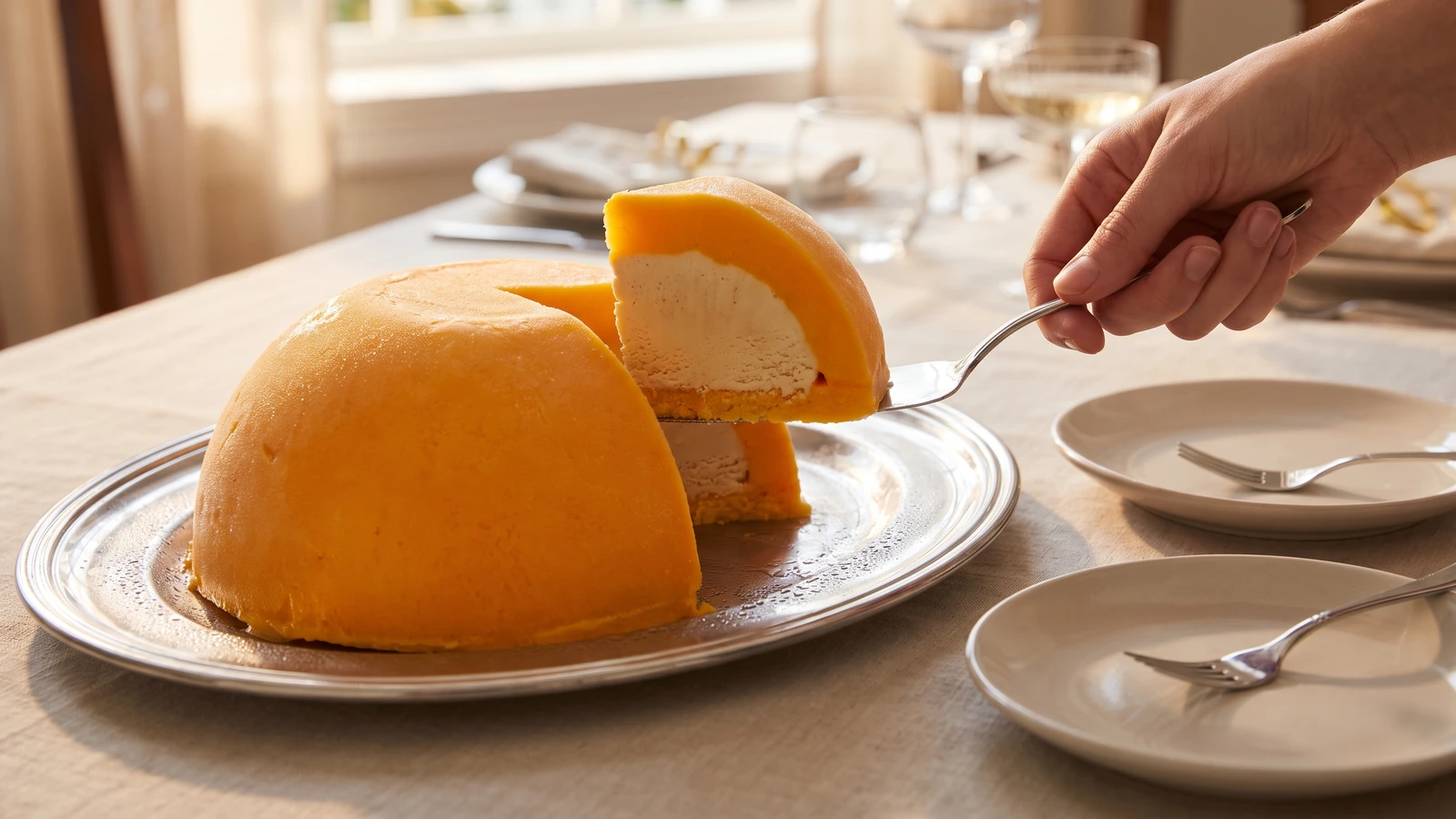
Orange perfume in a clean frozen shell, praline richness at the heart: Bombe Fedora turns two distinct ices into one celebration, provided the zest oil reaches the sugar before the juice does.
Bombe Fedora (orange ice around a whipped praline cream) teaches the architecture of a bombe glacée: a bright, sharply defined outer ice enclosing a rich centre that remains supple enough to slice. The one true thing to know before touching a pan is that orange juice supplies colour and acidity, but the peel holds the perfume. Rub sugar directly over the dry fruit before you juice it, or the finished shell will taste merely sweet and cold.
The original recipe assumed a pastry kitchen where orange ice and Pralin already waited, a dedicated bombe mould stood ready, and freezing happened in equipment packed with salt and ice. At home, smooth almond-hazelnut praline paste replaces the pastry pantry, a 1½ litre metal bowl replaces the ornate mould, and a countertop ice cream maker replaces the freezing cabinet. Those are brigade scaffolding and can go. The perfumed orange shell, the distinct pralined Bombe-preparation, and the careful clothing of the mould are the dish itself, so they stay. One cook, one stove, one evening.
When the Bombe Fedora is cut, the orange shell should form a vivid, even crescent around a pale praline heart, with no hollow pockets and no blurred seam between them. Everything depends on the first small act: rub the sugar cubes over every part of the orange peel until they turn damp, golden, and intensely fragrant.
Bombe glacée belongs to the Parisian grand-kitchen and pâtisserie repertoire, where frozen preparations were layered in domed moulds and distinguished by the exact pairing of their outer ice and inner bombe mixture. Fedora is defined precisely by orange ice clothing a pralined Bombe-preparation, not by decorative garnish or a cake-like filling. The book points to an aspic method for clothing the mould because savoury and sweet cold work shared the same grammar: establish an even outer coat first, then fill the centre.
Quantity
5 to 6 (about 2¼ pounds / 1 kg)
enough to yield 1⅔ cups (400 ml / 410 g) strained juice
Quantity
8 cubes (about 2 tablespoons / 32 g)
for capturing the orange-peel oil
Quantity
⅔ cup (160 ml / 135 g)
Quantity
⅔ cup (160 ml / 160 g)
Quantity
1 tablespoon (15 ml / 15 g)
Quantity
4 large (about ¼ cup / 70 g)
Quantity
½ cup (120 ml / 100 g)
Quantity
3 tablespoons (45 ml / 45 g)
Quantity
½ cup (120 ml / 140 g)
brought to room temperature
Quantity
1¼ cups (300 ml / 295 g)
Quantity
1 technique application (No. 916)
consulted only for clothing the mould; no aspic ingredient enters the dessert
| Ingredient | Quantity |
|---|---|
| medium unwaxed orangesenough to yield 1⅔ cups (400 ml / 410 g) strained juice | 5 to 6 (about 2¼ pounds / 1 kg) |
| rough-cut white sugar cubesfor capturing the orange-peel oil | 8 cubes (about 2 tablespoons / 32 g) |
| superfine sugar for the orange ice | ⅔ cup (160 ml / 135 g) |
| water for the orange ice | ⅔ cup (160 ml / 160 g) |
| fresh lemon juice | 1 tablespoon (15 ml / 15 g) |
| pasteurized egg yolks | 4 large (about ¼ cup / 70 g) |
| superfine sugar for the pâte à bombe | ½ cup (120 ml / 100 g) |
| water for the pâte à bombe | 3 tablespoons (45 ml / 45 g) |
| smooth 50% almond-hazelnut praline pastebrought to room temperature | ½ cup (120 ml / 140 g) |
| cold heavy cream | 1¼ cups (300 ml / 295 g) |
| Another Method of Preparing Aspics de Filets de Solesconsulted only for clothing the mould; no aspic ingredient enters the dessert | 1 technique application (No. 916) |
Wash the oranges if necessary, then dry them completely. Rub each sugar cube firmly over the coloured peel, turning both cube and fruit so the sugar passes across the entire surface without digging into the bitter white pith. The cubes should become damp, orange-gold, and powerfully fragrant. Drop them into a small saucepan as they are finished, then juice the oranges and strain 1⅔ cups (400 ml / 410 g) of juice.
Add the superfine sugar and water for the orange ice to the scented cubes. Warm gently, stirring only until every grain dissolves, then remove the pan from the heat and cover it for five minutes so the captured oil remains in the syrup. Stir in the strained orange juice and lemon juice. Set the pan in a bowl of ice water and stir until thoroughly cold, then chill the mixture until the ice cream maker and mould are ready.
Churn the orange mixture until it holds the texture of soft sorbet. Use the cold-moulding principle from Another Method of Preparing Aspics de Filets de Soles (No. 916): reserve about ¾ cup (180 ml) of the orange ice for the closing layer, then spread the remainder over the bottom and sides of a thoroughly chilled 1½ litre metal mould. Work with the back of a spoon or a small offset spatula until the coat is an even ½ inch (1.25 cm) thick. If the ice slides toward the bottom, freeze the mould for ten minutes and patch the thin places with more soft ice. Ça se rattrape. Freeze the clothed mould for at least forty-five minutes, and hold the reserved ice in a covered container.
Begin whipping the pasteurized yolks at medium speed until they are pale and loose. Put the sugar and water for the pâte à bombe into a small saucepan and bring them to 244°F (118°C), without stirring once the syrup boils. If crystals gather around the pan, cover it for thirty seconds so condensation washes them down, then uncover and continue. With the mixer running, pour the hot syrup in a thin stream down the inside of the bowl, never onto the moving whisk. Increase the speed and whip for seven to ten minutes, until the mixture is thick, glossy, and cool enough that the bowl no longer feels warm.
Reserve 2 tablespoons (30 ml / 30 g) of the unwhipped cream, then whip the remainder only to soft peaks. Fold one-third of the pâte à bombe into the room-temperature praline paste to loosen it, then fold that mixture gently through the remaining pâte à bombe. Fold in the whipped cream in two additions, preserving as much volume as possible. This is the pralined Bombe-preparation. If the cream becomes grainy from overwhipping, add the reserved liquid cream and whisk briefly by hand until smooth before folding. Ça se rattrape.
Check that the orange shell is completely firm. Spoon in the pralined Bombe-preparation, pressing it gently against the shell so no air pockets remain, and stop ½ inch (1.25 cm) below the rim. Tap the mould once against a folded towel, then freeze for thirty minutes. Let the reserved orange ice soften just enough to spread, use it to cover the exposed centre in an even layer, and smooth it flush with the rim. Cover tightly and freeze for at least six hours, preferably overnight.
Chill the serving platter. Dip the outside of the mould into warm water at about 100°F (38°C) for five seconds, dry it, invert it over the platter, and lift carefully. If the bombe refuses to release, repeat for two seconds rather than forcing it. If the surface softens before it comes free, return the whole mould to the freezer for twenty minutes and begin again. Rest the unmoulded Bombe Fedora in the refrigerator for ten minutes, then cut it with a long knife dipped in hot water and wiped dry between slices. À table!
1 serving (about 165g)
Culinary guides, cultural storytelling, and the editorial depth that makes cooking meaningful.
Discover Culinary ExplorerChef Juliette
Five almond preparations, one discipline: remove the skins cleanly, dry every kernel through, then cut, toast, or cloak it in pale caramel without letting its fragrant oils escape.

Chef Juliette
A pastry pantry lesson in one tray: filberts warmed only until their red skins release, rubbed clean, cooled, and chopped into a fragrant mise-en-place for cakes, creams, pralines, and petits fours.

Chef Juliette
The smallest pâtisserie discipline decides whether a cake leaves its mould intact: clarified butter in every corner, followed by the lightest veil of dry flour or fécule.

Chef Juliette
Four whites, one spotless bowl, and a patient change of speed: whisk gently until loosened, then briskly to glossy stiffness, with powdered sugar waiting if the foam begins to granulate.