
Chef Juliette
Bombe Aboukir
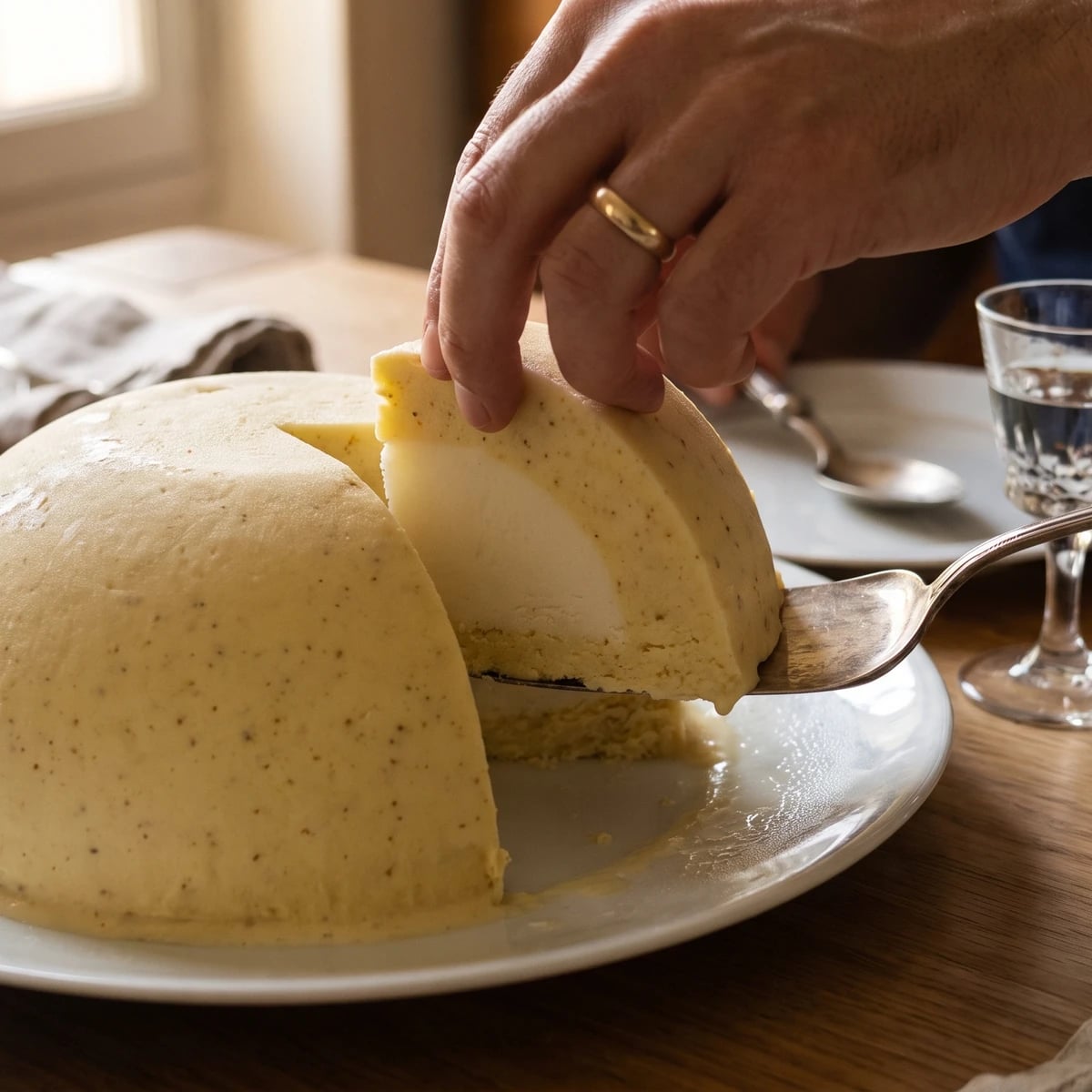
Bombe Aboukir sets a pale pistachio ice shell around pralined pâte à bombe, cool, nutty, and cleanly sliceable, with chopped pistachios held in a centre as light as frozen mousse.
A cooking platform built around craft, culture, and the stories behind what we eat.
Created by Chef Juliette
Based on No. 2852, Bombe Duchesse, from Le Guide Culinaire (1907) by Auguste Escoffier
A pale banana-ice shell hides pear pâte à bombe scented with Kirsch, a make-ahead frozen centerpiece whose clean layers depend on fast freezing and one steady hand.
Bombe Duchesse (a banana ice shell around Kirsch-scented pear frozen cream) teaches the discipline of temperature. Everything must meet cold: cold syrup meets banana, cold pear meets pâte à bombe, and cold filling meets a firmly frozen shell. Let one layer grow warm and the clean dome becomes a sweet landslide. Ça se rattrape, but prevention here takes only freezer space and patience.
The original assumed a pastry brigade, a sorbetière turning nearby, and a bombe mould packed in salted ice while another pair of hands made the filling. Your honest equivalents are a small metal mould, an ordinary freezer, and one ice-cream machine or food processor. Packing the mould in salted ice was brigade scaffolding and can go. The banana shell and pear pâte à bombe must stay, because their contrast is the dish itself. One cook, one stove, one evening, followed by a good night in the freezer.
Banana browns the moment it is mashed, so cool the syrup before the fruit touches it, blend in the lemon, and churn it at once. Before you touch a pan, clear a level freezer shelf and chill the mould. Cold-on-cold is the one true thing that decides this bombe.
Bombe glacée belongs to the Parisian grand-kitchen repertoire, where contrasting frozen preparations were layered in domed moulds and unmoulded whole as an entremets for the table. Duchesse is a catalog name, not a regional claim: this particular arrangement is defined by banana ice outside and pear bombe preparation scented with Kirsch within. The striking cross-reference to Another Method of Preparing Aspics de Filets de Soles (No. 916) is not a flavor connection; it borrows chemiser, the technique of clothing a mould evenly, from the cold savory kitchen.
Quantity
¾ cup (180 ml / 180 g)
Quantity
¾ cup (180 ml / 150 g)
Quantity
2 large (about 1¼ cups / 300 ml / 300 g peeled fruit)
peeled immediately before blending
Quantity
2 tablespoons (30 ml / 30 g)
Quantity
2 large (about 2 cups / 475 ml / 350 g peeled and cored fruit)
diced
Quantity
2 tablespoons (30 ml / 25 g)
Quantity
1 tablespoon (15 ml / 15 g)
Quantity
4 (about ¼ cup / 60 ml / 72 g)
Quantity
½ cup (120 ml / 100 g)
Quantity
3 tablespoons, plus up to 1 tablespoon if needed (45 to 60 ml / 45 to 60 g)
Quantity
1¼ cups (300 ml / 300 g)
Quantity
2 tablespoons (30 ml / 29 g)
Quantity
⅛ teaspoon (0.6 ml / 0.7 g)
divided
Quantity
1 technique reference: Another Method of Preparing Aspics de Filets de Soles (No. 916)
for clothing the mould
| Ingredient | Quantity |
|---|---|
| water for the banana ice | ¾ cup (180 ml / 180 g) |
| granulated sugar for the banana ice | ¾ cup (180 ml / 150 g) |
| ripe bananaspeeled immediately before blending | 2 large (about 1¼ cups / 300 ml / 300 g peeled fruit) |
| fresh lemon juice for the banana ice | 2 tablespoons (30 ml / 30 g) |
| ripe pearsdiced | 2 large (about 2 cups / 475 ml / 350 g peeled and cored fruit) |
| granulated sugar for the pears | 2 tablespoons (30 ml / 25 g) |
| fresh lemon juice for the pears | 1 tablespoon (15 ml / 15 g) |
| large egg yolks | 4 (about ¼ cup / 60 ml / 72 g) |
| granulated sugar for the pâte à bombe | ½ cup (120 ml / 100 g) |
| water for the pâte à bombe | 3 tablespoons, plus up to 1 tablespoon if needed (45 to 60 ml / 45 to 60 g) |
| cold heavy cream | 1¼ cups (300 ml / 300 g) |
| Kirsch | 2 tablespoons (30 ml / 29 g) |
| fine sea saltdivided | ⅛ teaspoon (0.6 ml / 0.7 g) |
| Another Method of Preparing Aspics de Filets de Solesfor clothing the mould | 1 technique reference: Another Method of Preparing Aspics de Filets de Soles (No. 916) |
Clear a level freezer shelf. Chill a 1½-quart (1.4-liter) metal bombe mould or round-bottomed mixing bowl for at least 30 minutes, along with the serving platter and the bowl and beaters for the cream. Set up an ice bath large enough to hold a saucepan. Temperature is part of the mise en place here, not something to arrange after the fruit is cut.
Combine the water and sugar for the banana ice in a small saucepan. Warm gently until every crystal dissolves, then boil for 1 minute without allowing the syrup to color. Set the pan in the ice bath and stir until the syrup is thoroughly cold. Only then peel the bananas and blend them immediately into the syrup with the lemon juice and half the salt until perfectly smooth. If a grey film appears while the purée waits, skim it, blend once more, and proceed at once; the flavor is sound, though waiting will not improve the color.
Churn the banana mixture until it holds the texture of a firm, smooth slush, usually 20 to 25 minutes. It must be soft enough to spread but firm enough to cling to a vertical surface. If it is flowing, freeze it for 10 minutes and stir again; if it has become hard, leave it in the refrigerator for 5 minutes. This working consistency matters more than the clock.
Using the mould-clothing principle preserved in Another Method of Preparing Aspics de Filets de Soles (No. 916), press the banana ice over the bottom and sides of the frozen mould in an even ½-inch (1.25-cm) layer. Work with the back of a chilled spoon, turning the mould as you go, and carry the layer cleanly to the rim. If the ice slides downward, both it and the mould are too warm. Freeze them for 10 minutes and begin again. Ça se rattrape. Fill thin spots with more banana ice, smooth the inner wall, and freeze the shell until hard, at least 45 minutes.
While the shell hardens, put the diced pears in a small saucepan with their sugar, lemon juice, and the remaining salt. Cover and cook over medium-low heat until the fruit collapses under a spoon, 8 to 12 minutes. Uncover and stir until loose juice has evaporated and the pears resemble a thick compote. Blend until smooth, then pass through a fine sieve to remove any grit. Spread the purée in a shallow bowl and chill it over ice until cold to the touch. Warm pear purée will melt the filling before it ever reaches the mould.
Begin beating the egg yolks at medium speed until they are thick and pale. Put the sugar and 3 tablespoons (45 ml / 45 g) water for the pâte à bombe in a clean saucepan, dissolve the sugar gently, then boil without stirring to 244°F (118°C). With the mixer running, pour the syrup into the yolks in a thin stream down the side of the bowl, never directly onto the beaters, and whip at high speed until the mixture is voluminous, holds a broad ribbon, and the bowl feels cool, 7 to 10 minutes. If the syrup crystallizes before pouring, add the reserved tablespoon of water, dissolve it completely over low heat, and bring it back to temperature. Do not scrape crystals from the pan wall into the yolks.
Stir the cold pear purée and Kirsch together, then fold them through the cool pâte à bombe in three additions. Whip the cold cream to soft peaks that bend rather than stand rigid, and fold it into the pear mixture with a broad spatula, preserving as much volume as possible. The finished filling should be pale, thick, and softly mounded. If the base feels even slightly warm, stop before adding the cream and set it over the ice bath until cool. Once chilled, it will fold normally.
Check that the banana shell is firm from rim to center. Spoon in the pear pâte à bombe, pressing gently against the shell so no large air pockets remain, then level the filling flush with the rim. Cover the surface directly with parchment and wrap the mould well. Freeze on the level shelf for at least 8 hours, preferably overnight. The long freeze is not ceremony; the center must become solid enough to release and slice without crushing the shell.
Remove the wrapping and press the chilled platter over the mould. Dip the outside of the mould in warm water for 5 seconds, dry it, then invert both mould and platter together. If the bombe resists, cover the mould with a warm towel for another 3 seconds and try again. Too much warmth melts the banana detail before the center releases. Cut with a long knife dipped in hot water and wiped dry between slices. Serve while the banana shell is firm and the pear center yields cleanly to the fork. À table!
1 serving (about 190g)
Culinary guides, cultural storytelling, and the editorial depth that makes cooking meaningful.
Discover Culinary Explorer
Chef Juliette
Bombe Aboukir sets a pale pistachio ice shell around pralined pâte à bombe, cool, nutty, and cleanly sliceable, with chopped pistachios held in a centre as light as frozen mousse.

Chef Juliette
A thin dark chocolate chemise gives way to golden apricot pâte à bombe, a frozen dinner-party dessert whose elegance depends on spreading the shell evenly before it firms.

Chef Juliette
Apricot ice holds a Kirsch-scented pâte à bombe and ribbons of stewed fruit, frozen into a gleaming dome whose clean layers depend on cold components and thoroughly drained apricots.

Chef Juliette
Strawberry ice forms a bright, clean shell around a satin Kirsch pâte à bombe, a frozen dessert that teaches precise layering, restrained alcohol, and the patience to let each layer set.