
Chef Juliette
Bombe Aboukir
Bombe Aboukir sets a pale pistachio ice shell around pralined pâte à bombe, cool, nutty, and cleanly sliceable, with chopped pistachios held in a centre as light as frozen mousse.
A cooking platform built around craft, culture, and the stories behind what we eat.
Created by Chef Juliette
Based on No. 2851, Bombe Diplomate, from Le Guide Culinaire (1907) by Auguste Escoffier
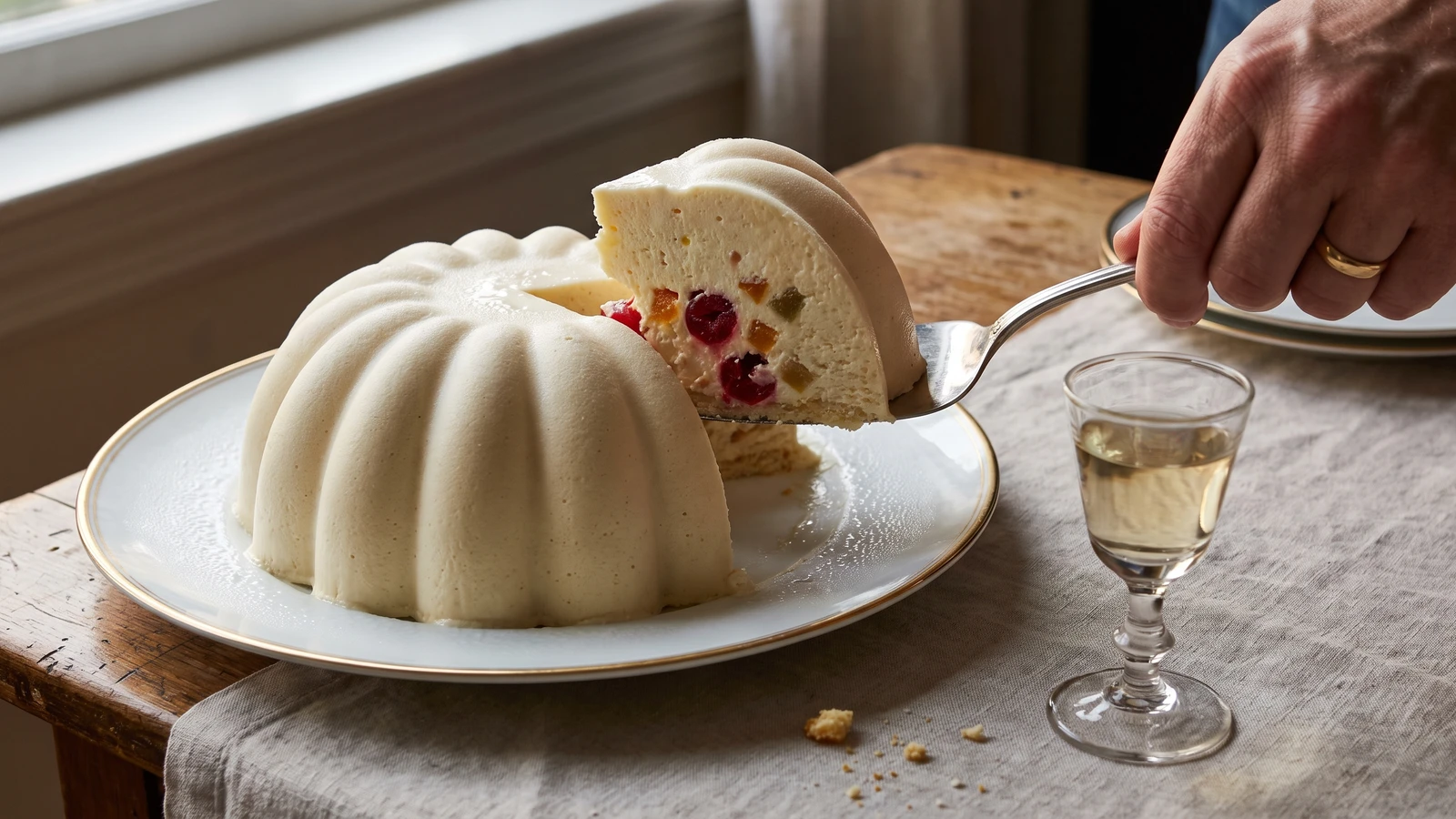
A vanilla ice-cream shell around airy Maraschino pâte à bombe and jewel-bright candied fruit: a grand frozen dessert brought home by one cold mould, steady folding, and the nerve to unmould it.
Bombe Diplomate (a vanilla and Maraschino frozen bombe) teaches the architecture of a bombe glacée. The firm vanilla shell must hold a lighter pâte à bombe (yolks aerated and set with hot sugar syrup), and every fold must preserve that air. The one true thing to know before touching a pan is simpler still: dice the candied fruit small and freeze it hard, because sticky fruit at room temperature drags through the filling and flattens the cream.
The source gives the brigade shorthand: clothe a mould with vanilla ice cream, then fill it with Maraschino bombe preparation and candied fruit. It assumes prepared ice cream, a proper metal bombe mould kept in a salted-ice chest, and enough hands to pour hot syrup while the yolks are beaten. Here, good full-fat vanilla ice cream, a 6-cup metal bowl, a home freezer, and a stand mixer do the same work for eight. Making the vanilla ice cream and packing a mould in salt are brigade scaffolding, so they can go. The even shell, the hot-syrup pâte à bombe, and the hard-chilled fruit are the dish, so they stay.
The savory aspic cross-reference is deliberate, not a stray fish instruction. To clothe a mould means to set an even layer against its walls before filling it. C'est la même grammaire: coat, set, fill, set again. Freeze the diced fruit until it is hard-cold before folding. That is the step that keeps the center buoyant and its candied colors suspended.
Bombe glacée belongs to the Parisian pâtisserie and grand dining-room repertoire, where a rounded metal mould turned layered ices into a ceremonial dessert that could be brought out whole. Diplomate is a classical garnish name linked to candied fruit and liqueur; here it means vanilla ice cream around a Maraschino bombe mixture, not crème diplomate and not the baked pudding that shares the name. The technique passed naturally from grand kitchens to home tables as domestic freezing simplified the cold work, while the borrowed aspic method reveals the canon's practical logic: savory and sweet stations shared the same geometry for clothing a cold mould.
Quantity
2½ cups (590 ml / about 500 g)
divided and softened only when needed
Quantity
⅔ cup (160 ml / 110 g)
cut into 5 mm dice, blotted dry, and frozen hard
Quantity
4
Quantity
½ cup (120 ml / 100 g)
Quantity
3 tablespoons (45 ml / 45 g), plus 1 tablespoon (15 ml / 15 g) only if needed
for the syrup and its possible rescue
Quantity
1¼ cups (300 ml / 300 g)
Quantity
3 tablespoons (45 ml / 45 g)
Quantity
1 application of Another Method of Preparing Aspics de Filets de Soles (No. 916)
applied here with vanilla ice cream in place of jelly
| Ingredient | Quantity |
|---|---|
| full-fat vanilla ice creamdivided and softened only when needed | 2½ cups (590 ml / about 500 g) |
| mixed candied fruitcut into 5 mm dice, blotted dry, and frozen hard | ⅔ cup (160 ml / 110 g) |
| large egg yolks | 4 |
| granulated sugar | ½ cup (120 ml / 100 g) |
| waterfor the syrup and its possible rescue | 3 tablespoons (45 ml / 45 g), plus 1 tablespoon (15 ml / 15 g) only if needed |
| cold heavy cream | 1¼ cups (300 ml / 300 g) |
| Maraschino liqueur | 3 tablespoons (45 ml / 45 g) |
| referenced mould-clothing techniqueapplied here with vanilla ice cream in place of jelly | 1 application of Another Method of Preparing Aspics de Filets de Soles (No. 916) |
Put a clean 6-cup metal bombe mould or deep round bowl in the freezer for at least 30 minutes. Cut the candied fruit into neat 5 mm dice, blot away any syrup, spread the pieces in one layer on a small tray, and freeze them for 45 minutes, until rigid, separate, and hard-cold. Do not soak them in the liqueur. Alcohol would keep them soft, and soft sticky fruit is precisely what drags the air out of the filling.
Let about 2 cups of the vanilla ice cream soften in the refrigerator until spreadable but still matte and firm. Chemiser le moule (clothe the mould) by applying the cold-moulding principle from Another Method of Preparing Aspics de Filets de Soles (No. 916): press the ice cream evenly over the bottom and sides of the frozen mould in a layer about ½ inch (1 cm) thick, leaving no metal showing. If the ice cream turns glossy or slides, freeze the mould for 10 minutes, then patch the thin places. Reserve the remaining ice cream for the cap and freeze the clothed mould until hard, about 45 minutes.
Put the yolks in the stand-mixer bowl before beginning the syrup. Combine the sugar and 3 tablespoons of water in a small heavy saucepan, warm gently until the sugar dissolves, then boil without stirring to 244°F (118°C), the petit boulé or soft-ball stage. If crystals gather before the syrup reaches temperature, cover the pan for 30 seconds so condensation washes down the sides. If the syrup seizes completely, add the reserved tablespoon of water and dissolve it again over low heat. Ça se rattrape.
Beat the yolks at medium speed until loosened and lightly foamy. With the mixer running at medium-low speed, pour the hot syrup in a thin, steady thread down the inside wall of the bowl, never directly onto the whisk, where it would spin into hard sugar threads. Increase the speed and beat for 7 to 10 minutes, until the pâte à bombe is very pale, tripled in volume, and thick enough to fall from the whisk in a ribbon. The bowl must feel no warmer than your hand before the cream goes in. Beat in the Maraschino gradually; if the bowl is still warm, keep beating until it cools.
Whip the cold cream to soft peaks that bend over rather than stand stiff. Fold one-third into the cooled pâte à bombe to lighten it, then fold in the remainder in two additions, reaching down to the bottom and turning the bowl as you work. Add the frozen candied fruit with the last few folds. Stop as soon as the fruit is dispersed. If the filling becomes shiny and loose, put the bowl in the freezer for 8 to 10 minutes, until the mixture holds a soft mound, then give it one final fold. Do not beat it back together.
Spoon the Maraschino filling into the hard vanilla shell, easing it against the sides to prevent empty pockets without compacting away its air. Leave about ½ inch (1 cm) at the rim. Soften the reserved vanilla ice cream just enough to spread, then cover the filling with it, joining this cap firmly to the frozen shell all the way around. Cover the surface closely with baking parchment, wrap the mould, and freeze for at least 6 hours, preferably overnight, until solid through the center.
Chill the serving platter for 15 minutes. Dip only the outside of the mould in lukewarm water for 5 seconds, dry it, invert it onto the platter, and lift. If the bombe does not release, repeat for 2 seconds rather than soaking it; patience preserves the vanilla shell. If an edge softens after release, return the platter to the freezer for 15 minutes. Cut with a knife dipped in hot water and wiped completely dry between slices, revealing the pale Maraschino center and suspended candied fruit. À table!
1 serving (about 140g)
Culinary guides, cultural storytelling, and the editorial depth that makes cooking meaningful.
Discover Culinary ExplorerChef Juliette
Bombe Aboukir sets a pale pistachio ice shell around pralined pâte à bombe, cool, nutty, and cleanly sliceable, with chopped pistachios held in a centre as light as frozen mousse.

Chef Juliette
A thin dark chocolate chemise gives way to golden apricot pâte à bombe, a frozen dinner-party dessert whose elegance depends on spreading the shell evenly before it firms.

Chef Juliette
Apricot ice holds a Kirsch-scented pâte à bombe and ribbons of stewed fruit, frozen into a gleaming dome whose clean layers depend on cold components and thoroughly drained apricots.

Chef Juliette
Strawberry ice forms a bright, clean shell around a satin Kirsch pâte à bombe, a frozen dessert that teaches precise layering, restrained alcohol, and the patience to let each layer set.