
Chef Juliette
Various Almond Preparations
Five almond preparations, one discipline: remove the skins cleanly, dry every kernel through, then cut, toast, or cloak it in pale caramel without letting its fragrant oils escape.
A cooking platform built around craft, culture, and the stories behind what we eat.
Created by Chef Juliette
Based on No. 2849, Bombe Danicheff, from Le Guide Culinaire (1907) by Auguste Escoffier
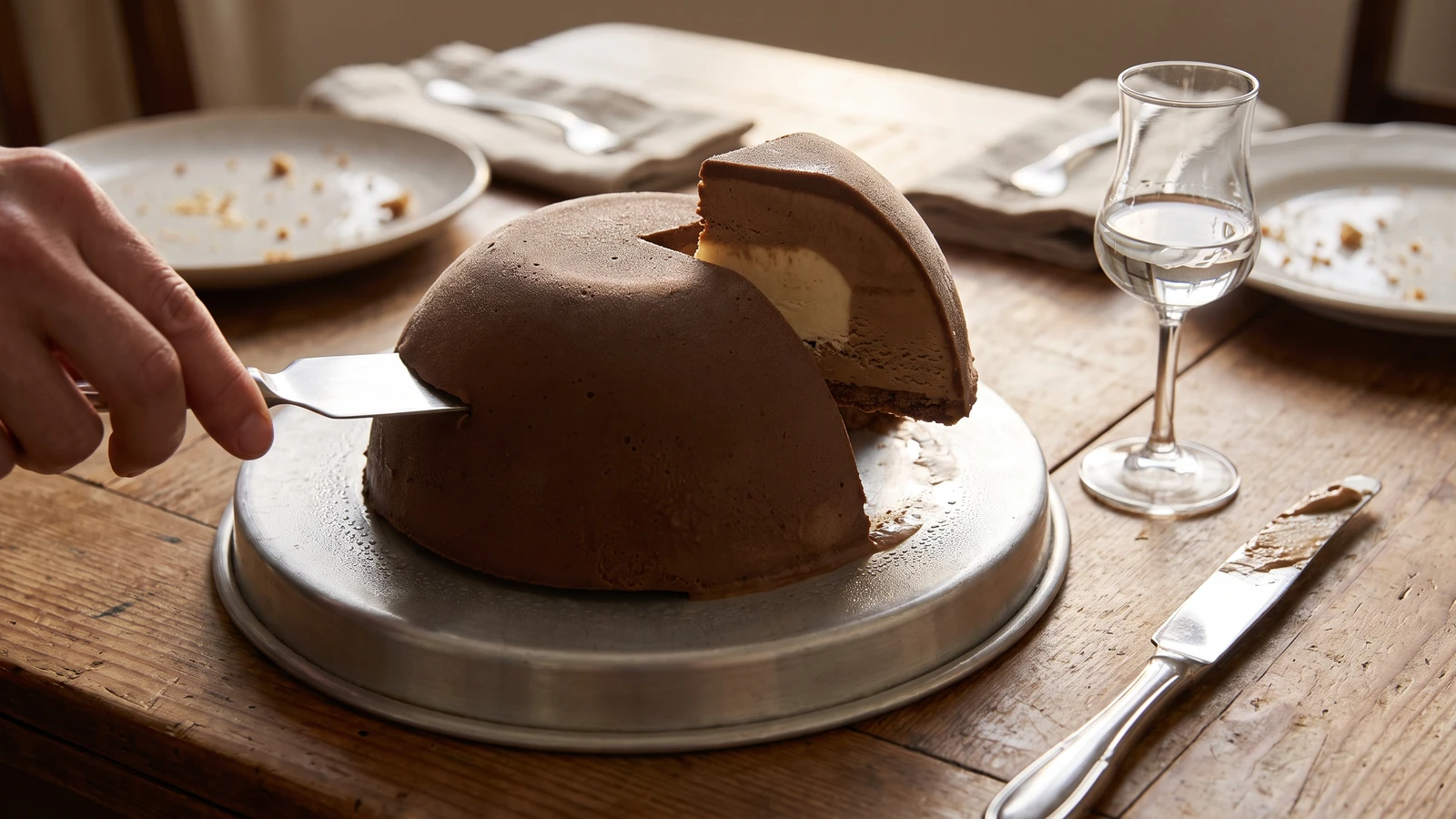
Bombe Danicheff layers force against finesse: deep coffee ice around an airy Kirsch pâte à bombe, frozen in a dome and sliced to reveal two bold flavors held in clean, creamy balance.
Bombe Danicheff (a coffee ice shell filled with Kirsch frozen mousse) teaches a cold truth: flavor must be louder before freezing, because cold hushes aroma and sweetness. Coffee and Kirsch only agree if both are strong. A timid infusion leaves the shell tasting of milky nothing, while a shy measure of eau-de-vie disappears inside the cream.
The original entry assumed that coffee ice and Kirsch Bombe-preparation waited ready at the pastry station, along with a bombe mould that could be rocked over broken ice until evenly clothed. At home, you’ll churn one small coffee ice, make a pâte à bombe, yolks cooked with hot sugar syrup and lightened with cream, and use a freezer-cold metal mould. The broken ice and extra hands were brigade scaffolding, so they can go. The even shell cannot. One cook, one stove, one evening of work, then the freezer takes the watch.
The shell decides the dish. Press the coffee ice into an even layer and freeze it until unyielding before the Kirsch filling goes anywhere near it. If the surface smears beneath a finger, stop and refreeze it. Ça se rattrape.
Bombe Danicheff belongs to Parisian grande cuisine, where a bombe glacée took its name from the rounded metal mould and frozen desserts were often christened for fashionable plays and public spectacles. Danicheff echoes Les Danicheff, a Paris stage drama with a Russian setting, but the composition remains firmly in the French pâtissier’s grammar: coffee ice clothing a Kirsch Bombe-preparation. The Russian name is theater, not evidence of a Russian regional dessert.
Quantity
1¼ cups (300 ml / 309 g)
for the coffee ice
Quantity
1¼ cups (300 ml / 300 g)
for the coffee ice
Quantity
½ cup (120 ml / 70 g)
coarsely crushed
Quantity
1 tablespoon (15 ml / 6 g)
Quantity
½ cup plus 2 tablespoons (150 ml / 125 g)
divided, for the coffee ice
Quantity
5
for the coffee ice
Quantity
⅛ teaspoon (0.6 ml / 0.8 g)
Quantity
4
for the Kirsch pâte à bombe
Quantity
½ cup (120 ml / 100 g)
for the Kirsch pâte à bombe
Quantity
3 tablespoons (45 ml / 45 g)
Quantity
¼ cup (60 ml / 56 g)
Quantity
1¼ cups (300 ml / 300 g)
for the Kirsch pâte à bombe
Quantity
1 technique reference (No. 916)
used only for the clothing-the-mould method; no edible component enters the dessert
| Ingredient | Quantity |
|---|---|
| whole milkfor the coffee ice | 1¼ cups (300 ml / 309 g) |
| heavy creamfor the coffee ice | 1¼ cups (300 ml / 300 g) |
| dark-roast whole coffee beanscoarsely crushed | ½ cup (120 ml / 70 g) |
| instant espresso powder | 1 tablespoon (15 ml / 6 g) |
| granulated sugardivided, for the coffee ice | ½ cup plus 2 tablespoons (150 ml / 125 g) |
| large egg yolksfor the coffee ice | 5 |
| fine sea salt | ⅛ teaspoon (0.6 ml / 0.8 g) |
| large pasteurized egg yolksfor the Kirsch pâte à bombe | 4 |
| granulated sugarfor the Kirsch pâte à bombe | ½ cup (120 ml / 100 g) |
| water | 3 tablespoons (45 ml / 45 g) |
| Kirsch | ¼ cup (60 ml / 56 g) |
| cold heavy creamfor the Kirsch pâte à bombe | 1¼ cups (300 ml / 300 g) |
| Another Method of Preparing Aspics de Filets de Solesused only for the clothing-the-mould method; no edible component enters the dessert | 1 technique reference (No. 916) |
Set a 1.5 litre metal bombe mould or smooth metal bowl in the freezer. Chill a shallow metal pan for the coffee custard and prepare a large bowl of ice water. If your ice-cream maker uses a frozen bowl, it must already be frozen solid. Cold equipment is not fuss here; it keeps the churned coffee ice firm enough to stay on the walls of the mould.
Reserve 2 tablespoons of the coffee-ice cream, then combine the remaining cream with the milk, crushed coffee beans, espresso powder, and half the coffee-ice sugar. Warm gently until a ring of bubbles appears at the edge, remove from the heat, cover, and infuse for 20 minutes. Strain through a fine sieve without crushing the beans against it, since hard pressing extracts bitterness, then return the liquid to the saucepan.
Whisk the 5 yolks with the remaining coffee-ice sugar and the salt until smooth. Pour in a third of the warm coffee mixture while whisking, return everything to the saucepan, and cook over gentle heat with a spatula until the crème anglaise, a stirred custard, coats the spatula and reaches 82 to 84°C. Never let it boil. If you see fine curds, pull it from the heat immediately, blend in the reserved cold cream, and strain it into the chilled pan. Ça se rattrape, provided the eggs haven’t become firm pieces. Stir the reserved cream into a smooth custard, set the pan over ice, and cool it completely.
Churn the cold coffee custard until dense and softly frozen. Apply the clothing-mould principle from Another Method of Preparing Aspics de Filets de Soles (No. 916): instead of rocking liquid jelly over broken ice, press the semi-frozen coffee ice against freezer-cold metal. Spoon roughly three quarters into the mould and use the back of a cold spoon to build an even 1.5 to 2 cm layer over the base and sides. Freeze for 15 minutes, inspect for thin patches, and repair them with more coffee ice. Reserve about ¾ cup in a covered container for the final cap, then freeze the clothed mould for at least 45 minutes, until the lining is hard.
Begin beating the 4 pasteurized yolks at medium speed. Put the sugar and water in a small clean saucepan, bring them to a boil without stirring, and cook to 118°C. If crystals appear around the sides, cover the pan for 30 seconds so condensation washes them down, then continue uncovered. Pour the hot syrup in a narrow stream down the side of the moving mixer bowl, never onto the whisk, and beat until the pâte à bombe is pale, thick enough to hold a ribbon, and barely cool. If the syrup spins into hard threads, stop, remove them, and resume pouring against the bowl. Add the Kirsch gradually and beat until evenly combined.
Whip the cold cream to soft peaks that bend at their tips. The pâte à bombe must be cool before the two meet; if the bowl still feels warm, set it briefly over ice and keep whisking. Fold in one quarter of the cream to loosen the base, then fold in the remainder with broad strokes until no white streaks remain. If the mixture goes loose after the Kirsch, chill it for 10 minutes before folding. Don’t add more sugar. Cold will soften the alcohol’s edge, and the Kirsch must remain unmistakable.
Touch the coffee shell with a fingertip. It must feel hard and dry, not tacky. Spoon in the Kirsch pâte à bombe, pressing gently to exclude large air pockets and stopping about 1.5 cm below the rim. Let the reserved coffee ice soften just enough to spread, then seal the filling beneath an even cap. Cover the mould closely and freeze for at least 5 hours, preferably overnight. Any extra filling belongs in a small ramekin for the cook.
Chill the serving platter. Wrap the mould in a warm, well-wrung towel for 5 to 8 seconds, invert it onto the platter, and lift. If it clings, repeat with the towel for 3 seconds at a time; patience, not hot water, preserves the coffee shell. Return the unmoulded bombe to the freezer for 15 minutes if its surface has softened. Temper it for 5 minutes before slicing with a knife dipped in hot water and wiped dry between cuts. Serve without sauce or decoration. Coffee outside, Kirsch within, nothing timid. À table!
1 serving (about 165g)
Culinary guides, cultural storytelling, and the editorial depth that makes cooking meaningful.
Discover Culinary ExplorerChef Juliette
Five almond preparations, one discipline: remove the skins cleanly, dry every kernel through, then cut, toast, or cloak it in pale caramel without letting its fragrant oils escape.

Chef Juliette
A pastry pantry lesson in one tray: filberts warmed only until their red skins release, rubbed clean, cooled, and chopped into a fragrant mise-en-place for cakes, creams, pralines, and petits fours.

Chef Juliette
The smallest pâtisserie discipline decides whether a cake leaves its mould intact: clarified butter in every corner, followed by the lightest veil of dry flour or fécule.

Chef Juliette
Four whites, one spotless bowl, and a patient change of speed: whisk gently until loosened, then briskly to glossy stiffness, with powdered sugar waiting if the foam begins to granulate.