
Chef Juliette
Various Almond Preparations
Five almond preparations, one discipline: remove the skins cleanly, dry every kernel through, then cut, toast, or cloak it in pale caramel without letting its fragrant oils escape.
A cooking platform built around craft, culture, and the stories behind what we eat.
Created by Chef Juliette
Based on No. 2846, Bombe Coppélia, from Le Guide Culinaire (1907) by Auguste Escoffier
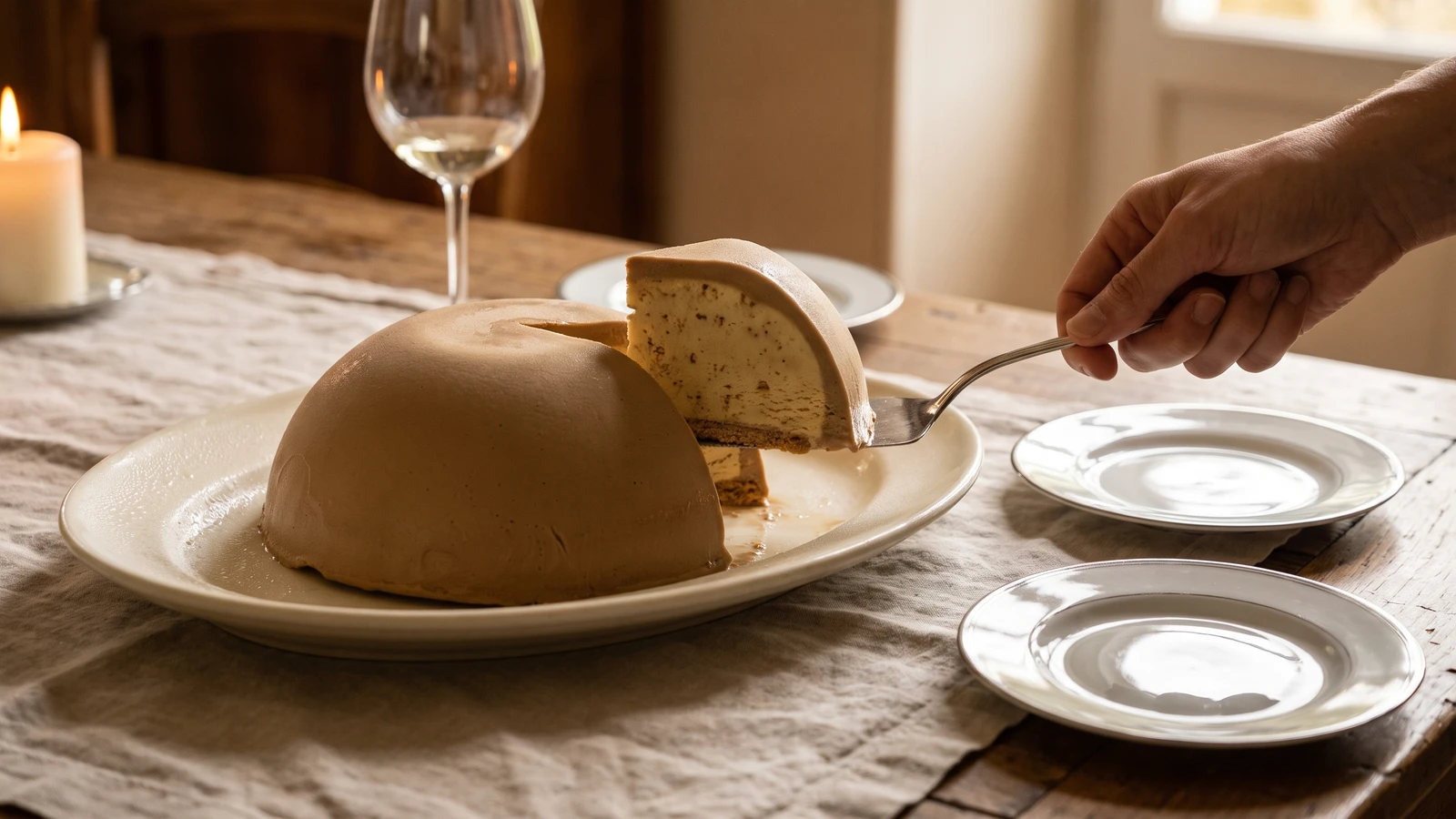
Bombe Coppélia pairs a firm coffee-ice shell with a soft praline pâte à bombe, teaching the cold architecture that lets two frozen textures release cleanly and melt together on the spoon.
Bombe Coppélia (coffee ice around a praline frozen cream) teaches the architecture of a moulded dessert: a firm shell must hold a softer heart without either becoming heavy. The one true thing is temperature discipline. The pralin must be finely ground and completely cold before it meets the cream, or warm caramel bleeds into the mixture and leaves the centre grey and slack.
The original assumed churned coffee ice waiting at the pastry station, a mould worked over broken ice, brigade portions, and several hands to keep every layer cold. At home, a 1.2-litre metal bowl, dense cream-based coffee ice cream, and a dependable freezer perform that work. I have removed the separate churning of the coffee ice because it is brigade scaffolding in this entry, not its defining act. The even coffee lining and the pralined pâte à bombe (a cooked-syrup yolk foam folded with whipped cream) remain, because they are the dish. One cook, one stove, one evening, then the freezer keeps watch.
Turned out, the Bombe Coppélia is smooth and café-brown outside; the first slice reveals a pale nut-gold centre, softer beneath the spoon than the coffee shell surrounding it. Before you touch the pan, remember the step that decides everything: cool the pralin completely, then grind it fine.
Bombe Coppélia belongs to the Parisian grand-kitchen repertoire of moulded ices, in which a firm ice or ice-cream shell enclosed a richer, softer bombe preparation. Its name follows the pastry kitchen's habit of borrowing from the Paris stage, Coppélia being the ballet of the lifelike mechanical doll, while its structure is thoroughly practical rather than theatrical. The book sends the cook to a sole aspic for the technique of clothing the mould, proof that the same grammar governed savoury jelly and frozen sweets; a home freezer now performs the broken-ice work that once fixed those layers.
Quantity
3 cups (720 ml / about 480 g) (No. 916)
Quantity
3 tablespoons (45 ml / 25 g)
Quantity
3 tablespoons (45 ml / 25 g)
Quantity
1/4 cup (60 ml / 50 g)
Quantity
1 tablespoon (15 ml / 15 g)
Quantity
3 (about 54 g)
Quantity
1/4 cup (60 ml / 50 g)
Quantity
2 tablespoons (30 ml / 30 g)
Quantity
3/4 cup (180 ml / 180 g)
very cold
| Ingredient | Quantity |
|---|---|
| dense coffee ice cream, for the coffee-ice lining made by the clothing-the-mould method in Another Method of Preparing Aspics de Filets de Soles | 3 cups (720 ml / about 480 g) (No. 916) |
| blanched almonds | 3 tablespoons (45 ml / 25 g) |
| skinned hazelnuts | 3 tablespoons (45 ml / 25 g) |
| granulated sugar, for the pralin | 1/4 cup (60 ml / 50 g) |
| water, for the pralin | 1 tablespoon (15 ml / 15 g) |
| large egg yolks | 3 (about 54 g) |
| granulated sugar, for the pâte à bombe | 1/4 cup (60 ml / 50 g) |
| water, for the pâte à bombe | 2 tablespoons (30 ml / 30 g) |
| heavy creamvery cold | 3/4 cup (180 ml / 180 g) |
Set a 1.2-litre metal bombe mould or bowl in a freezer at 0°F (-18°C) for 30 minutes. Chill the serving platter as well. Move the coffee ice cream to the refrigerator for 15 minutes before lining; it should yield to a spoon but remain dense and cold, with no liquid around its edges.
Adapt the clothing-the-mould method from Another Method of Preparing Aspics de Filets de Soles (No. 916): press about two-thirds of the coffee ice cream across the bottom and sides in a smooth layer 1 to 1.5 cm thick, turning the cold mould as you work with the back of a chilled spoon. Freeze for 20 minutes, inspect for thin patches, and fill them with more ice cream. Keep the remaining ice cream frozen for the base. If the lining slides, it has softened too far; freeze the mould for 10 minutes, then press the layer back into place.
Toast the almonds and hazelnuts in a dry heavy pan over medium heat until fragrant and lightly coloured, then tip them onto a plate. Put the 50 g sugar and 15 ml water in the pan and cook without stirring until the caramel turns a clear deep amber. Add the warm nuts, turn them through the caramel, and pour everything onto a silicone mat in one thin layer. If the caramel clumps around the nuts, return it to the lowest heat and turn gently until fluid again. Let it cool until absolutely hard and cold, about 30 minutes, then break it up and pulse it into fine, sandy pralin. Stop before the nuts release enough oil to make a paste; if that happens, chill the paste and use it cold, accepting a slightly denser centre.
Beat the yolks at medium speed until pale and slightly thickened. Meanwhile, cook the remaining 50 g sugar with 30 ml water in the smallest heavy saucepan you own, without stirring after it boils, until the syrup reaches 244°F (118°C). With the mixer running, pour the syrup in a thin stream down the inside of the bowl, keeping it clear of the whisk. Beat at high speed until the pâte à bombe is thick enough to fall in a ribbon and the bowl no longer feels warm, 6 to 8 minutes. It must be below 75°F (24°C) before the cream enters; if it remains warm, set the bowl over ice and continue whisking.
Whip the cold cream to soft peaks that hold their curve without looking grainy. Fold one-third into the cooled pâte à bombe to loosen it, then fold in the rest with broad strokes. Add the cold, finely ground pralin and fold only until evenly dispersed. Pralined means treated throughout with pralin, not merely sprinkled with nuts. If the pralin feels warm, stop and chill it before folding. If it has already gone in and the cream begins to slacken, set the bowl over ice and fold gently just until some body returns, then fill the mould at once. The centre may be a little denser, but it will set. Ça se rattrape.
Spoon the pralined pâte à bombe into the frozen coffee shell, pressing gently toward the sides so no air pockets remain. Stop about 1 cm below the rim; if there is extra filling, freeze it separately in a small cup. Soften the reserved coffee ice cream just enough to spread, then close the exposed base with an even layer and scrape it level with the mould. Cover tightly and freeze for at least 6 hours, preferably overnight, until completely firm.
Lower only the outside of the mould into lukewarm water for 5 seconds, dry it, and invert it onto the chilled platter. If it does not release, wrap the mould briefly in a warm towel and try again; do not leave it in water long enough to melt the coffee shell. If the surface becomes soft before release, return the still-moulded bombe to the freezer for 20 minutes. Cut with a knife dipped in hot water and wiped dry between slices, then serve immediately. À table!
1 serving (about 145g)
Culinary guides, cultural storytelling, and the editorial depth that makes cooking meaningful.
Discover Culinary ExplorerChef Juliette
Five almond preparations, one discipline: remove the skins cleanly, dry every kernel through, then cut, toast, or cloak it in pale caramel without letting its fragrant oils escape.

Chef Juliette
A pastry pantry lesson in one tray: filberts warmed only until their red skins release, rubbed clean, cooled, and chopped into a fragrant mise-en-place for cakes, creams, pralines, and petits fours.

Chef Juliette
The smallest pâtisserie discipline decides whether a cake leaves its mould intact: clarified butter in every corner, followed by the lightest veil of dry flour or fécule.

Chef Juliette
Four whites, one spotless bowl, and a patient change of speed: whisk gently until loosened, then briskly to glossy stiffness, with powdered sugar waiting if the foam begins to granulate.