
Chef Juliette
Various Almond Preparations
Five almond preparations, one discipline: remove the skins cleanly, dry every kernel through, then cut, toast, or cloak it in pale caramel without letting its fragrant oils escape.
A cooking platform built around craft, culture, and the stories behind what we eat.
Created by Chef Juliette
Based on No. 2842, Bombe Ceylan, from Le Guide Culinaire (1907) by Auguste Escoffier
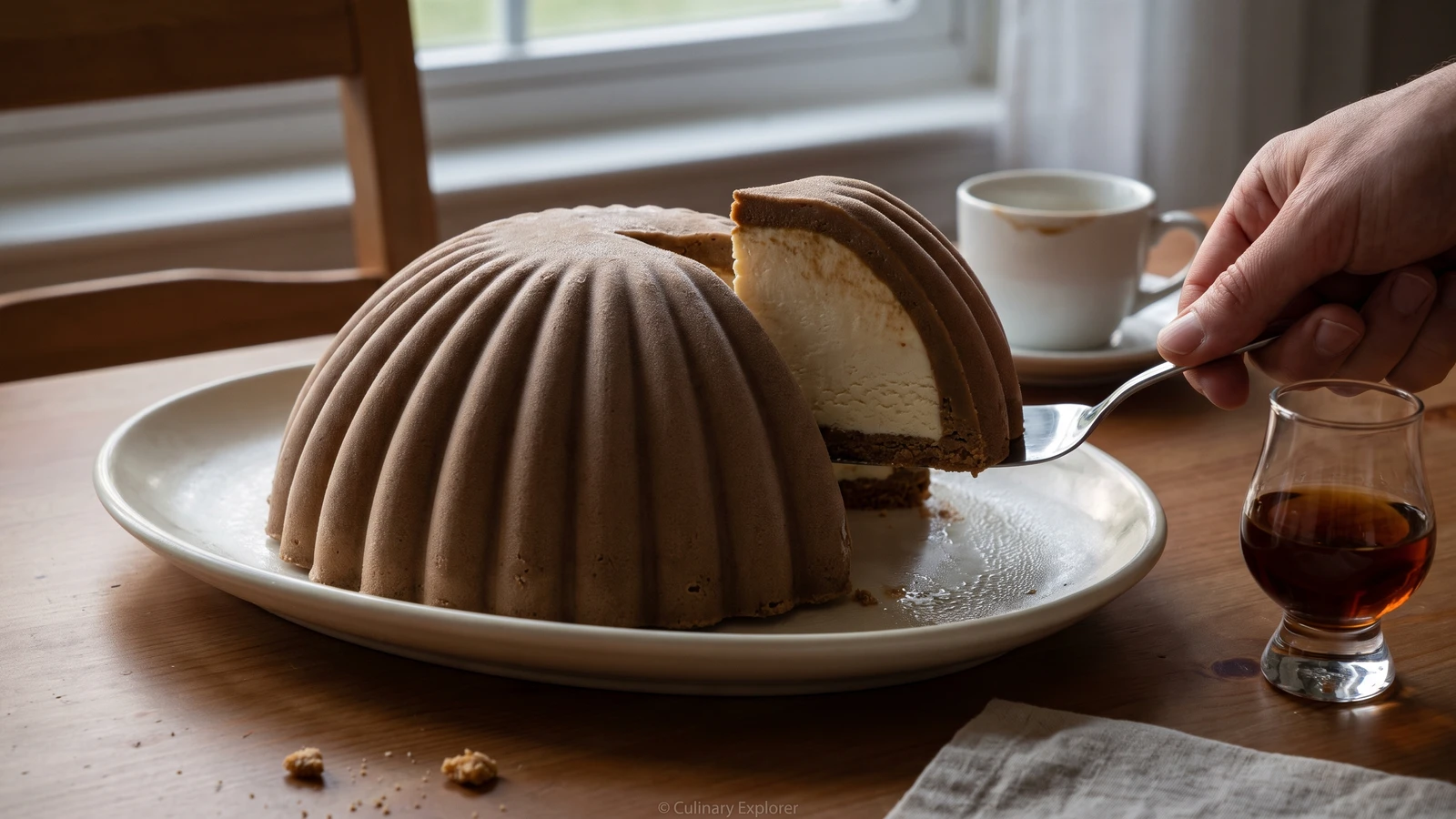
A coffee-dark shell, a pale rum-scented heart, and the lesson every frozen bombe teaches: line the mould evenly, cool the pâte à bombe completely, then give the freezer time to finish the work.
Bombe Ceylan (a coffee ice dome enclosing rum-scented frozen cream) teaches that cold is an ingredient, not merely a means of storage. Its coffee shell must be firm enough to hold a clean curve, while the pâte à bombe (yolks expanded with hot sugar syrup and lightened with whipped cream) stays supple and fragrant. The one truth to carry to the stove is simple: the rum enters only after the yolk base is truly cold, because warmth carries its perfume away.
The original entry assumed a brigade with coffee ice already churned, a deep bombe mould banked in salted ice, and spare hands to rock that mould until its lining set evenly. At home, a 1.25-liter metal mould, an electric mixer, and a modern freezer do the same work. The salted-ice station is brigade scaffolding and can go; chemiser le moule (clothing the mould with an even layer) is the dish and must stay. This version makes eight generous slices, one cook, one stove, one evening of assembly, then the freezer's quiet work.
When cut, the bombe should show two confident bands: coffee-brown ice around a pale, soft-textured rum center. Patch any thin places in the shell before filling, because ça se rattrape while the coffee ice is still pliable. Above all, cool the pâte à bombe completely before the rum meets it.
Bombe glacée belongs to the classical pâtisserie and dining-room service of Paris, where layered ices were packed into rounded metal moulds whose silhouette suggested an artillery shell. Ceylan is not a claim that the dessert comes from Sri Lanka; it reflects the French repertory's use of traded coffee, rum, and faraway place names to announce an aromatic character. This entry is unusually spare and exact: coffee ice outside, rum bombe preparation within, assembled through a mould-coating technique shared with the savory aspic canon.
Quantity
1⅓ cups (300 ml / 307 g)
Quantity
¾ cup (180 ml / 180 g)
Quantity
⅓ cup (80 ml / 30 g)
coarsely crushed
Quantity
½ cup (120 ml / 100 g)
Quantity
4 large
Quantity
⅛ teaspoon (0.6 ml / 0.8 g)
Quantity
½ cup (120 ml / 100 g)
Quantity
3 tablespoons (45 ml / 45 g)
Quantity
4 large
Quantity
1 cup (240 ml / 240 g)
Quantity
¼ cup (60 ml / 57 g)
Quantity
⅛ teaspoon (0.6 ml / 0.8 g)
Quantity
1 cited method, Another Method of Preparing Aspics de Filets de Soles (No. 916)
consulted only for the mould-coating method, not used as an edible component
| Ingredient | Quantity |
|---|---|
| whole milk | 1⅓ cups (300 ml / 307 g) |
| heavy cream for the coffee ice | ¾ cup (180 ml / 180 g) |
| whole medium-dark coffee beanscoarsely crushed | ⅓ cup (80 ml / 30 g) |
| granulated sugar for the coffee ice | ½ cup (120 ml / 100 g) |
| egg yolks for the coffee ice | 4 large |
| fine sea salt for the coffee ice | ⅛ teaspoon (0.6 ml / 0.8 g) |
| granulated sugar for the pâte à bombe | ½ cup (120 ml / 100 g) |
| water | 3 tablespoons (45 ml / 45 g) |
| egg yolks for the pâte à bombe | 4 large |
| cold heavy cream for the bombe filling | 1 cup (240 ml / 240 g) |
| dark rum | ¼ cup (60 ml / 57 g) |
| fine sea salt for the bombe filling | ⅛ teaspoon (0.6 ml / 0.8 g) |
| technique reference for clothing the mouldconsulted only for the mould-coating method, not used as an edible component | 1 cited method, Another Method of Preparing Aspics de Filets de Soles (No. 916) |
Clear a level space in the freezer. Chill a 1.25-liter metal bombe mould or deep metal bowl for at least 30 minutes, and chill the bowl and beaters that will later whip the cream. A cold mould catches the coffee ice quickly instead of letting it slide toward the bottom.
Combine the milk, the cream for the coffee ice, and the crushed coffee beans in a saucepan. Heat gently until small bubbles gather at the edge, then remove from the stove, cover, and infuse for 20 minutes. Strain through a fine sieve, pressing the beans only lightly; squeezing hard releases bitterness rather than more useful coffee flavor. Return the infused dairy to the clean saucepan and warm it again.
Whisk the four coffee-ice yolks with their sugar and salt until smooth. Pour in a third of the warm coffee dairy while whisking, then return everything to the saucepan. Stir continuously over low heat until the crème anglaise, a pourable custard, coats the spoon and reaches 82 to 84°C (180 to 183°F). Never let it boil. If a few grains of yolk appear, remove it from the heat immediately, blend briefly, and strain into a cold bowl. Ça se rattrape. Set the bowl over ice water, stir until cold, then cover and refrigerate for at least 2 hours.
Churn the cold custard in an ice cream machine until thick, smooth, and pliable, usually 20 to 25 minutes. It should hold the mark of a spoon without becoming hard. Without a machine, freeze it in a shallow metal pan and beat it thoroughly every 30 minutes until evenly frozen but spreadable, about four rounds; the texture will be a little less fine, but the dish remains honest.
Chemiser le moule by spreading the soft coffee ice over the bottom and sides of the chilled mould in an even layer about 1.5 cm thick. The source preserves this coating motion through Another Method of Preparing Aspics de Filets de Soles (No. 916); that preparation supplies the moulding reference only, and no fish preparation enters this dessert. Use the back of a cold spoon to press the ice firmly against the metal, then freeze for 30 minutes. Hold the mould toward a light and inspect the shell. If any patch looks thin or cracked, press in more coffee ice and freeze again. Ça se rattrape. Reserve enough coffee ice to close the base.
Put the sugar for the pâte à bombe and the water in a small saucepan, stirring only until the sugar is evenly wet. Bring it to a boil and cook without further stirring to 118°C (244°F). If crystals gather before the syrup reaches temperature, add a tablespoon of water, cover the pan for 30 seconds so condensation washes the sides, and continue cooking. Meanwhile, beat the four filling yolks until foamy. With the mixer running at medium speed, pour the hot syrup in a thin stream down the side of the bowl, never directly onto the whisk. Increase the speed and beat until the mixture triples in volume, falls in a thick ribbon, and the bowl no longer feels warm, about 6 to 8 minutes.
Test the underside of the pâte à bombe bowl. It must feel cool, ideally no warmer than 24°C (75°F). If it retains warmth, set it over ice water and continue whisking; add the rum too early and its perfume leaves before the dessert reaches the table. Once cold, beat in the rum and salt. Whip the cold cream to soft peaks, fold one-third into the yolk base to loosen it, then fold in the remainder with broad strokes until no white streaks remain. If the mixture slackens because the base was still warm, set it over ice and fold gently until it regains body. Do not discard it.
Spoon the rum pâte à bombe into the frozen coffee shell, pressing it gently into the curve so no large air pockets remain. Stop about 1.5 cm below the rim. Soften the reserved coffee ice in the refrigerator just until spreadable, then cover the filling completely and scrape the surface level; this becomes the bombe's base when it is turned out. Cover tightly and freeze on a level shelf for at least 6 hours, preferably overnight.
Chill the serving platter. Press a towel dipped in hot water and wrung nearly dry around the mould for 5 to 10 seconds, then invert it onto the platter. If the bombe resists, repeat with the towel rather than pulling or twisting. Should the surface soften too far, return the unmoulded bombe to the freezer for 10 minutes. Let it stand for 5 minutes before cutting with a knife warmed in hot water and wiped dry between slices. The coffee shell should cut cleanly around the pale rum center. À table!
1 serving (about 145g)
Culinary guides, cultural storytelling, and the editorial depth that makes cooking meaningful.
Discover Culinary ExplorerChef Juliette
Five almond preparations, one discipline: remove the skins cleanly, dry every kernel through, then cut, toast, or cloak it in pale caramel without letting its fragrant oils escape.

Chef Juliette
A pastry pantry lesson in one tray: filberts warmed only until their red skins release, rubbed clean, cooled, and chopped into a fragrant mise-en-place for cakes, creams, pralines, and petits fours.

Chef Juliette
The smallest pâtisserie discipline decides whether a cake leaves its mould intact: clarified butter in every corner, followed by the lightest veil of dry flour or fécule.

Chef Juliette
Four whites, one spotless bowl, and a patient change of speed: whisk gently until loosened, then briskly to glossy stiffness, with powdered sugar waiting if the foam begins to granulate.