
Chef Juliette
Various Almond Preparations
Five almond preparations, one discipline: remove the skins cleanly, dry every kernel through, then cut, toast, or cloak it in pale caramel without letting its fragrant oils escape.
A cooking platform built around craft, culture, and the stories behind what we eat.
Created by Chef Juliette
Based on No. 2838, Bombe Bourdaloue, from Le Guide Culinaire (1907) by Auguste Escoffier
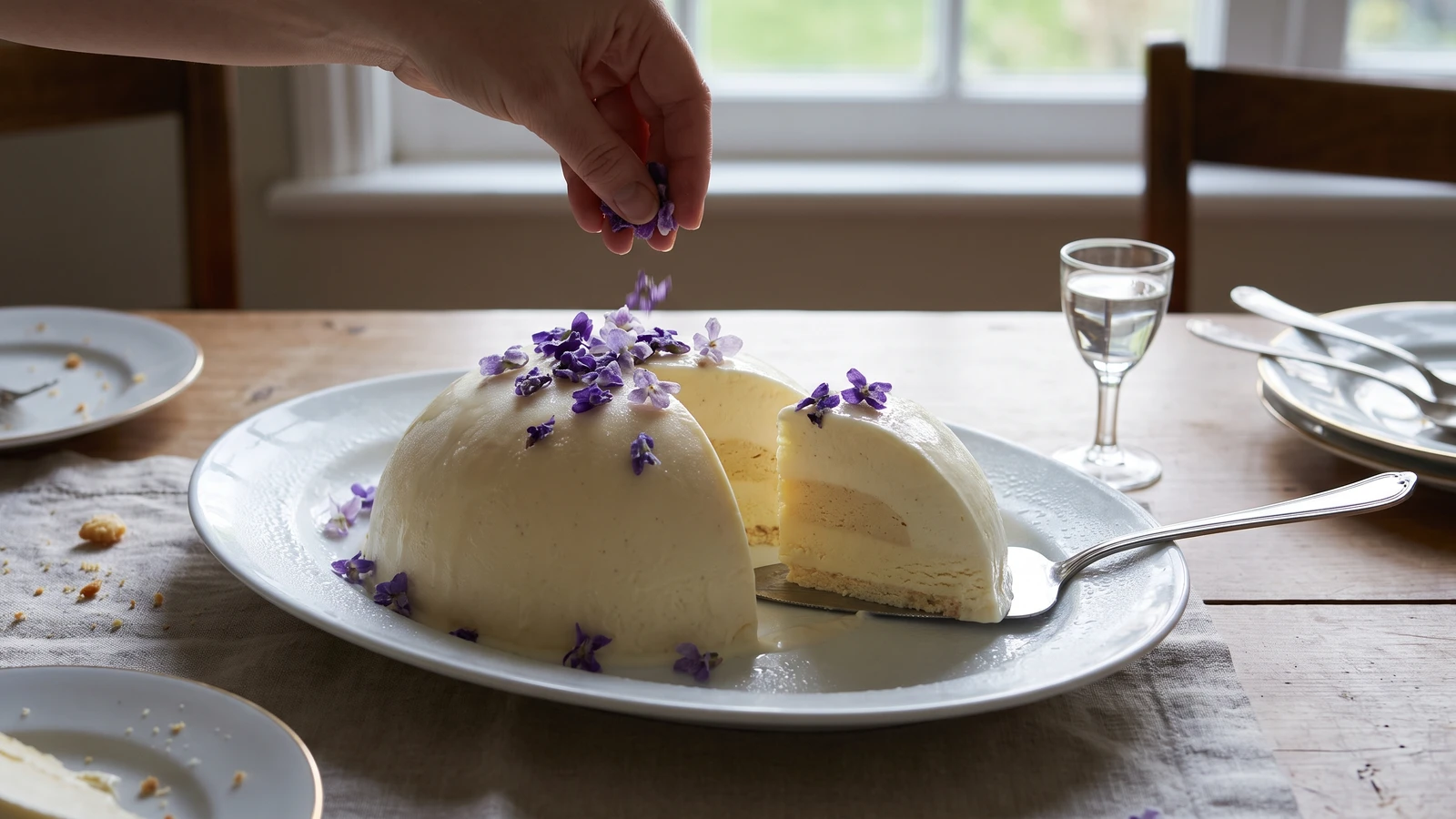
Bombe Bourdaloue sets a pale anisette pâte à bombe inside a firm vanilla ice-cream shell, then turns the whole dome onto a cold platter and scatters crystallised violets at the last possible moment.
Bombe Bourdaloue (a moulded vanilla and anisette frozen dessert) teaches the architecture of frozen desserts: the outside must be firm enough to contain the inside, and the inside must be light enough to slice without becoming hard. The one true thing is temperature. Freeze the vanilla clothing solid before the anisette filling touches it, or the two layers blur into one.
The original recipe assumed a pastry station with separate frozen preparations waiting, a deep metal bombe mould, an ice-and-salt freezing chest, and enough hands to make vanilla ice cream alongside the Anisette Bombe-preparation. For one cook, we use a 1.5-litre metal mould or stainless bowl, a reliable home freezer, and good finished vanilla ice cream for the coat. Churning that second base was brigade scaffolding and can go. Making the pâte à bombe, preserving the distinct layers, and finishing with crystallised violets are the dish, so they stay.
Done properly, the cut bombe shows a clean ivory shell around a softer, faintly anise-scented centre, with dry violet petals catching the light on top. Set those violets on only after unmoulding, because freezer dampness dulls their sugar. The step that decides everything is the hard freeze after lining: don't add the filling until a fingertip leaves no mark.
Frozen bombes belong to the Parisian pâtisserie and grand dining-room repertoire, named for rounded metal moulds resembling an artillery shell and designed to combine contrasting frozen preparations in one clean slice. Bourdaloue is better known at Paris pastry counters as a pear-and-almond tart name, but this formula contains neither pear nor almond: its identity is vanilla ice cream, anisette pâte à bombe, and crystallised violets. The violet finish comes from the confectioner's pantry, where preserved flowers supplied fragrance and colour beyond their brief fresh season.
Quantity
3 cups (720 ml / about 450 g)
softened just until spreadable
Quantity
4 large (about 1/4 cup / 72 g)
at room temperature
Quantity
1/2 cup (120 ml / 100 g)
Quantity
3 tablespoons (45 ml / 45 g)
Quantity
1 cup plus 2 tablespoons (270 ml / about 268 g)
well chilled
Quantity
1/4 cup (60 ml / about 65 g)
Quantity
1 small pinch (less than 1 ml / about 0.3 g)
Quantity
1/3 cup (80 ml / about 25 g)
Quantity
1 method reference, Another Method of Preparing Aspics de Filets de Soles (No. 916)
consulted for the mould technique only; it contributes no food to the dessert
| Ingredient | Quantity |
|---|---|
| full-fat vanilla ice creamsoftened just until spreadable | 3 cups (720 ml / about 450 g) |
| pasteurised egg yolksat room temperature | 4 large (about 1/4 cup / 72 g) |
| granulated sugar | 1/2 cup (120 ml / 100 g) |
| water | 3 tablespoons (45 ml / 45 g) |
| heavy creamwell chilled | 1 cup plus 2 tablespoons (270 ml / about 268 g) |
| clear anisette liqueur | 1/4 cup (60 ml / about 65 g) |
| fine sea salt | 1 small pinch (less than 1 ml / about 0.3 g) |
| crystallised violets | 1/3 cup (80 ml / about 25 g) |
| method reference for clothing the mouldconsulted for the mould technique only; it contributes no food to the dessert | 1 method reference, Another Method of Preparing Aspics de Filets de Soles (No. 916) |
Clear a level space in a freezer set to 0°F or -18°C. Chill a 1.5-litre metal bombe mould or deep stainless bowl for 20 minutes, along with the platter you will use for unmoulding. Metal conducts cold quickly and releases cleanly; a glass bowl freezes more slowly and asks for too much warming at the finish.
Move the vanilla ice cream to the refrigerator for 15 to 25 minutes, until a spoon passes through it with some resistance. It must spread like cold plaster, not pour. If the edges melt while the centre stays hard, stir gently to an even texture and return it to the freezer for 5 minutes; melted ice cream refreezes coarse.
Following the mould-clothing principle preserved in Another Method of Preparing Aspics de Filets de Soles (No. 916), press the softened vanilla ice cream over the bottom and sides of the chilled mould in an even layer about 1/2 inch or 1.25 cm thick. Work from the deepest point upward with the back of a spoon or small offset spatula, closing every gap and keeping the rim neat. C'est la même grammaire: the cited aspic remains in its own entry, while the reusable technique gives this dessert its clean shell.
Set the clothed mould level in the freezer for at least 1 hour, preferably 90 minutes. The vanilla layer must feel completely hard and matte before it receives the centre. This pause is not brigade scaffolding. It is the dish.
Reserve 2 tablespoons of the cold cream, then whip the remainder to soft peaks that curl over when the whisk lifts. Stop before the surface looks grainy. If you go too far, ça se rattrape: fold in the reserved liquid cream a teaspoon at a time until the texture becomes smooth and supple again. Keep the whipped cream cold.
Put the sugar and water in a small heavy saucepan. Warm gently, stirring only until the sugar dissolves, then raise the heat and cook without stirring to 244°F or 118°C. If crystals form and the syrup turns grainy, stop before it colours, add 1 tablespoon of water, and dissolve it again over low heat. Ça se rattrape. While the syrup rises, beat the yolks until pale and slightly thickened.
With the mixer running at medium speed, pour the hot syrup into the yolks in a very thin thread down the inside of the bowl, never directly onto the whisk. Increase the speed and beat for 6 to 8 minutes, until the pâte à bombe, a cooked yolk foam, is thick enough to fall in a ribbon and has cooled below 75°F or 24°C. If a few cooked flecks appear, pass the mixture through a fine sieve while still warm and continue beating; a few flecks can be rescued, but a fully scrambled base must be remade.
Beat the salt into the cooled pâte à bombe, then add the anisette gradually, mixing just until even. Fold in one-third of the whipped cream to lighten the base, then fold in the remainder with broad strokes until no white streaks remain. This is the Anisette Bombe-preparation the entry requires. It should be airy and softly spoonable, with anise present but not medicinal.
Spoon the Anisette Bombe-preparation into the frozen vanilla shell, easing it into the curve without crushing out its air. Fill the mould to the rim and level the surface. Cover closely with a parchment circle and then foil, set the mould level, and freeze for at least 8 hours. An overnight freeze gives the cleanest unmoulding and slices.
Remove the parchment and dip the mould to just below its rim in lukewarm water for 5 seconds. Dry it, invert the chilled platter over the mould, and turn both together. If the bombe does not release, repeat the dip for 2 seconds only; too much warmth erases the vanilla shell. Return the unmoulded bombe to the freezer for 10 minutes if its surface has softened, then scatter the crystallised violets over it at the last possible moment. Cut with a knife dipped in hot water and wiped dry between slices. À table!
1 serving (about 125g)
Culinary guides, cultural storytelling, and the editorial depth that makes cooking meaningful.
Discover Culinary ExplorerChef Juliette
Five almond preparations, one discipline: remove the skins cleanly, dry every kernel through, then cut, toast, or cloak it in pale caramel without letting its fragrant oils escape.

Chef Juliette
A pastry pantry lesson in one tray: filberts warmed only until their red skins release, rubbed clean, cooled, and chopped into a fragrant mise-en-place for cakes, creams, pralines, and petits fours.

Chef Juliette
The smallest pâtisserie discipline decides whether a cake leaves its mould intact: clarified butter in every corner, followed by the lightest veil of dry flour or fécule.

Chef Juliette
Four whites, one spotless bowl, and a patient change of speed: whisk gently until loosened, then briskly to glossy stiffness, with powdered sugar waiting if the foam begins to granulate.