
Chef Juliette
Various Almond Preparations
Five almond preparations, one discipline: remove the skins cleanly, dry every kernel through, then cut, toast, or cloak it in pale caramel without letting its fragrant oils escape.
A cooking platform built around craft, culture, and the stories behind what we eat.
Created by Chef Juliette
Based on No. 2829, Bombe Aboukir, from Le Guide Culinaire (1907) by Auguste Escoffier
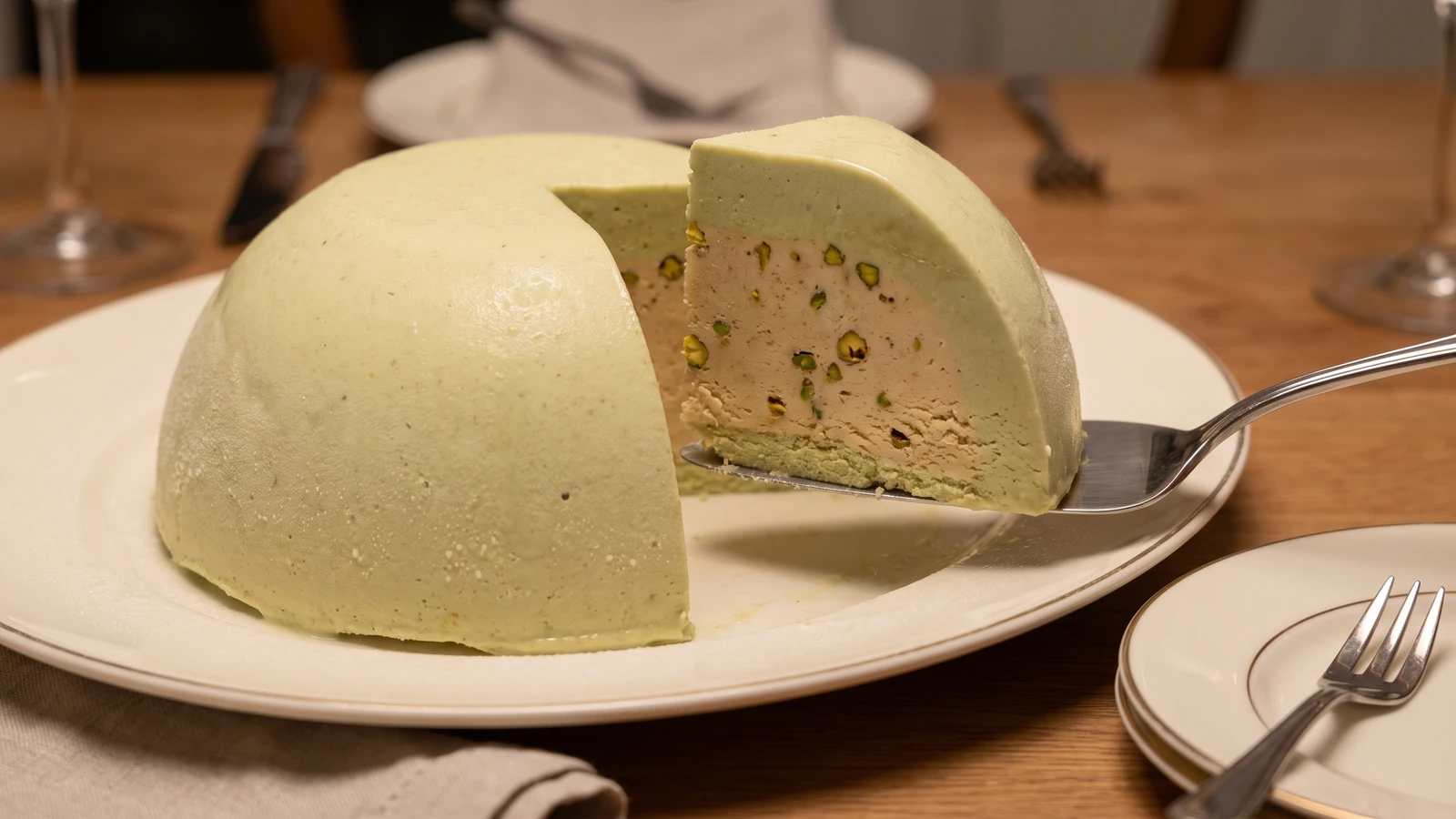
Bombe Aboukir sets a pale pistachio ice shell around pralined pâte à bombe, cool, nutty, and cleanly sliceable, with chopped pistachios held in a centre as light as frozen mousse.
Bombe Aboukir (a pistachio-lined frozen praline bombe) teaches architecture through temperature. The one true thing is simple: the pistachio shell must be firm, and the pralined pâte à bombe completely cool, before they meet. If either is soft, the green shell smears into the centre and the filling freezes heavy. Keep them cold and the knife reveals two clean layers, pale pistachio around a buff-coloured, nut-flecked heart.
The original assumed a pastry section where pistachio ice was already churned, pralin waited on the shelf, and metal bombe moulds were packed into salt and broken ice. Your honest equivalents are dense pistachio ice cream, a smooth almond pralin, a pre-frozen stainless-steel bowl, and the coldest part of an ordinary freezer. Making a separate batch of pistachio ice is brigade scaffolding and can go; the firm pistachio lining and the pralined centre are the dish, so both stay. The active work belongs to one cook, one stove, one evening. The freezer keeps watch overnight.
Pâte à bombe is a yolk foam cooked with hot sugar syrup, then cooled before whipped cream enters. Pralined means treated with pralin, the paste of caramelized nuts that gives this centre its deep toasted flavour. Never warm the pralin to loosen it, and fold the chopped pistachios in straight from the cold. That final temperature check decides the bombe.
Bombe Aboukir belongs to Parisian grand pâtisserie, where contrasting frozen mixtures were layered in domed metal moulds and given names as imposing as their shapes. Aboukir is a Mediterranean port in Egypt remembered in French military history, but the dessert is French rather than Egyptian, built entirely from the classical pastry kitchen's pistachio ice, pralin, and pâte à bombe. Across generations, household freezers replaced salt-and-ice packing, while the bombe retained its defining contrast between a firm flavoured shell and a lighter frozen centre.
Quantity
2 cups (475 ml / about 430 g)
softened only until spreadable
Quantity
4 (about 1/4 cup / 72 g)
Quantity
1/2 cup (120 ml / 100 g)
Quantity
2 tablespoons (30 ml / 30 g)
Quantity
Scant 1/2 cup (110 ml / 130 g)
kept cool and never warmed
Quantity
1 1/4 cups (300 ml / 300 g)
well chilled
Quantity
1/3 cup (80 ml / 45 g)
finely chopped and refrigerated until cold
Quantity
as needed
for a cooling bath
Quantity
1 application of Another Method of Preparing Aspics de Filets de Soles (No. 916)
used only for clothing the mould; no aspic or fish enters the dessert
| Ingredient | Quantity |
|---|---|
| pistachio ice, using dense pistachio ice creamsoftened only until spreadable | 2 cups (475 ml / about 430 g) |
| large egg yolks | 4 (about 1/4 cup / 72 g) |
| granulated sugar | 1/2 cup (120 ml / 100 g) |
| water | 2 tablespoons (30 ml / 30 g) |
| smooth almond pralin pastekept cool and never warmed | Scant 1/2 cup (110 ml / 130 g) |
| heavy creamwell chilled | 1 1/4 cups (300 ml / 300 g) |
| shelled unsalted pistachiosfinely chopped and refrigerated until cold | 1/3 cup (80 ml / 45 g) |
| icefor a cooling bath | as needed |
| technique referenceused only for clothing the mould; no aspic or fish enters the dessert | 1 application of Another Method of Preparing Aspics de Filets de Soles (No. 916) |
Freeze a 1.25-liter stainless-steel bombe mould or deep bowl for 30 minutes. Let the pistachio ice stand just until a spoon can move through it, about 8 to 10 minutes, without allowing the edges to melt. The book borrows the clothing action from Another Method of Preparing Aspics de Filets de Soles (No. 916): here the reference governs only the even coating of the mould. No aspic or fish enters the dessert. Press the pistachio ice over the bottom and sides in an even layer about 3/8 inch (1 cm) thick, carrying it cleanly to the rim. Patch any bare metal now, then freeze the lined mould for at least 1 hour, until hard.
Whip the cold cream to soft peaks that curl gently from the whisk, then refrigerate it. Keep the chopped pistachios in the cold as well. Stir the almond pralin until smooth, but never heat it to make it fluid; if it is stiff, you will loosen it with cooled pâte à bombe. Warm pralin slackens the cream and gives the frozen centre a wet, heavy texture.
Put the yolks in the mixer bowl and beat at low speed until smooth. Combine the sugar and water in a small heavy saucepan, stirring over gentle heat only until the sugar dissolves. Stop stirring and boil the syrup to 244°F (118°C). If crystals gather on the pan wall, cover the pan for 30 seconds so condensation washes them down, then uncover and continue. Ça se rattrape. With the mixer running slowly, pour the hot syrup in a thin stream down the inside of the bowl, never onto the moving whisk. Raise the speed and whip for 6 to 8 minutes, until the pâte à bombe is pale, very thick, and falls from the whisk in a ribbon while the bowl feels cool.
Fold about one-quarter of the cooled pâte à bombe into the pralin to loosen it, then fold that mixture back into the remaining pâte à bombe. Check the underside of the bowl. The mixture must be no warmer than 70°F (21°C) before the cream enters. If it still carries warmth, set the bowl over ice and fold slowly until cool, then remove it from the ice. Do not hurry this point. Temperature is the structure of the dessert.
Fold one-third of the whipped cream into the pralined base to lighten it, then fold in the remainder in two additions with broad strokes from the bottom of the bowl. Add the refrigerator-cold chopped pistachios last. The filling should hold a soft mound on the spatula. If it turns loose and shiny, stop and set the bowl over ice for 5 to 10 minutes, folding gently until it regains body. Ça se rattrape. Never pour a runny filling into the shell, because it will settle densely and weep when sliced.
Take the pistachio-lined mould from the freezer and spoon in the pralined filling, pressing each addition lightly against the shell so no large air pockets remain. Level the surface just below the rim and cover it directly with parchment or reusable freezer wrap. Freeze for at least 6 hours, preferably overnight, until the centre is completely firm.
Chill the serving platter. Dip the mould up to its rim in warm, not hot, water for 5 seconds, dry the outside, and invert it onto the platter. If the bombe clings, repeat for only 2 seconds; if the shell starts softening before it releases, return the mould to the freezer for 20 minutes and begin again. Let the unmoulded bombe stand for 5 minutes, then slice with a long knife dipped in warm water and wiped dry between cuts. À table!
1 serving (about 138g)
Culinary guides, cultural storytelling, and the editorial depth that makes cooking meaningful.
Discover Culinary ExplorerChef Juliette
Five almond preparations, one discipline: remove the skins cleanly, dry every kernel through, then cut, toast, or cloak it in pale caramel without letting its fragrant oils escape.

Chef Juliette
A pastry pantry lesson in one tray: filberts warmed only until their red skins release, rubbed clean, cooled, and chopped into a fragrant mise-en-place for cakes, creams, pralines, and petits fours.

Chef Juliette
The smallest pâtisserie discipline decides whether a cake leaves its mould intact: clarified butter in every corner, followed by the lightest veil of dry flour or fécule.

Chef Juliette
Four whites, one spotless bowl, and a patient change of speed: whisk gently until loosened, then briskly to glossy stiffness, with powdered sugar waiting if the foam begins to granulate.