
Chef Juliette
Various Almond Preparations
Five almond preparations, one discipline: remove the skins cleanly, dry every kernel through, then cut, toast, or cloak it in pale caramel without letting its fragrant oils escape.
A cooking platform built around craft, culture, and the stories behind what we eat.
Created by Chef Juliette
Based on No. 2826, Bombes (Generic Recipe), from Le Guide Culinaire (1907) by Auguste Escoffier
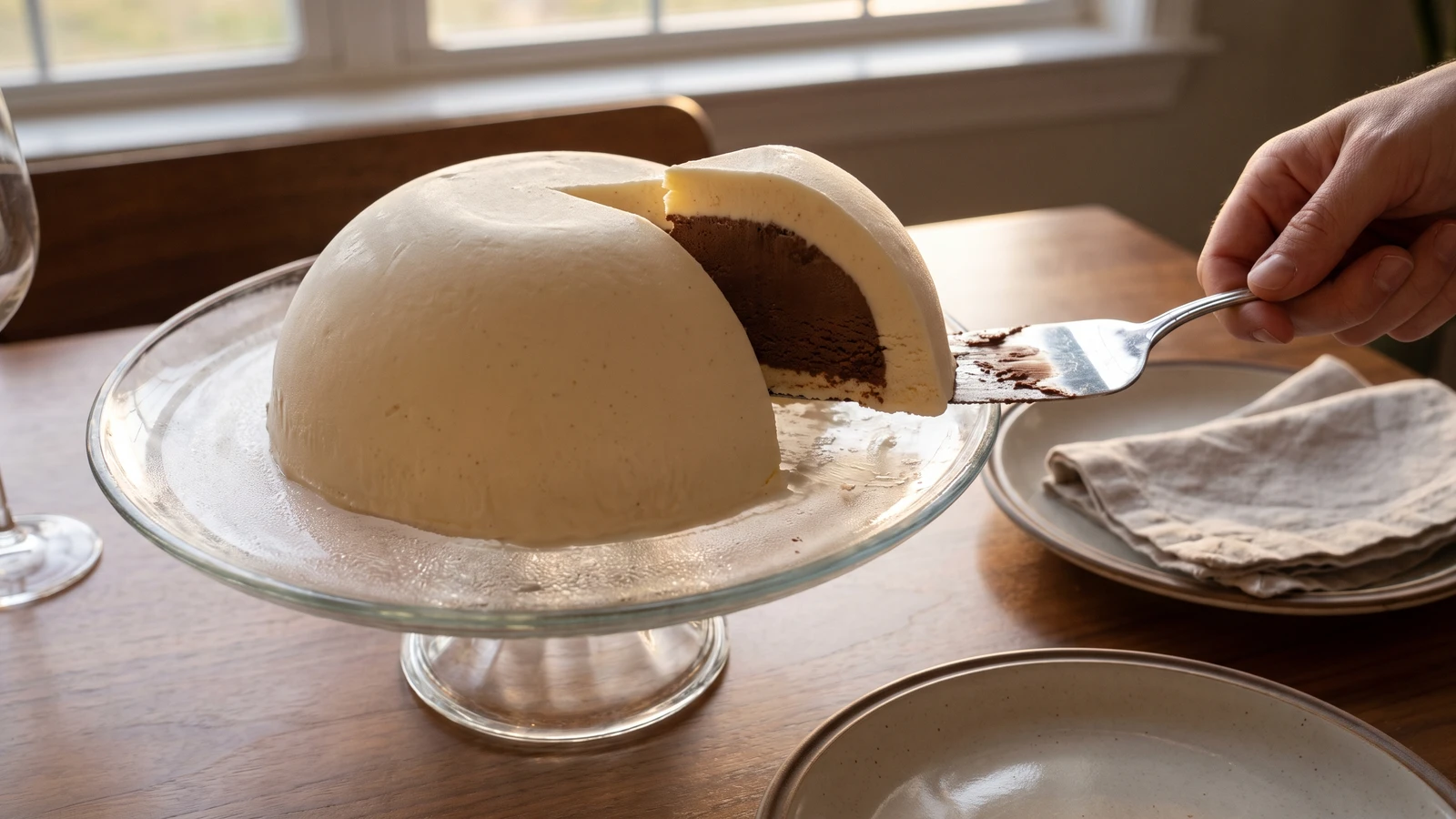
A thin vanilla shell gives way to a silken chocolate pâte à bombe: the classical frozen mould translated from salted ice and a dedicated mould to one bowl, one freezer, and a confident unmoulding.
Bombe glacée (moulded layered frozen dessert) teaches architecture: a thin, firm outer ice enclosing a softer and more delicate heart. The one true thing to know before touching the saucepan is that the shell must freeze solid before the filling goes in. Rush that boundary and the layers blur; hold it firm and every slice reveals the bombe exactly as intended.
The original entry assumed a pâtisserie with prepared ices, a spherical metal mould packed in salted ice, and enough hands to build concentric layers on demand. Your equivalents are a dense prepared vanilla ice cream, a chilled metal bowl, and an ordinary freezer. The separate churn and buried ice chest were brigade scaffolding and can go; the thin outer wall, the pâte à bombe, and the patient final freezing are the dish and must stay.
The entry gives structure rather than a fixed flavouring, so vanilla outside and dark chocolate within make that structure clear without changing its intent. Cut into the finished dome and the pale shell should yield cleanly to a silken chocolate center, rich but light enough to soften before the ice cream does. Freeze the vanilla shell until it is hard from rim to base before making the pâte à bombe.
Bombe glacée belongs to the French family of entremets glacés, moulded frozen desserts shaped and layered in pâtisserie kitchens and formal dining rooms, especially in Paris. Its name came from the round mould, resembling a bomb, and from the concentric construction with a particularly thin outer layer. Shell-shaped moulds later joined the sphere and the filling became finer, but the defining practice remained the same: a firm ice surrounding a more delicate frozen preparation.
Quantity
3 cups (710 ml / about 650 g)
softened until spreadable but still cold
Quantity
⅔ cup chopped (160 ml / 115 g)
finely chopped
Quantity
1½ cups (360 ml / 360 g)
divided
Quantity
5 large (⅓ cup / 90 g)
Quantity
½ cup (120 ml / 100 g)
Quantity
¼ cup (60 ml / 60 g)
Quantity
1 teaspoon (5 ml / 5 g)
Quantity
⅛ teaspoon (0.6 ml / 0.7 g)
| Ingredient | Quantity |
|---|---|
| dense full-fat vanilla ice creamsoftened until spreadable but still cold | 3 cups (710 ml / about 650 g) |
| dark chocolate, 64 to 70 percent cocoafinely chopped | ⅔ cup chopped (160 ml / 115 g) |
| cold heavy creamdivided | 1½ cups (360 ml / 360 g) |
| large egg yolks | 5 large (⅓ cup / 90 g) |
| granulated sugar | ½ cup (120 ml / 100 g) |
| water | ¼ cup (60 ml / 60 g) |
| pure vanilla extract | 1 teaspoon (5 ml / 5 g) |
| fine sea salt | ⅛ teaspoon (0.6 ml / 0.7 g) |
Clear a level space in the freezer and chill a 1.5-litre metal bowl for at least 20 minutes. Let the vanilla ice cream stand just until a spoon moves through it without force, usually 10 to 15 minutes; it must be spreadable but never liquid at the edges. Return it to the freezer for 5 minutes if it starts looking glossy or loose.
Reserve about one-third of the vanilla ice cream for the closing layer and return it to the freezer. Spoon the rest into the cold bowl, then press it evenly over the base and sides in a layer about 1 cm thick, using the back of a cold spoon. The outer layer must be thin, continuous, and especially firm at the rim. If the ice cream slides toward the base, freeze the bowl for 10 minutes and continue; patch every translucent spot before proceeding. Freeze the finished shell for 45 to 60 minutes, until hard throughout.
Put the chopped chocolate in a heatproof bowl. Heat ½ cup of the cream just until small bubbles appear around the edge, then pour it over the chocolate and leave it untouched for 1 minute. Stir slowly from the center outward until dark, smooth, and glossy, then add the vanilla and salt. Let it cool to about 30 to 32°C, when it feels barely warm. If the emulsion looks oily or split, whisk in 1 tablespoon of the remaining cold cream. Ça se rattrape.
Begin whipping the yolks at medium speed until they are pale and slightly thickened. Put the sugar and water in a small heavy saucepan, bring them to a boil, and cook without stirring to 118°C. If crystals gather on the sides, cover the pan for 30 seconds so condensation washes them down, then uncover and continue. With the mixer running on low, pour the syrup in a slow thread down the inside of the bowl, never onto the moving whisk. Increase to medium-high and beat for 6 to 8 minutes, until the pâte à bombe, the yolk-and-hot-syrup foam, falls in a thick ribbon and the bowl feels barely warm.
Fold one-third of the pâte à bombe into the lukewarm chocolate base to loosen it, then fold that mixture back into the remaining pâte à bombe. Whip the remaining cream to soft peaks that bend at their tips, not stiff peaks, and fold it through in three additions. Stop when the filling is uniformly chocolate-colored and still airy. If the chocolate begins setting into small flecks, place the bowl over barely warm water for 5 seconds, fold gently, and remove it at once.
Spoon the chocolate filling into the frozen vanilla shell, pressing gently into the curve so no large air pockets remain. Leave about 1 cm below the rim. Soften the reserved vanilla ice cream just enough to spread, then cover the filling completely and smooth it level with the rim, sealing the chocolate inside the ice. Cover the surface with parchment and foil, then freeze on a level shelf for at least 6 hours, preferably overnight.
Chill the serving platter. Remove the coverings, wrap the outside of the mould in a warm damp towel for 5 to 8 seconds, then invert it onto the platter. If it does not release, return it to the freezer for 10 minutes and repeat with the towel; don't keep warming until the shell melts. Let the unmoulded bombe stand for 5 to 8 minutes, then cut it with a knife dipped in hot water and wiped dry between slices. The knife should reveal a narrow vanilla border around the chocolate center. À table!
1 serving (about 175g)
Culinary guides, cultural storytelling, and the editorial depth that makes cooking meaningful.
Discover Culinary ExplorerChef Juliette
Five almond preparations, one discipline: remove the skins cleanly, dry every kernel through, then cut, toast, or cloak it in pale caramel without letting its fragrant oils escape.

Chef Juliette
A pastry pantry lesson in one tray: filberts warmed only until their red skins release, rubbed clean, cooled, and chopped into a fragrant mise-en-place for cakes, creams, pralines, and petits fours.

Chef Juliette
The smallest pâtisserie discipline decides whether a cake leaves its mould intact: clarified butter in every corner, followed by the lightest veil of dry flour or fécule.

Chef Juliette
Four whites, one spotless bowl, and a patient change of speed: whisk gently until loosened, then briskly to glossy stiffness, with powdered sugar waiting if the foam begins to granulate.