
Chef Juliette
Coupes d’Antigny
Coupes d’Antigny layers wild strawberry ice, fresh cream, vanilla-poached peach, and spun sugar into one cold lesson in timing: soften the ice carefully, then spin the brittle veil only when the table is ready.
A cooking platform built around craft, culture, and the stories behind what we eat.
Created by Chef Juliette
Based on No. 2825, Iced Biscuit Sigurd, from Le Guide Culinaire (1907) by Auguste Escoffier
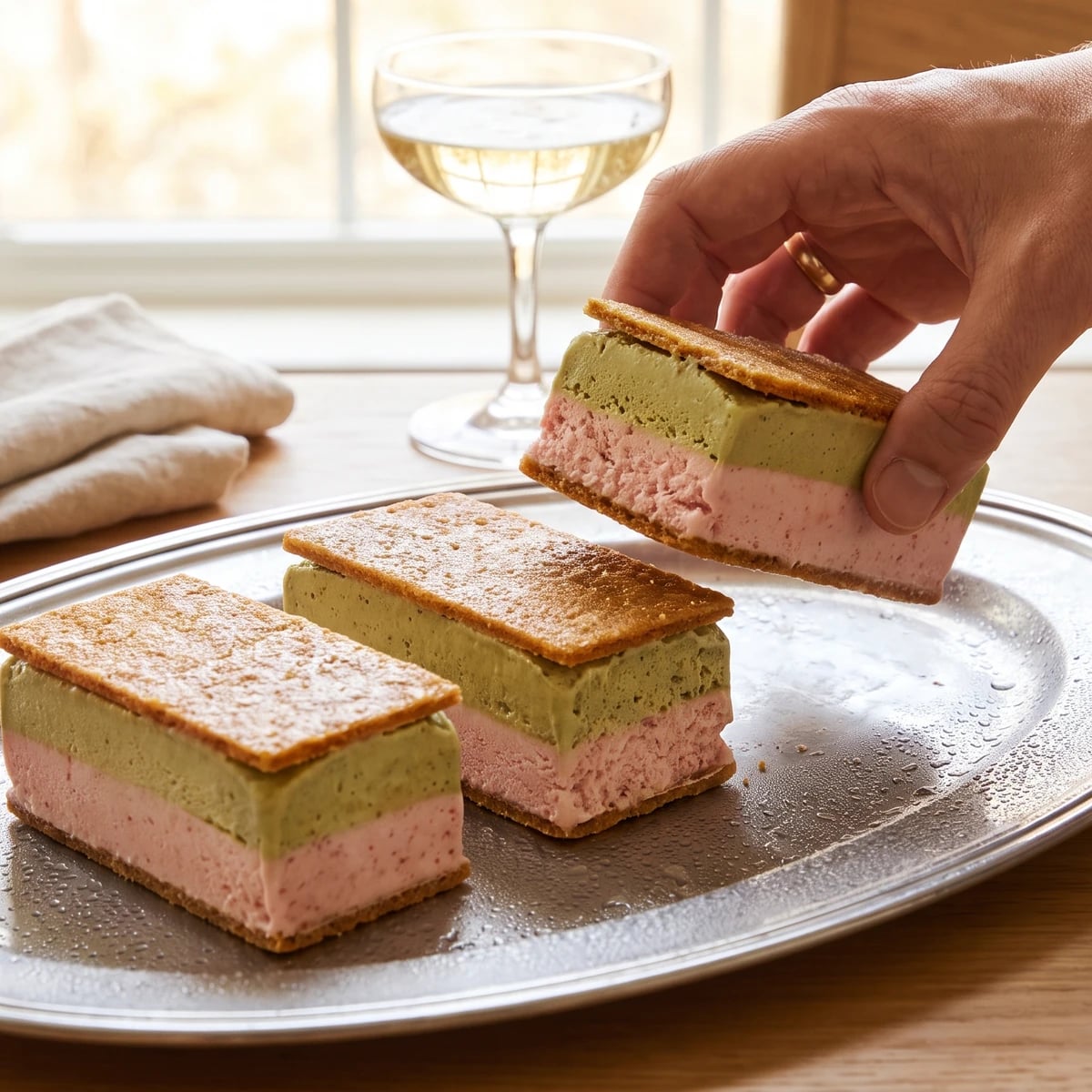
Strawberry below, pistachio above, both held in a feather-light biscuit glacé and cut into clean rectangles. Crisp sugar wafers close around each slice only when the plate is heading to the table.
Biscuit glacé Sigurd (strawberry and pistachio frozen biscuit sandwiches) teaches that timing can be part of a dessert's structure. The one true thing is simple: the gaufrettes, thin sugar wafers, never enter the freezer with the biscuit. They meet it only as each portion goes to the table, because their crispness disappears within minutes against the frozen filling.
The original entry assumed two finished flavored biscuit preparations, a cold station with rapid-freezing molds, and another pair of hands assembling portions to order. The home equivalent is one pâte à bombe, a hot-syrup yolk foam, divided between strawberry and pistachio, layered in an 8-inch metal pan, and given enough time in an ordinary freezer. Separate production schedules were brigade scaffolding and can go. The strawberry-under-pistachio order, the aerated cream, the firm freeze, and the last-second wafers are the dish and must stay. One cook, one stove, one evening.
When it is right, each cut shows a soft rose layer beneath a natural pistachio green, both dense enough to hold a rectangle yet light on the tongue. The step that decides Sigurd is the final one: cut while truly firm, sandwich between dry gaufrettes, and carry it directly to the table.
Biscuit glacé Sigurd belongs to the Parisian grand-kitchen repertory of entremets glacés, not to a regional farmhouse table. Despite biscuit in the title, it is not a baked cake: the classical preparation takes its body from aerated yolks, syrup, and cream, then is molded and sliced. The surviving formula offers no regional claim for the name Sigurd; what it preserves precisely is banquet-service practice, strawberry below pistachio, with crisp gaufrettes added only as each portion leaves the cold station.
Quantity
1 1/3 cups (320 ml / 200 g)
hulled, or use unsweetened frozen strawberries, thawed and well drained
Quantity
1/3 cup (80 ml / 75 g)
Quantity
Scant 1 cup (215 ml / 180 g)
Quantity
1/4 cup (60 ml / 60 g)
Quantity
6 large
Quantity
2 cups (480 ml / 475 g)
Quantity
16, each about 4 x 2 inches (10 x 5 cm)
| Ingredient | Quantity |
|---|---|
| ripe strawberrieshulled, or use unsweetened frozen strawberries, thawed and well drained | 1 1/3 cups (320 ml / 200 g) |
| pure unsweetened pistachio paste | 1/3 cup (80 ml / 75 g) |
| granulated sugar | Scant 1 cup (215 ml / 180 g) |
| water | 1/4 cup (60 ml / 60 g) |
| pasteurized egg yolks | 6 large |
| cold heavy cream | 2 cups (480 ml / 475 g) |
| gaufrettes, thin unfilled sugar wafers | 16, each about 4 x 2 inches (10 x 5 cm) |
Line an 8-inch (20 cm) square metal pan with two crossed strips of parchment, leaving enough overhang to lift out the frozen biscuit. Purée the strawberries until smooth, then press them through a fine sieve to remove the seeds. Keep the purée cold. Stir the pistachio paste until completely smooth, but do not add coloring; pistachio is muted green, not emerald.
Whip the cold cream until it forms soft peaks that bend at their tips. Stop there. Stiff cream is difficult to fold and leaves buttery flecks through the biscuit. If it begins to look grainy, whisk in a teaspoon of cold unwhipped cream or cold milk until it smooths. Divide the whipped cream into two equal portions, cover, and refrigerate.
Put the sugar and water in a small saucepan and bring them to a boil without stirring. When the syrup reaches about 230°F (110°C), begin beating the yolks at medium speed. At 244°F (118°C), remove the syrup from the heat and pour it in a thin stream down the inside of the bowl while beating, keeping it away from the moving whisk. Increase the speed and whip until the pâte à bombe is thick, pale, and cool enough that the bowl no longer feels warm, about 7 minutes. If a little syrup hardens into threads against the bowl, set the bowl briefly over barely warm water and keep whisking until they dissolve; do not scrape hard sugar shards into the foam. Divide the pâte à bombe equally between two bowls and cover one portion.
Whisk the cold strawberry purée into one portion of pâte à bombe until the color is even. Fold in one portion of whipped cream in three additions, turning the bowl and cutting through the center with the spatula so the air survives. Spread this strawberry biscuit preparation evenly in the lined pan and level the surface without pressing it flat. Freeze for 40 to 50 minutes, until the surface no longer ripples when the pan is nudged but remains slightly tacky.
Loosen the pistachio paste with two spoonfuls of the reserved pâte à bombe, then whisk that mixture back into the remaining pâte à bombe. Fold in the second portion of whipped cream. Test the strawberry layer with one small spoonful of pistachio preparation. If it sinks, lift it off and return the pan to the freezer for 20 minutes. Ça se rattrape. Once the base holds, spoon the pistachio mixture gently across the surface and level it from edge to edge.
Freeze the layered biscuit uncovered until the top is firm, about 1 hour, then cover without letting the wrapping touch the surface. Continue freezing until solid through the center, at least 4 hours in total. Press the middle lightly through the covering: it should feel firm, with no soft pocket beneath the pistachio layer.
Lift the biscuit from the pan by its parchment and peel the paper away. Dip a long knife in hot water, wipe it completely dry, and cut the square into two 4-inch-wide strips, then cut each strip into four rectangles. Clean and warm the knife between cuts. If the layers smear or compress, return the block to the freezer for 15 minutes before continuing. Place each rectangle between two dry gaufrettes without pressing hard. Serve immediately, before the wafers soften. À table!
1 serving (about 145g)
Culinary guides, cultural storytelling, and the editorial depth that makes cooking meaningful.
Discover Culinary Explorer
Chef Juliette
Coupes d’Antigny layers wild strawberry ice, fresh cream, vanilla-poached peach, and spun sugar into one cold lesson in timing: soften the ice carefully, then spin the brittle veil only when the table is ready.

Chef Juliette
Coupes Clo-clo marry vanilla ice, maraschino-soaked marrons glacés, and strawberry Chantilly in a festive glass: cold against cream, cherry perfume against chestnut, softness against a firm piped ridge.

Chef Juliette
Coupes Dame Blanche set a vanilla-poached peach over snowy almond-milk ice, hiding Bar-le-Duc currant jam beneath its dome and circling it with a bright piped cord of lemon ice.

Chef Juliette
Coupes Denise set coffee-dark Moka ice against rum bonbons and softly drooping Chantilly, proving that a composed frozen dessert depends less on ornament than on temperature, proportion, and the confidence to use a spoon.