
Chef Juliette
Various Almond Preparations
Five almond preparations, one discipline: remove the skins cleanly, dry every kernel through, then cut, toast, or cloak it in pale caramel without letting its fragrant oils escape.
A cooking platform built around craft, culture, and the stories behind what we eat.
Created by Chef Juliette
Based on No. 2822, Iced Biscuit Mont-Blanc, from Le Guide Culinaire (1907) by Auguste Escoffier
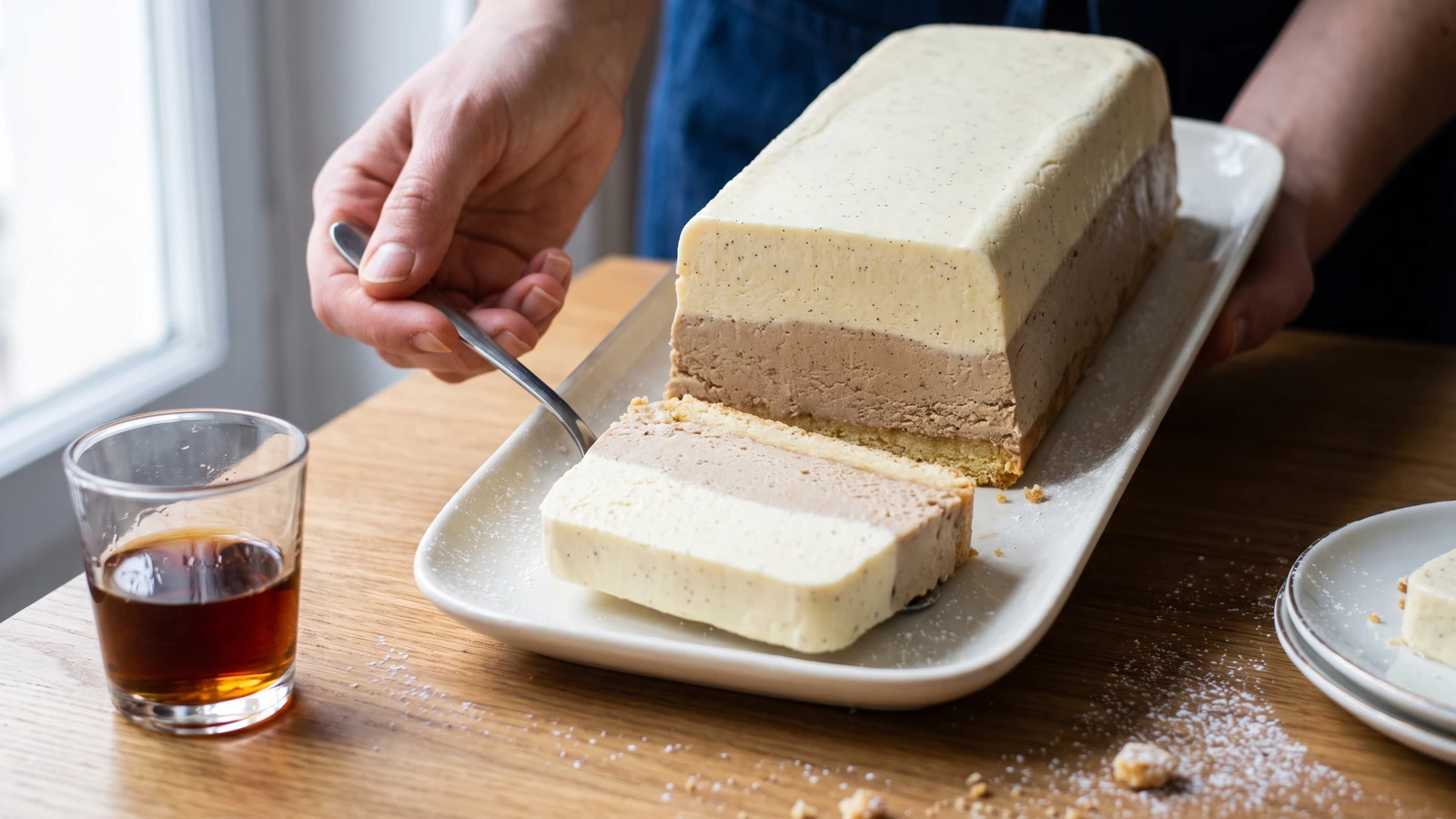
Rum at the base, chestnut through the middle, vanilla on top: this sliceable biscuit glacé rises in three clean layers, a snowy holiday mountain built by patience, a fine sieve, and one honest pâte à bombe.
Biscuit glacé Mont-Blanc (a layered rum, chestnut, and vanilla frozen biscuit) teaches architecture. Three preparations must freeze as one while remaining distinct under the knife. The one true thing to know before touching a pan is this: the chestnut must pass through a fine sieve. Leave its fibers behind and they drag through every slice.
The original entry assumed a pastry brigade with several frozen-biscuit preparations already moving through service and deep molds ready to fill. The home equivalent is one pâte à bombe, one bowl of softly whipped cream, and a loaf tin, divided so the chestnut itself supplies part of the middle layer's volume. Separate brigade batches are scaffolding and can go. The order cannot: rum at the base, chestnut through the middle, vanilla on top, exactly as the dish defines itself. One cook, one stove, one evening's work.
Cut it properly and the rum layer tastes warm despite the cold, the chestnut gives the dessert its dense, earthy heart, and vanilla finishes it in pale ivory. Before the sugar pan goes on, sieve the chestnut until absolutely smooth. That is the step that decides the cut.
Mont-Blanc draws on the chestnut cookery of the Alpine borderlands around Savoy and the Aosta Valley, where puréed chestnuts and cream naturally suggested a snow-covered peak. Parisian pâtisserie carried that image into the grand dessert repertoire, and biscuit glacé turned the mound into a molded frozen entremets with chestnut held between rum and vanilla. Biscuit here does not mean a baked cake; in the classical vocabulary it is an aerated frozen preparation lightened with eggs and cream.
Quantity
6
at room temperature
Quantity
3/4 cup (180 ml / 150 g)
Quantity
1/4 cup (60 ml / 60 g)
Quantity
1 pinch
Quantity
2 cups (480 ml / 480 g)
cold; reserve 2 tablespoons for the chestnut
Quantity
3/4 cup (180 ml / 180 g)
at room temperature
Quantity
2 tablespoons (30 ml / 28 g)
Quantity
1
split and scraped
| Ingredient | Quantity |
|---|---|
| large egg yolksat room temperature | 6 |
| granulated sugar | 3/4 cup (180 ml / 150 g) |
| water | 1/4 cup (60 ml / 60 g) |
| fine sea salt | 1 pinch |
| heavy cream, at least 35% fatcold; reserve 2 tablespoons for the chestnut | 2 cups (480 ml / 480 g) |
| unsweetened chestnut puréeat room temperature | 3/4 cup (180 ml / 180 g) |
| dark rum | 2 tablespoons (30 ml / 28 g) |
| vanilla beansplit and scraped | 1 |
Line a straight-sided 9 x 5-inch (23 x 13 cm) loaf tin with plastic wrap, smoothing it firmly into the corners and leaving enough overhang to lift the dessert out upright. Chill the tin. Stir 1 tablespoon of the reserved cream into the chestnut purée, then force it through a tamis, a very fine sieve, with a flexible scraper. If it bunches against the mesh, add the second reserved tablespoon of cream and warm the bowl briefly over barely warm water. Any unused reserved cream goes into the sieved purée. This step stays: chestnut fibers freeze into cords that catch the serving knife, while a fine purée gives a clean, creamy middle.
Whip the remaining cold cream until it forms soft peaks whose tips bend over. Stop while it still looks smooth and supple. Stiff cream is difficult to fold and leaves the frozen biscuit crumbly rather than close and creamy. Keep it covered in the refrigerator while you make the egg foundation.
Put the yolks and salt in the mixer bowl. Combine the sugar and water in a small heavy saucepan, stir over gentle heat only until the sugar dissolves, then boil without stirring. When the syrup reaches 230°F (110°C), begin whisking the yolks at medium speed. At 244°F (118°C), remove the syrup from the heat and pour it in a thin stream down the inside of the bowl, never directly onto the moving whisk. Increase the speed and beat for 6 to 8 minutes, until the pâte à bombe, the hot-syrup egg-yolk foam, is pale, tripled in volume, and no longer warm. If the syrup crystallizes in the pan, add 1 tablespoon of water, dissolve it gently, and bring it back to temperature.
Weigh the pâte à bombe and divide it among three bowls in a 3:2:3 ratio, labeling them rum, chestnut, and vanilla. Divide the whipped cream by weight in the same ratio. The chestnut portion is deliberately smaller because the purée supplies the missing volume; once flavored, all three preparations will fill roughly equal thirds of the mold. Cover and refrigerate the chestnut and vanilla portions while the rum layer sets.
Stir the dark rum into its portion of pâte à bombe. Fold in one-third of the corresponding whipped cream to loosen it, then fold in the rest with broad strokes, preserving as much air as possible. Spread the rum preparation across the bottom of the chilled mold and level it without pressing. Freeze for 30 to 40 minutes, until the surface is firm under a light fingertip but remains slightly tacky. Rum slows freezing, so give it another 10 minutes if the surface still yields wetly.
Whisk one-third of the chestnut portion of pâte à bombe into the sieved purée until perfectly smooth, then fold in the remaining pâte à bombe and its allotted whipped cream. Spoon or pipe the chestnut preparation gently over the rum base, working from the edges inward so the lower layer isn't disturbed. If the first spoonful sinks, stop, lift away only that spoonful, and freeze the rum layer for another 10 minutes. Ça se rattrape. Level the chestnut and freeze for 30 to 40 minutes, until firm enough to support the final layer.
Stir the scraped vanilla seeds into the final portion of pâte à bombe, then fold in its whipped cream as before. Spread the vanilla preparation over the set chestnut layer, filling the mold to the top and smoothing it cleanly. Fold the plastic overhang loosely above the surface without pressing against it, cover the tin, and freeze for at least 6 hours, preferably overnight.
Let the biscuit glacé stand at room temperature for 5 minutes. Open the plastic wrap and lift the loaf straight from the mold so the rum remains at the base and the vanilla at the top. If it clings, wrap the outside of the tin in a warm damp towel for 5 seconds and try again. Peel away the lining, then cut 8 generous slices with a knife warmed in hot water and wiped completely dry between cuts. Serve at once. À table!
1 serving (about 120g)
Culinary guides, cultural storytelling, and the editorial depth that makes cooking meaningful.
Discover Culinary ExplorerChef Juliette
Five almond preparations, one discipline: remove the skins cleanly, dry every kernel through, then cut, toast, or cloak it in pale caramel without letting its fragrant oils escape.

Chef Juliette
A pastry pantry lesson in one tray: filberts warmed only until their red skins release, rubbed clean, cooled, and chopped into a fragrant mise-en-place for cakes, creams, pralines, and petits fours.

Chef Juliette
The smallest pâtisserie discipline decides whether a cake leaves its mould intact: clarified butter in every corner, followed by the lightest veil of dry flour or fécule.

Chef Juliette
Four whites, one spotless bowl, and a patient change of speed: whisk gently until loosened, then briskly to glossy stiffness, with powdered sugar waiting if the foam begins to granulate.