
Chef Juliette
Coupes d’Antigny
Coupes d’Antigny layers wild strawberry ice, fresh cream, vanilla-poached peach, and spun sugar into one cold lesson in timing: soften the ice carefully, then spin the brittle veil only when the table is ready.
A cooking platform built around craft, culture, and the stories behind what we eat.
Created by Chef Juliette
Based on No. 2820, Iced Biscuit Bénédictine, from Le Guide Culinaire (1907) by Auguste Escoffier
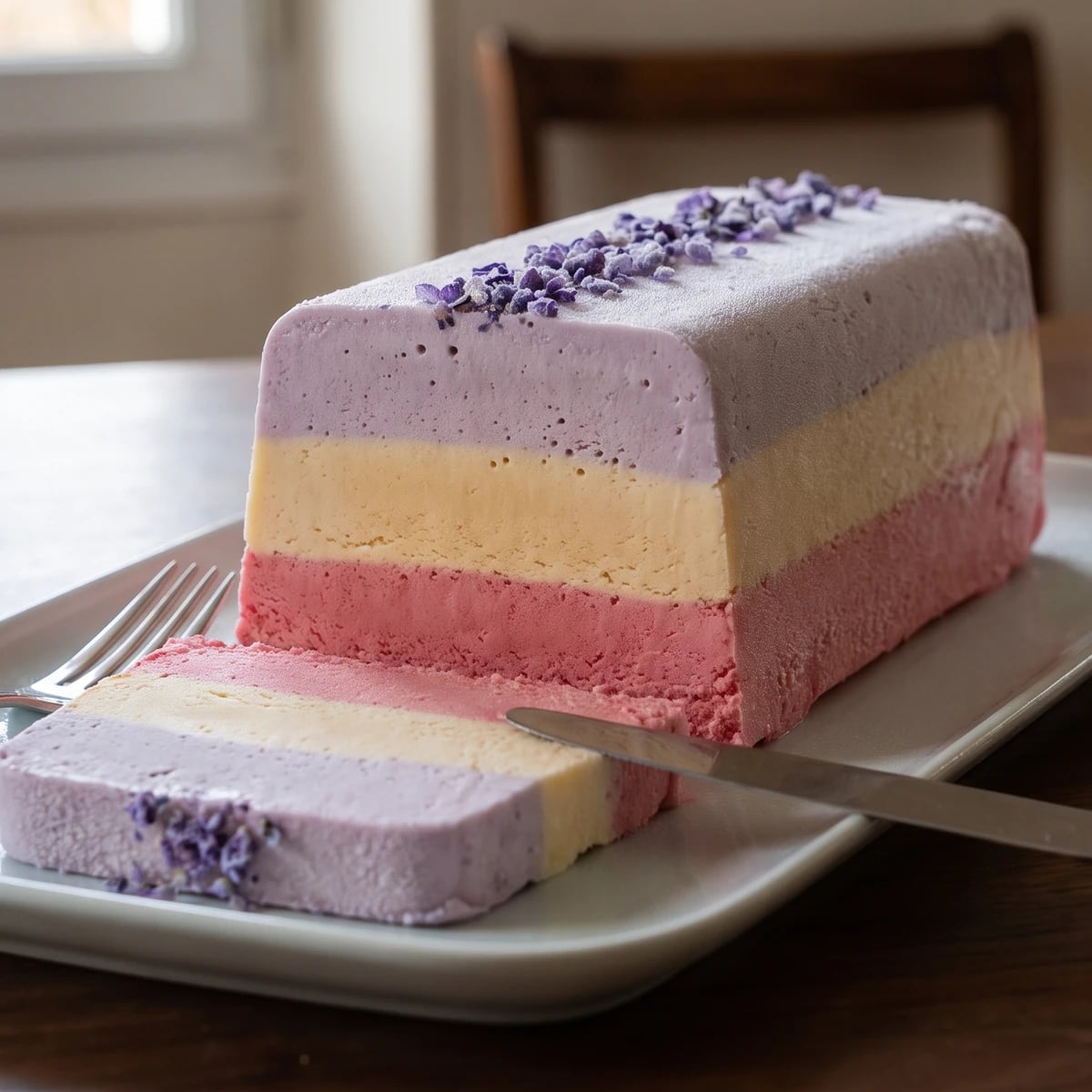
Three flavors, three clean bands, one lesson in patience: strawberry first, amber Bénédictine at the center, violet above, each frozen firm before the next is spread.
Biscuit glacé à la Bénédictine (layered Bénédictine frozen parfait) teaches the discipline of cold: each band must be firm before the next arrives. Strawberry stays rosy below, Bénédictine runs amber-ivory through the middle, and violet sits pale and floral on top. Rush the freezing and you haven't made three layers; you've made a handsome muddle.
The original entry assumed three prepared ices, a long biscuit mold, and a freezing cabinet ready for service. Your honest home equivalent is one pâte à bombe, the hot-syrup yolk foam that gives biscuit glacé its light body, divided and flavored in a lined loaf tin. Making three complete bases was brigade scaffolding, so that goes. The strawberry, Bénédictine, and violet sequence stays, as does the independent freezing of every layer. Those are the dish.
This is one cook, one freezer, one evening, with most of the evening spent elsewhere while the cold does its work. Before adding a new layer, press the one beneath it gently with a fingertip. It must feel firm and leave no mark. That pause decides the whole dessert.
Bénédictine belongs to Fécamp on Normandy's Alabaster Coast, where the amber herbal liqueur became both a digestif and a flavoring for creams, soufflés, and frozen entremets. Biscuit glacé belongs to the classical French family of aerated molded ices, which traveled from formal dining rooms into home kitchens as mechanical freezers replaced salt-and-ice cabinets. Despite its name, biscuit here does not promise a baked cookie; it describes a light frozen composition firm enough to unmold and cut.
Quantity
1⅓ cups (320 ml / 200 g)
hulled and sliced
Quantity
2 tablespoons (30 ml / 25 g)
Quantity
1½ teaspoons (7.5 ml / 7.5 g)
divided
Quantity
1¾ cups (420 ml / 420 g)
well chilled
Quantity
6 (about 108 g)
Quantity
¾ cup (180 ml / 150 g)
Quantity
¼ cup (60 ml / 60 g)
Quantity
⅛ teaspoon (0.6 ml / 0.7 g)
Quantity
3 tablespoons (45 ml / 43 g)
Quantity
2 tablespoons (30 ml / 38 g)
Quantity
1 tablespoon (15 ml / 8 g)
finely crushed and divided
| Ingredient | Quantity |
|---|---|
| ripe strawberrieshulled and sliced | 1⅓ cups (320 ml / 200 g) |
| granulated sugar for the strawberries | 2 tablespoons (30 ml / 25 g) |
| fresh lemon juicedivided | 1½ teaspoons (7.5 ml / 7.5 g) |
| heavy cream, at least 35% fatwell chilled | 1¾ cups (420 ml / 420 g) |
| pasteurized large egg yolks | 6 (about 108 g) |
| granulated sugar for the pâte à bombe | ¾ cup (180 ml / 150 g) |
| water | ¼ cup (60 ml / 60 g) |
| fine sea salt | ⅛ teaspoon (0.6 ml / 0.7 g) |
| Bénédictine liqueur | 3 tablespoons (45 ml / 43 g) |
| violet syrup (sirop de violette) | 2 tablespoons (30 ml / 38 g) |
| crystallized violetsfinely crushed and divided | 1 tablespoon (15 ml / 8 g) |
Line a 9 by 5-inch (23 by 13 cm), 1½-quart (1.5-liter) loaf tin with a smooth parchment sling, leaving enough overhang to lift the biscuit glacé without turning it upside down. If you have food-safe acetate, fit a strip against the short sides for an especially clean finish. Chill the lined tin while you make the three ices.
Combine the strawberries, their 2 tablespoons (30 ml / 25 g) of sugar, and 1 teaspoon (5 ml / 5 g) of the lemon juice in a small saucepan. Simmer for 6 to 8 minutes, crushing the fruit, until glossy and reduced to about ½ cup (120 ml / 125 g). Blend smooth, pass through a fine sieve, and cool completely over an ice bath. Warm purée would collapse the whipped base, so don't hurry this cooling.
Whip the cold cream in a chilled bowl until it holds soft, rounded peaks. Stop while it still looks supple and glossy; stiff cream makes the finished ice feel buttery rather than light. Keep it cold while you prepare the yolks.
Put the yolks in the mixer bowl and begin whisking at medium speed. Heat the ¾ cup (180 ml / 150 g) sugar and ¼ cup (60 ml / 60 g) water without stirring until the syrup reaches 244°F (118°C). With the mixer running, pour the syrup in a thin stream down the inside of the bowl, never onto the moving whisk, then whip at high speed until the pâte à bombe is very pale, thick enough to hold a ribbon, and barely warm, about 6 to 8 minutes. If a few cooked threads appear, pass the mixture through a fine sieve while it is still warm and continue whipping. Ça se rattrape.
Fold one third of the whipped cream into the pâte à bombe to lighten it, then fold in the rest with the salt, turning the bowl until no white streaks remain. Put one quarter of this neutral base into a chilled bowl and fold in the cold strawberry purée. Divide the remaining base equally between two more chilled bowls. Fold the Bénédictine into one. Into the other, fold the violet syrup, the remaining ½ teaspoon (2.5 ml / 2.5 g) lemon juice, and 2 teaspoons (10 ml / about 5 g) of the crushed crystallized violets. Cover the three bowls and keep them cold.
Spread the strawberry mixture evenly across the bottom of the chilled mold, working it into the corners and leveling the surface. Freeze for 60 to 90 minutes, until firm enough that a gentle fingertip leaves no dent. This is the step that matters. If you add the next mixture and see pink beginning to marble upward, lift the new mixture straight back into its bowl, smooth the strawberry layer, and freeze it for another 20 to 30 minutes. Ça se rattrape.
Give the Bénédictine mixture one gentle fold. Spoon it over the firm strawberry layer in small dollops, then join and level them without pressing into the fruit below. Freeze for 90 minutes to 2 hours. Alcohol slows freezing, so judge by touch rather than the clock: the center must feel firm and dry before the violet layer goes on.
Gently fold the violet mixture once, spread it over the firm Bénédictine layer, and level the top. Scatter over the reserved crushed crystallized violets, cover without touching the surface, and freeze for at least 6 hours, preferably overnight, until solid through the center.
Chill a long serving platter. Wrap the outside of the mold briefly in a cloth dampened with warm water, then lift the biscuit glacé out by its parchment sling so the violet layer remains on top. Peel away the lining and leave the dessert at room temperature for 5 minutes. Cut 8 slices with a long knife dipped in hot water and wiped completely dry between cuts. If the first slice cracks, wait another 2 minutes; if it smears, return the loaf to the freezer for 10 minutes. Serve at once. À table!
1 serving (about 125g)
Culinary guides, cultural storytelling, and the editorial depth that makes cooking meaningful.
Discover Culinary Explorer
Chef Juliette
Coupes d’Antigny layers wild strawberry ice, fresh cream, vanilla-poached peach, and spun sugar into one cold lesson in timing: soften the ice carefully, then spin the brittle veil only when the table is ready.

Chef Juliette
Coupes Clo-clo marry vanilla ice, maraschino-soaked marrons glacés, and strawberry Chantilly in a festive glass: cold against cream, cherry perfume against chestnut, softness against a firm piped ridge.

Chef Juliette
Coupes Dame Blanche set a vanilla-poached peach over snowy almond-milk ice, hiding Bar-le-Duc currant jam beneath its dome and circling it with a bright piped cord of lemon ice.

Chef Juliette
Coupes Denise set coffee-dark Moka ice against rum bonbons and softly drooping Chantilly, proving that a composed frozen dessert depends less on ornament than on temperature, proportion, and the confidence to use a spoon.