
Chef Juliette
Various Almond Preparations
Five almond preparations, one discipline: remove the skins cleanly, dry every kernel through, then cut, toast, or cloak it in pale caramel without letting its fragrant oils escape.
A cooking platform built around craft, culture, and the stories behind what we eat.
Created by Chef Juliette
Based on No. 2819, The Moulding of Iced Biscuits, from Le Guide Culinaire (1907) by Auguste Escoffier
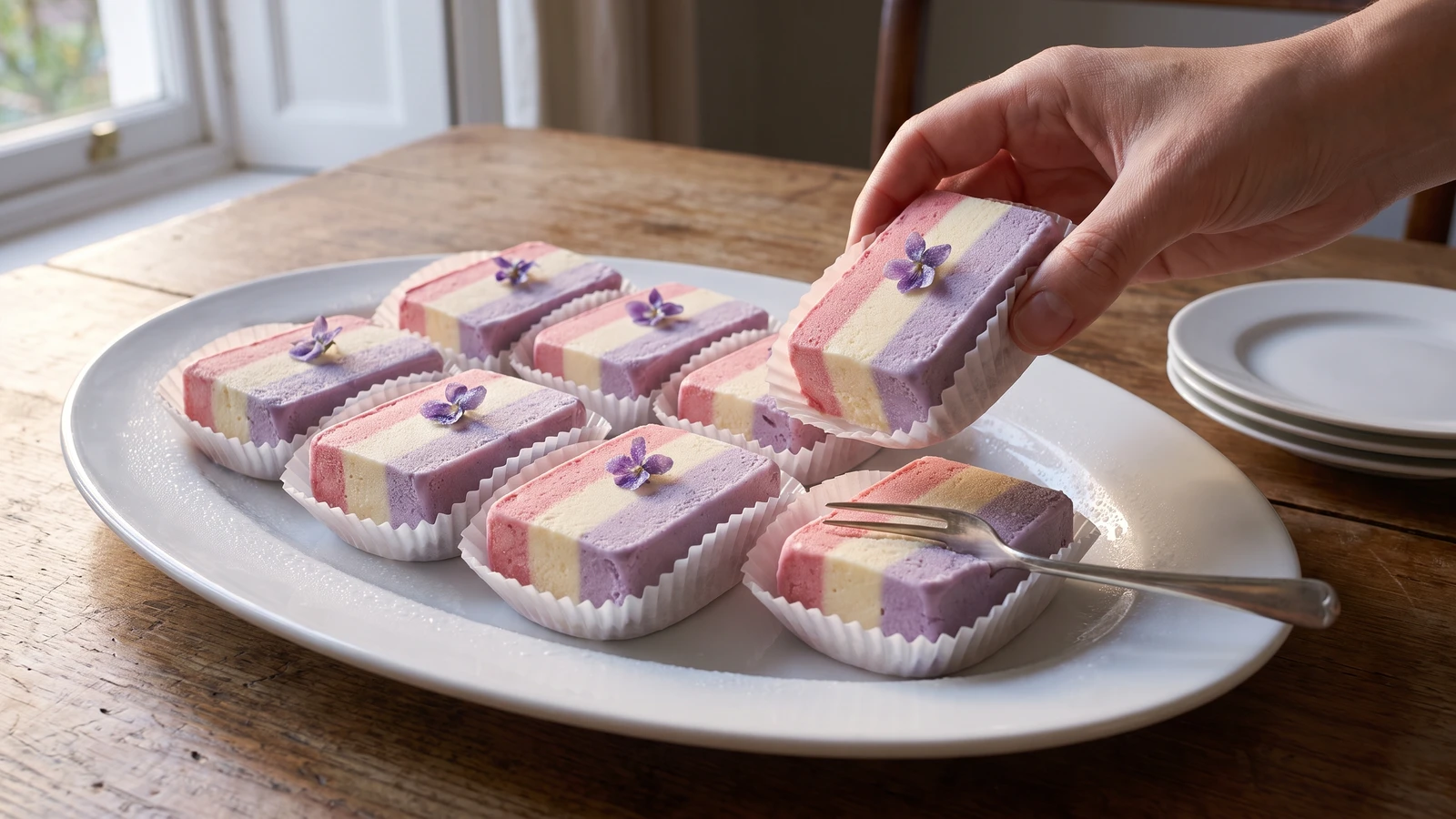
Three bands, strawberry, vanilla, and violet, set in one cold brick and cut so every rectangle wears the pattern: a lesson in controlling texture and timing through one airy frozen cream.
Biscuits glacés moulés teach that temperature makes the pattern. The one true thing to know before you touch a pan is this: the bands remain clean only when every mixture is equally cold and airy, and each laid band is firm before the next arrives. The color is not decoration applied afterward. The color is the moulding.
The original assumes a rectangular brick mould with fitted covers, several bombe preparations ready at once, and a pail packed with freezing ice that hardens the brick in three hours. At home, a metal loaf tin, a flat parchment cover, and the freezer do the same honest work. I make one pâté à bombe (a warm egg-yolk and sugar foam), fold it with real cream, then divide it among strawberry, vanilla, and violet. The domestic freezer gets six hours because it chills more gently. The special mould and ice pail were brigade scaffolding; the colored covers, vanilla center, and vertical cut are the dish. One cook, one stove, one evening.
The finished biscuits should be light rather than icy, with a rose-pink strawberry band, an ivory vanilla center, and a clear violet crown on every cut face. Do not hurry the setting between bands. That short wait is what keeps three flavors from becoming one muddy stripe.
Biscuits glacés belong to the Parisian pâtisserie and grand dining-room tradition of entremets glacés, where frozen preparations were organized as a family of moulds, fillings, and interchangeable bombe mixtures. Despite the name, no biscuit is baked here; biscuit describes the light, egg-rich character of the frozen preparation. The brick form made its ornament through cutting, with differently colored preparations at the two covers and a contrasting center revealed in every vertical slice.
Quantity
1 cup (240 ml / 150 g)
fresh or frozen and thawed
Quantity
2 tablespoons (30 ml / 25 g)
Quantity
2/3 cup (160 ml / 135 g)
Quantity
1/4 cup (60 ml / 60 g)
Quantity
6 large, about 6 tablespoons (90 ml / 100 g)
Quantity
1/8 teaspoon (0.6 ml / 0.8 g)
Quantity
2 cups (480 ml / 475 g)
35 percent fat or richer
Quantity
1 1/2 teaspoons (7.5 ml / 7 g)
Quantity
1 1/2 tablespoons (22 ml / 28 g)
Quantity
1 to 2 drops
use only if the syrup is pale
Quantity
8
| Ingredient | Quantity |
|---|---|
| hulled strawberriesfresh or frozen and thawed | 1 cup (240 ml / 150 g) |
| superfine sugar for the strawberries | 2 tablespoons (30 ml / 25 g) |
| superfine sugar for the syrup | 2/3 cup (160 ml / 135 g) |
| water | 1/4 cup (60 ml / 60 g) |
| large egg yolks | 6 large, about 6 tablespoons (90 ml / 100 g) |
| fine sea salt | 1/8 teaspoon (0.6 ml / 0.8 g) |
| cold heavy cream35 percent fat or richer | 2 cups (480 ml / 475 g) |
| pure vanilla extract or vanilla bean paste | 1 1/2 teaspoons (7.5 ml / 7 g) |
| food-grade violet syrup | 1 1/2 tablespoons (22 ml / 28 g) |
| food-grade violet coloring (optional)use only if the syrup is pale | 1 to 2 drops |
| candied violets (optional) | 8 |
Purée the strawberries and press them through a fine sieve into a small saucepan. Add the 2 tablespoons of sugar and simmer gently, stirring often, until reduced to a thick 1/4 cup (60 ml / about 70 g), 5 to 7 minutes. A spoon drawn across the pan should leave a path for a moment. Cool the reduction completely; warm fruit collapses the cream and blurs the bands. If it reduces to a paste, loosen it with a teaspoon of cold strawberry purée or water. Ça se rattrape.
Line an 8 1/2 by 4 1/2 inch (21.5 by 11.5 cm) metal loaf tin with freezer-safe film, pressing it closely into the corners and leaving enough overhang to lift the brick later. Cut a rectangle of parchment to fit directly against the final surface. Chill the lined tin while you make the bombe.
Whip the cold cream to soft peaks. It should mound and then bend from the whisk, not stand stiff. Hold it in the refrigerator. If you take it too far and it begins to look grainy, fold in a tablespoon of unwhipped cream until it becomes supple again.
Put the 2/3 cup sugar and water in a small heavy saucepan. Heat gently until the sugar dissolves, then boil without stirring to 244°F (118°C). Meanwhile, whisk the yolks and salt until loosened. With the mixer running at medium speed, pour the hot syrup in a thin stream down the inside of the bowl, never directly onto the beaters. Increase the speed and whisk for 6 to 8 minutes, until the mixture is pale, thick enough to fall in a ribbon, and no longer warm.
Fold one-third of the whipped cream into the pâte à bombe to lighten it, then fold in the remainder in two additions, turning the bowl and cutting through the center so the volume stays intact. Transfer about 1 cup (240 ml) of the base to the cold strawberry reduction and fold until evenly rose-pink. Put another 1 cup (240 ml) in a second bowl and fold in the violet syrup, with a drop or two of coloring only if needed. Fold the vanilla into the remaining base. Keep all three mixtures cold.
Spread the strawberry mixture across the bottom of the chilled mould to roughly one-quarter of its depth, smoothing it firmly into every corner. Freeze for 25 to 35 minutes, until the surface resists a light fingertip. Add the vanilla mixture, bringing the mould to about three-quarters full, and freeze again for 35 to 45 minutes. Finish with the violet mixture and level it flush with the rim. If one layer pulls into the next, stop and return the mould to the freezer until the surface firms; dragging through a soft band only makes the muddle worse.
Lay the fitted parchment directly against the violet surface, cover the tin tightly, and freeze on a level shelf for at least 6 hours, preferably overnight. Count the freezing time from the moment the completed brick goes into the freezer. It is ready when the center feels completely rigid under gentle pressure.
Chill a platter and eight paper cases. Lift the brick from the tin by its lining and peel the film away. If it refuses to release, press a towel wrung out in warm water against the outside of the tin for 5 seconds, then try again. Warm a long knife, wipe it completely dry, and cut straight down through all three bands into 8 even rectangles. Wipe and rewarm the knife after every cut so the faces remain clean. If the edges begin to slump, return the brick to the freezer for 15 minutes before continuing.
Place each rectangle in a paper case with its striped cut face clearly visible. Top with a candied violet if using, then return the biscuits to the freezer until needed. Move them to the refrigerator for 8 to 10 minutes before serving, just long enough for the spoon to enter without the bands losing their shape. À table!
1 serving (about 118g)
Culinary guides, cultural storytelling, and the editorial depth that makes cooking meaningful.
Discover Culinary ExplorerChef Juliette
Five almond preparations, one discipline: remove the skins cleanly, dry every kernel through, then cut, toast, or cloak it in pale caramel without letting its fragrant oils escape.

Chef Juliette
A pastry pantry lesson in one tray: filberts warmed only until their red skins release, rubbed clean, cooled, and chopped into a fragrant mise-en-place for cakes, creams, pralines, and petits fours.

Chef Juliette
The smallest pâtisserie discipline decides whether a cake leaves its mould intact: clarified butter in every corner, followed by the lightest veil of dry flour or fécule.

Chef Juliette
Four whites, one spotless bowl, and a patient change of speed: whisk gently until loosened, then briskly to glossy stiffness, with powdered sugar waiting if the foam begins to granulate.