
Chef Juliette
Coupes d’Antigny
Coupes d’Antigny layers wild strawberry ice, fresh cream, vanilla-poached peach, and spun sugar into one cold lesson in timing: soften the ice carefully, then spin the brittle veil only when the table is ready.
A cooking platform built around craft, culture, and the stories behind what we eat.
Created by Chef Juliette
Based on No. 2817, Various Preparations, from Le Guide Culinaire (1907) by Auguste Escoffier
Crème anglaise whisked cold and folded with softly whipped cream makes a biscuit glacé of quiet richness, a moulded frozen dessert poised close to both bombe glacée and the family of Mousses.
Biscuit glacé à la crème fouettée (iced biscuit with whipped cream) teaches one decisive principle: a cooked custard can carry air only after it is completely cold. Fold cream into a warm crème anglaise and the cream melts, the bubbles collapse, and the frozen result sits heavy on the spoon. Cold custard, soft cream, a light hand. C'est la même grammaire as a bombe or cold Mousses.
The source formula assumed a large basin, someone available to fan the custard as it cooled, and salted ice waiting beneath it. This home version is exactly one quarter of that formula: three yolks instead of twelve, with the sugar, milk, and measured whipped cream reduced in the same proportion. An ice bath replaces the fanning, an electric whisk replaces the brigade's arm, and a household freezer replaces the packed-ice mould. Those are scaffolding changes. Cooking the crème anglaise properly, whisking it cold, folding in the cream, and freezing it without churning are the dish and must stay.
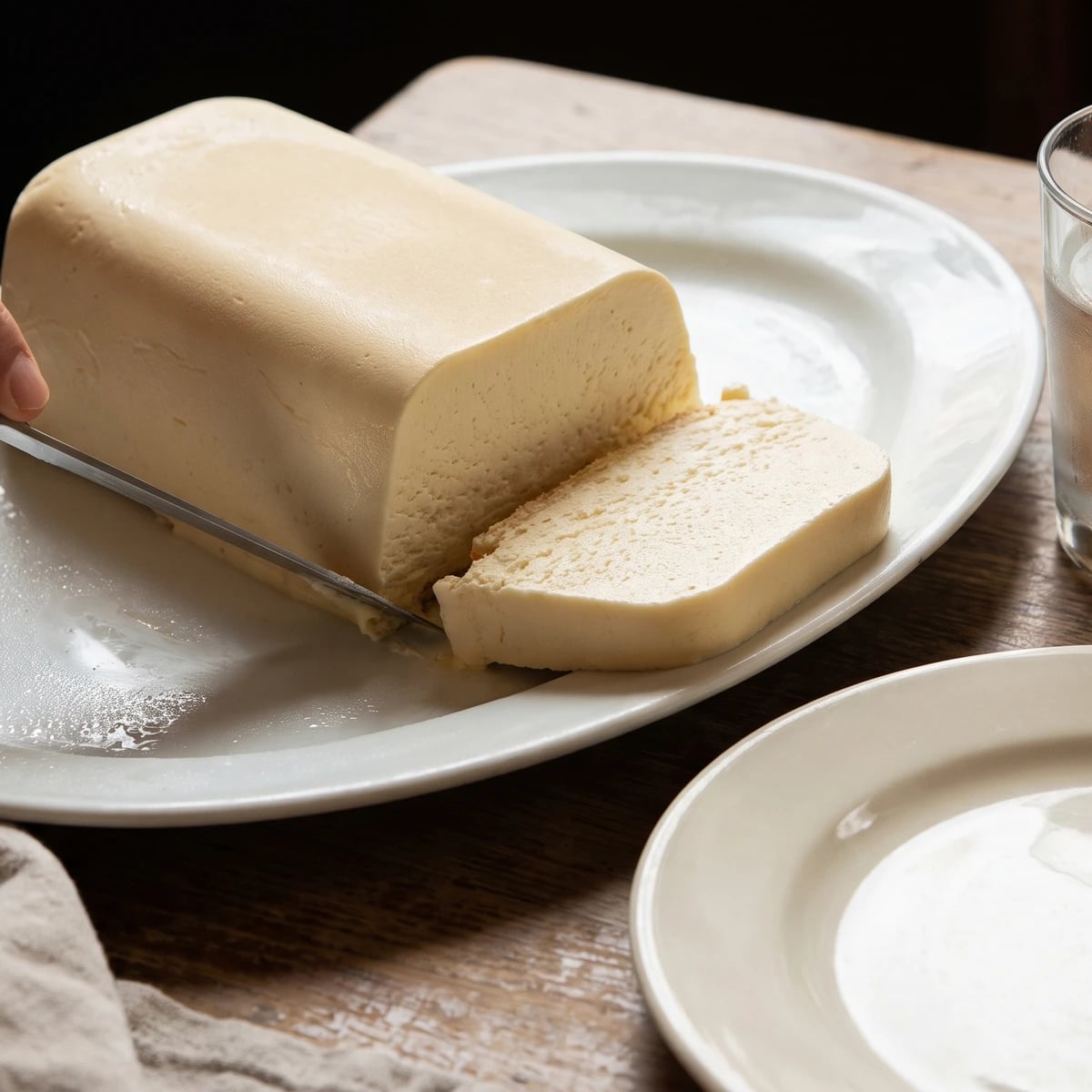
The finished biscuit glacé is pale ivory, finely aerated, and rich without becoming dense, with a clean slice that begins to soften at the plate. One cook, one stove, one evening, followed by a patient night in the freezer. The deciding step is to cool the crème anglaise completely before the cream meets it.
Biscuit glacé belongs to the Parisian repertoire of entremets glacés, where confectioners froze rich custards in lidded moulds packed with salted ice. Despite the name, no baked biscuit is involved: the preparation began as crème anglaise cooled and whisked over ice before being moulded. Folding in whipped cream brought it closer to the bombe and to Mousses, which share the principle of a lightened mixture set in a mould for several people.
Quantity
½ cup plus 1 tbsp (135 ml / 113 g)
Quantity
3 yolks (about 3 tbsp / 50 g)
Quantity
½ cup plus 1½ tbsp (142 ml / 146 g)
Quantity
⅔ cup (160 ml / 160 g)
reserve 1 tbsp, then whip the remainder to soft peaks measuring about 1¼ cups (285 ml)
| Ingredient | Quantity |
|---|---|
| granulated sugar | ½ cup plus 1 tbsp (135 ml / 113 g) |
| large egg yolks | 3 yolks (about 3 tbsp / 50 g) |
| whole milk | ½ cup plus 1½ tbsp (142 ml / 146 g) |
| cold heavy cream, 35% fatreserve 1 tbsp, then whip the remainder to soft peaks measuring about 1¼ cups (285 ml) | ⅔ cup (160 ml / 160 g) |
Set a 600 ml metal mould in the freezer. Fill a large bowl one-third full with ice and cold water, then nest a clean metal bowl inside without letting water spill over its rim. Have the sieve ready above it. Cooling begins the moment the custard leaves the heat, so arrange this before you touch the yolks.
Warm the milk in a small heavy saucepan until bubbles gather around the edge. Whisk the yolks and sugar together immediately until smooth, then pour in the milk gradually while whisking. Return everything to the saucepan and cook over low heat, stirring continuously into every corner, until the crème anglaise reaches 82 to 84°C and coats the back of a spoon. Draw a finger through the coating; the line should remain clean. Never let it boil. If the first fine grains appear, pull the pan from the heat, set its base in the ice bath, and whisk hard before straining. Ça se rattrape. Distinct scrambled curds have gone too far, and that custard must be remade.
Strain the crème anglaise immediately into the bowl over ice. Stir until it is cold throughout and has thickened slightly, about 10 minutes, scraping the sides often so no warm pockets remain. Chill it for another 20 minutes if necessary, then whisk the cold custard for 2 to 3 minutes until paler and a little lighter. This stirring and whisking perform the work once done by fanning the basin over ice.
Reserve 1 tablespoon of the measured cold cream. Whip the remainder in a cold bowl until it forms soft peaks that bend at their tips, yielding about 1¼ cups. Stop there. Stiff cream folds badly and leaves buttery grains in the biscuit glacé. If you carry it a little too far, add the reserved liquid cream and fold gently by hand until the texture smooths.
Whisk one-quarter of the whipped cream into the cold crème anglaise to lighten it. Add the remaining cream in two portions, folding from the bottom of the bowl and turning the bowl as you work. Stop as soon as no white streaks remain. Pour the mixture into the chilled mould, tap it once against a folded towel to settle any large air pockets, level the top, and cover it closely. Do not churn it later; the folded cream supplies the lightness this preparation requires.
Freeze in the coldest part of the freezer for at least 6 hours, preferably overnight, until firm through the centre. To unmould, dip the outside of the mould in warm water for 5 to 8 seconds, wipe it dry, and invert it onto a chilled platter. If it holds, repeat for only 3 seconds; patience, not force. Cut with a knife dipped in warm water and wiped dry between slices. Serve at once. À table!
1 serving (about 77g)
Culinary guides, cultural storytelling, and the editorial depth that makes cooking meaningful.
Discover Culinary Explorer
Chef Juliette
Coupes d’Antigny layers wild strawberry ice, fresh cream, vanilla-poached peach, and spun sugar into one cold lesson in timing: soften the ice carefully, then spin the brittle veil only when the table is ready.

Chef Juliette
Coupes Clo-clo marry vanilla ice, maraschino-soaked marrons glacés, and strawberry Chantilly in a festive glass: cold against cream, cherry perfume against chestnut, softness against a firm piped ridge.

Chef Juliette
Coupes Dame Blanche set a vanilla-poached peach over snowy almond-milk ice, hiding Bar-le-Duc currant jam beneath its dome and circling it with a bright piped cord of lemon ice.

Chef Juliette
Coupes Denise set coffee-dark Moka ice against rum bonbons and softly drooping Chantilly, proving that a composed frozen dessert depends less on ornament than on temperature, proportion, and the confidence to use a spoon.