
Chef Juliette
Various Almond Preparations
Five almond preparations, one discipline: remove the skins cleanly, dry every kernel through, then cut, toast, or cloak it in pale caramel without letting its fragrant oils escape.
A cooking platform built around craft, culture, and the stories behind what we eat.
Created by Chef Juliette
Based on No. 2816, Light Ices, from Le Guide Culinaire (1907) by Auguste Escoffier
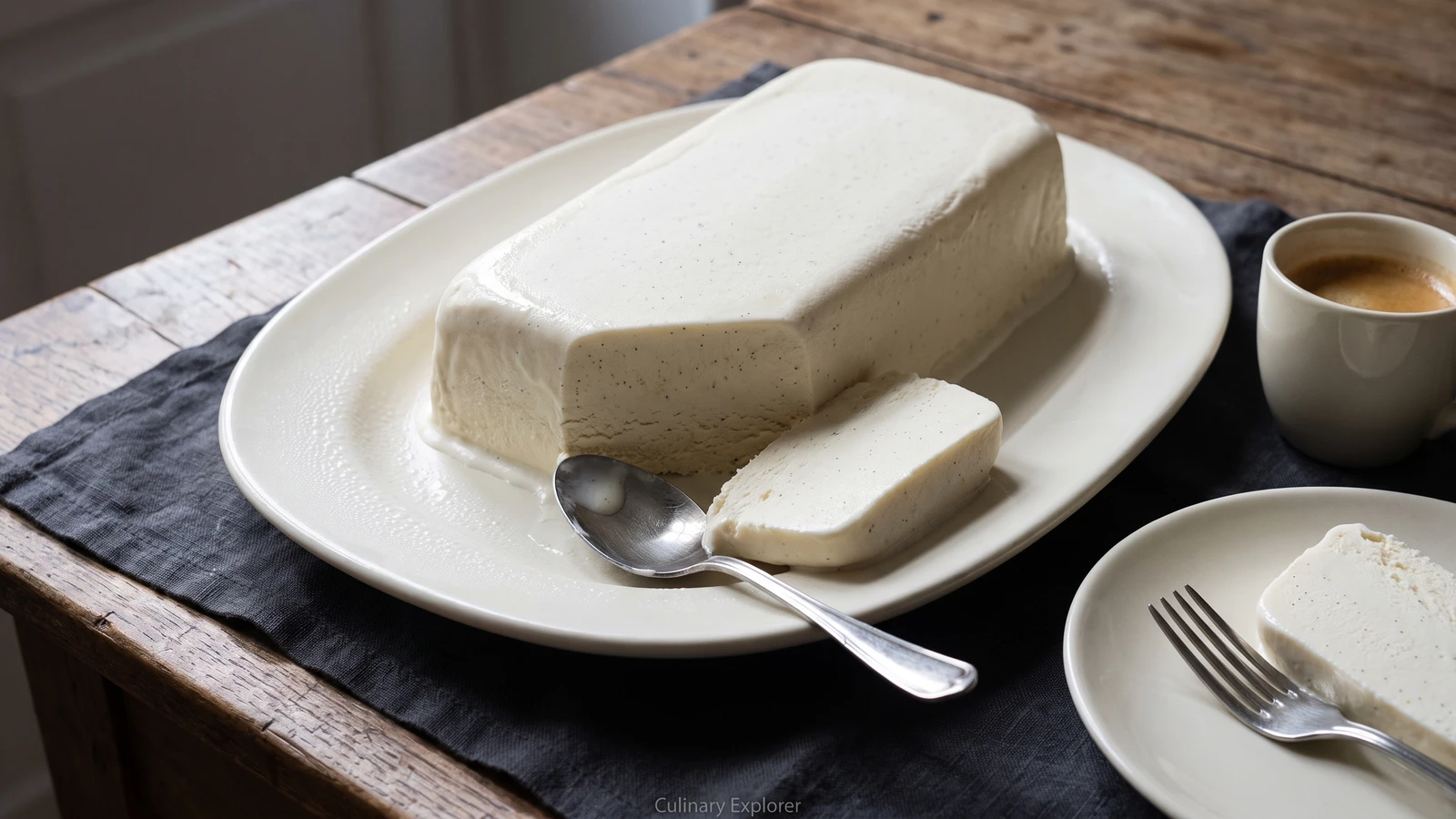
Glaces légères take one well-aerated pâte à bombe, softly whipped cream, and an undisturbed freeze, then turn a simple loaf tin into the honest home mould for a silken no-churn dessert.
Glaces légères teach one clean rule: air is the structure, and cold merely holds it. The pâte à bombe, yolks aerated with hot sugar syrup, must reach a broad ribbon before the softly whipped cream is folded through it. Flatten that air and the freezer can only preserve heaviness.
The source names a family rather than a single flavour formula: iced biscuits, bombes, mousses, parfaits, puddings, and iced soufflés. It is clear that no special freezing utensil is required. Grand service surrounded the simple method with a cupboard of named moulds and portions for a roomful; at home, one lined loaf tin makes six generous slices, and a domestic freezer replaces both the mould cupboard and cold room. Those presentation differences are brigade scaffolding and may go. The aerated base and direct, undisturbed freeze are the dish. Because the entry supplies no fixed flavour or ratio, vanilla is the honest master version: it brings perfume without extra liquid that would distort the freeze. One cook, one stove, one evening of work, then the freezer keeps watch.
The step that decides everything is the fold. Whip the pâte à bombe until the bowl no longer feels warm, keep the cream soft rather than stiff, and bring them together without knocking out the volume you worked to build.
Glaces légères belong to Parisian classical service and the broader French dessert table, where bombes, parfaits, puddings, iced biscuits, iced soufflés, and mousses were moulded for several guests and frozen without churning. Their names often describe shape and presentation more than a strict difference of composition, which is why the source treats them as close relations; its glossary places Mousses within the wider family of sweet or savoury preparations moulded in quantity. A domestic freezer and small loaf tin preserve the method while replacing the cold room and cupboard of presentation moulds.
Quantity
1¼ cups (300 ml / 300 g)
very cold
Quantity
2 tablespoons (30 ml / 30 g)
very cold, for rescuing overwhipped cream
Quantity
4 (about ¼ cup / 60 ml / 68 g)
at room temperature
Quantity
½ cup (120 ml / 100 g)
Quantity
3 tablespoons (45 ml / 45 g)
Quantity
1
split lengthwise and seeds scraped
Quantity
⅛ teaspoon (0.6 ml / 0.75 g)
| Ingredient | Quantity |
|---|---|
| heavy creamvery cold | 1¼ cups (300 ml / 300 g) |
| heavy cream (optional)very cold, for rescuing overwhipped cream | 2 tablespoons (30 ml / 30 g) |
| large egg yolksat room temperature | 4 (about ¼ cup / 60 ml / 68 g) |
| granulated sugar | ½ cup (120 ml / 100 g) |
| water | 3 tablespoons (45 ml / 45 g) |
| vanilla beansplit lengthwise and seeds scraped | 1 |
| fine sea salt | ⅛ teaspoon (0.6 ml / 0.75 g) |
Line an 8½ by 4½ inch (21 by 11 cm) metal loaf tin with two crossed sheets of food-safe plastic wrap, leaving enough overhang to cover the surface. Smooth the lining against the corners and clear a level space in a freezer set to 0°F (-18°C) or colder. The loaf tin replaces an ornamental ice mould without changing the direct-freezing method.
Whip the 1¼ cups (300 ml / 300 g) cold cream until it forms soft peaks that curl over at their tips. Stop before it becomes stiff or grainy, because supple cream folds into the pâte à bombe without crushing its air. If it does turn grainy, don't discard it. Ça se rattrape: add the optional cold cream a teaspoon at a time and fold gently until the texture becomes smooth and soft again. Keep the whipped cream cold while you make the syrup.
Put the sugar, water, vanilla seeds, and scraped pod in a small heavy saucepan. Warm gently, stirring only until the sugar dissolves, then bring it to a steady boil without further stirring. Cook until the syrup reaches 244°F (118°C), the firm end of the soft-ball stage. If crystals begin forming around the pan wall, cover the pan for 30 seconds so condensation washes them down, or brush the sides with a clean brush dipped in water. Do not scrape crystals back into the syrup. Remove the vanilla pod when the syrup reaches temperature.
Begin whisking the yolks and salt at medium speed until they are blended and slightly thickened. With the mixer running, pour the hot syrup into the yolks in a hair-thin stream between the whisk and the bowl wall, never directly onto the moving whisk. Continue beating at high speed for 5 to 7 minutes, until the pâte à bombe is pale, voluminous, cool beneath your palm, and falls from the whisk in a broad ribbon that rests briefly on the surface. If a little syrup hardens against the bowl wall, leave it there rather than scraping brittle sugar into the smooth base; the pâte à bombe itself is still sound.
Fold one-third of the whipped cream into the pâte à bombe to loosen it, turning the bowl as the spatula cuts down through the centre and lifts from underneath. Add the remaining cream in two portions and fold only until the last white streak disappears. Work gently but decisively. Lingering over the bowl deflates the air, and that air is what keeps a directly frozen ice light rather than hard.
Transfer the mixture immediately to the lined tin, pressing it lightly into the corners without packing it down. Smooth the surface, fold the plastic wrap over it, and freeze on the level shelf for at least 8 hours, preferably overnight. Do not stir or churn it during freezing. Direct moulding is the defining method of these glaces légères, not a step omitted for convenience.
Chill the serving platter and plates. Uncover the tin, invert it onto the platter, and lift away the wrap. If the glace resists, wrap the outside of the tin in a warm damp towel for 5 seconds and try again; if the edges soften before the centre releases, return everything to the freezer for 15 minutes. Let the unmoulded glace stand for 5 minutes, then slice it with a knife dipped in hot water and wiped dry between cuts. Serve while the slices hold their clean shape but yield easily to a spoon. À table!
1 serving (about 90g)
Culinary guides, cultural storytelling, and the editorial depth that makes cooking meaningful.
Discover Culinary ExplorerChef Juliette
Five almond preparations, one discipline: remove the skins cleanly, dry every kernel through, then cut, toast, or cloak it in pale caramel without letting its fragrant oils escape.

Chef Juliette
A pastry pantry lesson in one tray: filberts warmed only until their red skins release, rubbed clean, cooled, and chopped into a fragrant mise-en-place for cakes, creams, pralines, and petits fours.

Chef Juliette
The smallest pâtisserie discipline decides whether a cake leaves its mould intact: clarified butter in every corner, followed by the lightest veil of dry flour or fécule.

Chef Juliette
Four whites, one spotless bowl, and a patient change of speed: whisk gently until loosened, then briskly to glossy stiffness, with powdered sugar waiting if the foam begins to granulate.