
Chef Juliette
Coupes d’Antigny
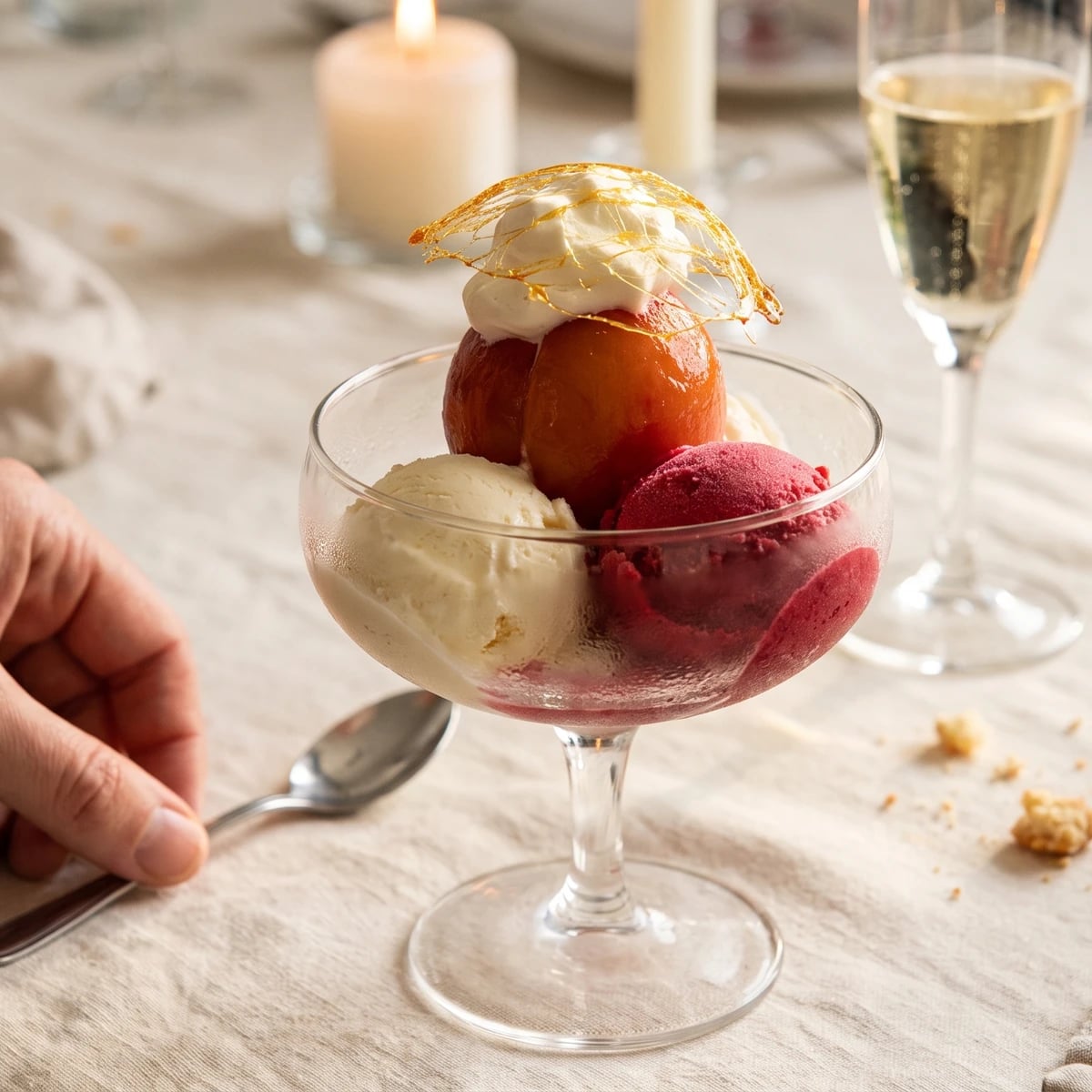
Coupes d’Antigny layers wild strawberry ice, fresh cream, vanilla-poached peach, and spun sugar into one cold lesson in timing: soften the ice carefully, then spin the brittle veil only when the table is ready.
A cooking platform built around craft, culture, and the stories behind what we eat.
Created by Chef Juliette
Based on No. 2810, Coupes Mireille, from Le Guide Culinaire (1907) by Auguste Escoffier
Vanilla and tart red-currant cream ices meet around a syrup-poached nectarine filled with rare Bar-le-Duc white-currant jam, then Chantilly and a fine spun-sugar veil make the celebration unmistakable.
Coupes Mireille (vanilla and red-currant cream ices with a jam-filled poached nectarine) teaches that an assembled dessert succeeds by contrast and order. Pale vanilla against tart garnet fruit, cold cream against tender nectarine, soft Chantilly under crisp sugar. Before you touch a pan, stone the nectarines. Once syrup has softened them, asking them to surrender their pits is how you make compote by accident.
The original formula assumed a pâtissier's station already holding two finished ices, poached fruit, Chantilly, and spun sugar for service. At home, buy a very good vanilla ice cream, make the red-currant glace, poach four nectarines, and spin four small veils with two forks. The purchased vanilla is brigade scaffolding we can dismiss. The divided ices, vanilla-poached fruit, white-currant heart, Chantilly, and sugar veil are the dish, so each remains. One cook, one stove, one evening.
Keep every component fully cold before assembly and work quickly once the scoops enter the coupes. The step that matters most still comes before the heat begins: stone the fruit while it is firm.
Coupes Mireille belongs to the Parisian grand dining-room tradition of named ice desserts, where several prepared elements were assembled in a glass coupe at the moment of service. Mireille is a Provençal name celebrated in poetry and opera, but the formula is not a Provençal regional sweet; its technique and composition belong to the cosmopolitan French dessert repertory. Its precise geographic anchor is Bar-le-Duc in Lorraine, where white currants are traditionally seeded berry by berry before becoming a pale, translucent preserve worthy of hiding inside the nectarine.
Quantity
2 cups (475 ml / 250 g)
stemmed and thawed if frozen
Quantity
⅔ cup (160 ml / 135 g)
Quantity
2 tablespoons (30 ml / 30 g)
Quantity
1 cup (240 ml / 240 g)
Quantity
⅛ teaspoon (0.6 ml / 0.7 g)
Quantity
4 medium
Quantity
2½ cups (600 ml / 600 g)
Quantity
1½ cups (360 ml / 300 g)
Quantity
1
split lengthwise and scraped
Quantity
2 cups (475 ml / 400 g)
Quantity
¼ cup (60 ml / 80 g)
Quantity
¾ cup (180 ml / 180 g)
Quantity
2 tablespoons (30 ml / 15 g)
Quantity
½ teaspoon (2.5 ml / 2 g)
Quantity
¾ cup (180 ml / 150 g)
Quantity
¼ cup plus 2 tablespoons if needed (60 ml plus 30 ml / 60 g plus 30 g)
Quantity
½ teaspoon (2.5 ml / 2 g)
| Ingredient | Quantity |
|---|---|
| fresh or frozen red currantsstemmed and thawed if frozen | 2 cups (475 ml / 250 g) |
| granulated sugar, for the red-currant cream ice | ⅔ cup (160 ml / 135 g) |
| water, for the red-currant cream ice | 2 tablespoons (30 ml / 30 g) |
| cold heavy cream, for the red-currant cream ice | 1 cup (240 ml / 240 g) |
| fine sea salt | ⅛ teaspoon (0.6 ml / 0.7 g) |
| firm-ripe freestone nectarines | 4 medium |
| water, for poaching | 2½ cups (600 ml / 600 g) |
| granulated sugar, for poaching | 1½ cups (360 ml / 300 g) |
| vanilla beansplit lengthwise and scraped | 1 |
| good vanilla ice cream | 2 cups (475 ml / 400 g) |
| Bar-le-Duc white-currant jam | ¼ cup (60 ml / 80 g) |
| cold heavy cream, for the Chantilly | ¾ cup (180 ml / 180 g) |
| confectioners' sugar | 2 tablespoons (30 ml / 15 g) |
| pure vanilla extract | ½ teaspoon (2.5 ml / 2 g) |
| granulated sugar, for the spun sugar | ¾ cup (180 ml / 150 g) |
| water, for the spun sugar | ¼ cup plus 2 tablespoons if needed (60 ml plus 30 ml / 60 g plus 30 g) |
| neutral oil, for the sugar-spinning supports | ½ teaspoon (2.5 ml / 2 g) |
Combine the red currants, ⅔ cup sugar, and 2 tablespoons water in a saucepan. Bring them to a gentle simmer and cook for 4 to 5 minutes, just until the berries burst and the sugar dissolves. Blend briefly, then press the purée through a fine sieve without grinding the seeds against the mesh. Cool it completely over an ice bath before stirring in the 1 cup cold cream and the salt. The cream goes into cold fruit, not hot acid. If the mixture looks grainy, chill it, blend it briefly, and strain once more. Ça se rattrape.
Churn the glace aux groseilles à la crème, the red-currant cream ice, until it mounds softly and holds the trail of the paddle, usually 20 to 25 minutes. Pack it into a shallow chilled container, press parchment against the surface, and freeze for about 2 hours. Without a machine, freeze it in a shallow metal pan and whisk vigorously every 30 minutes four times before letting it firm. The texture will be a little less fine, but the fruit and cream remain true. If the glace freezes too hard, let it stand in the refrigerator for 15 minutes before scooping rather than hacking at it on the counter.
Peel the nectarines, halve each one neatly along its seam, and remove the stones while the flesh is still firm. Keep the matching halves together. Combine the 2½ cups water, 1½ cups sugar, vanilla pod, and vanilla seeds in a wide saucepan, then simmer for 5 minutes. Lower in the nectarine halves, cover them with a round of parchment, and poach at the barest tremble for 6 to 10 minutes. They are ready when a fine skewer enters without force but the edges still hold their shape. If the syrup boils and a fruit begins to slump, take the pan off the heat immediately and let the remaining halves finish in the cooling syrup. Lift the fruit carefully into a shallow dish, strain the syrup over it, and chill for at least 1 hour.
Chill four glass coupes. Reserve 2 tablespoons of the Chantilly cream, then whip the remainder with the confectioners' sugar and vanilla extract until it holds clean, soft ridges firm enough to pipe. Stop there. Chantilly should look generous and silken, not stiff. If it turns grainy, fold in the reserved liquid cream a teaspoon at a time until smooth again.
Line the sink or work surface with parchment and set two wooden spoon handles 6 inches apart over it, brushing the handles very lightly with neutral oil. Put the ¾ cup sugar and ¼ cup water in a small clean saucepan. Stir over low heat only until the sugar dissolves, then stop stirring and cook to a pale amber, about 311°F to 320°F (155°C to 160°C). Let the syrup stand briefly until a fork lifted from it draws a fine thread. Dip two forks held back-to-back into the caramel and flick quick strands across the handles, then gather the cooled threads into four loose veils. Hot caramel burns fiercely, so use dry tools and never touch a strand until it has hardened. If crystals seize the syrup before it colors, add the reserved 2 tablespoons water, dissolve it gently, and begin again. If humidity softens the veils, remelt the caramel and spin them immediately before serving.
Drain the cold nectarine halves and blot them gently. Spoon 1 tablespoon of Bar-le-Duc white-currant jam into each stone cavity, then reunite each pair of halves. In every chilled coupe, set a generous scoop of vanilla ice cream on one side and a matching scoop of red-currant glace on the other, preserving the original half-and-half arrangement. Place one filled nectarine in the middle, pipe or spoon Chantilly around its base, and drape a spun-sugar veil over the top at the last possible moment. Serve at once. À table!
1 serving (about 520g)
Culinary guides, cultural storytelling, and the editorial depth that makes cooking meaningful.
Discover Culinary Explorer
Chef Juliette
Coupes d’Antigny layers wild strawberry ice, fresh cream, vanilla-poached peach, and spun sugar into one cold lesson in timing: soften the ice carefully, then spin the brittle veil only when the table is ready.

Chef Juliette
Coupes Clo-clo marry vanilla ice, maraschino-soaked marrons glacés, and strawberry Chantilly in a festive glass: cold against cream, cherry perfume against chestnut, softness against a firm piped ridge.

Chef Juliette
Coupes Dame Blanche set a vanilla-poached peach over snowy almond-milk ice, hiding Bar-le-Duc currant jam beneath its dome and circling it with a bright piped cord of lemon ice.

Chef Juliette
Coupes Denise set coffee-dark Moka ice against rum bonbons and softly drooping Chantilly, proving that a composed frozen dessert depends less on ornament than on temperature, proportion, and the confidence to use a spoon.