
Chef Juliette
Various Almond Preparations
Five almond preparations, one discipline: remove the skins cleanly, dry every kernel through, then cut, toast, or cloak it in pale caramel without letting its fragrant oils escape.
A cooking platform built around craft, culture, and the stories behind what we eat.
Created by Chef Juliette
Based on No. 2807, Coupes Jacques, from Le Guide Culinaire (1907) by Auguste Escoffier
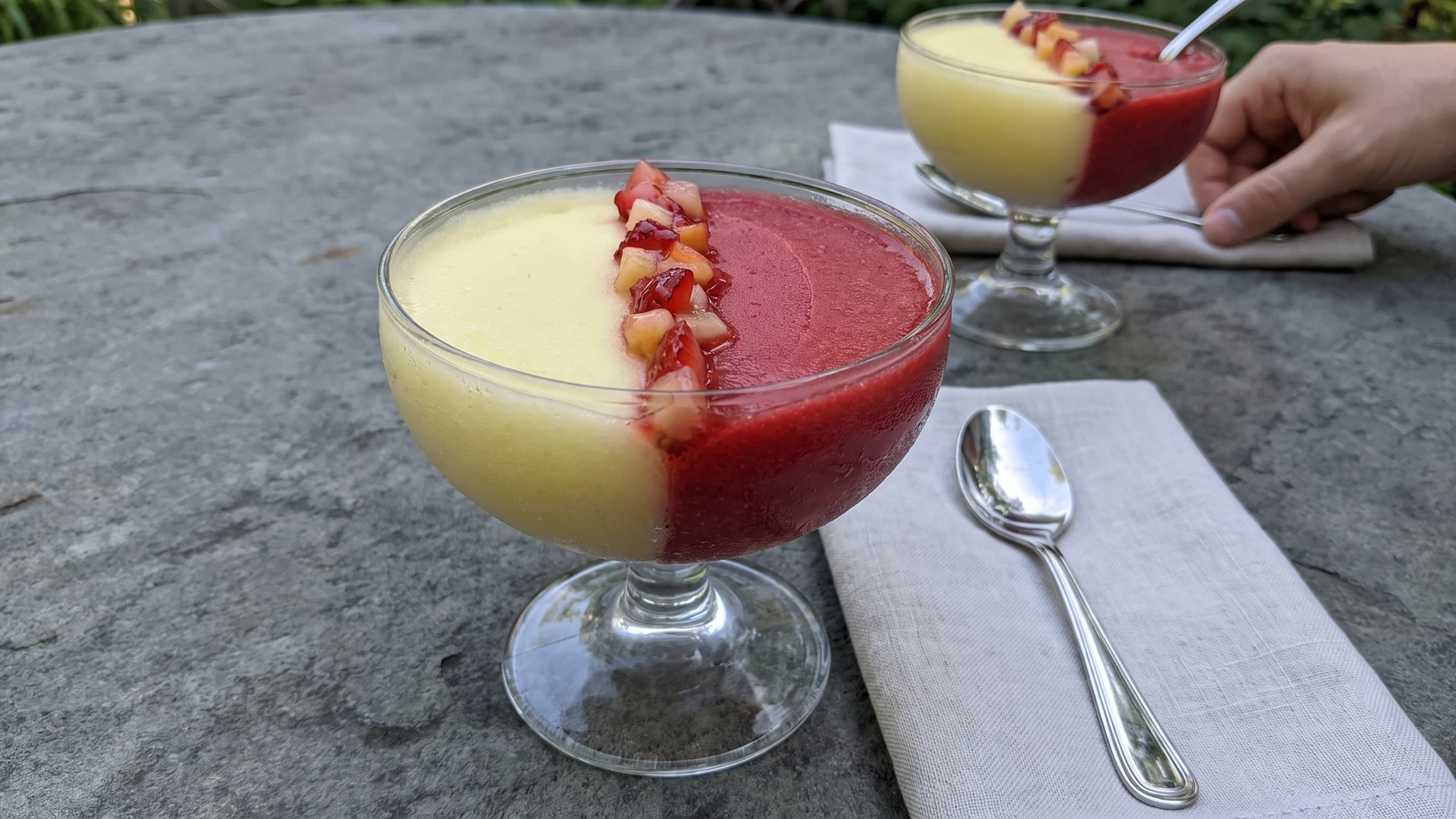
Coupes Jacques set tart lemon ice against ripe strawberry ice, then mark the clean divide with kirsch-soaked fruit macédoine: a cold dessert whose elegance depends on equal texture and an exact little dice.
Coupes Jacques (lemon and strawberry ice coupes) teach a cold dessert's central principle: temperature is structure. The lemon ice and strawberry ice must reach the glass at the same claylike firmness, or their clean vertical halves slump into one another. The fruit macédoine must be cut small and even, so every spoonful carries strawberry, peach, and pear.
The original entry assumed an ice station holding two finished ices at identical serving texture, with enough hands to assemble every coupe to order. That repeated holding and service are brigade scaffolding, so they can go. Two shallow pans and a food processor replace the sorbetières, and the quantities become enough for four glasses. What stays is the dish itself: half lemon, half strawberry, with one tablespoonful of kirsch-macerated macédoine along the seam. One cook, one stove, one evening.
When it lands correctly, the coupe is pale lemon on one side, vivid strawberry on the other, with bright little fruit dice marking their meeting place. Before you build the first glass, match the firmness of the two ices. That single check decides the dish.
Coupes Jacques belongs to the Parisian grand-hotel repertory of composed ices, where a coupe meant an arranged frozen dessert in a stemmed glass rather than a single scoop. Its precise namesake is not securely attached to the dish, but the classical formula is unambiguous: lemon and strawberry ices divided vertically, with fresh-fruit macédoine macerated in kirsch between them. Whipped cream, meringue, and sundae trimmings belong elsewhere; the measured contrast of fruit, acidity, colour, and cold is the whole composition.
Quantity
⅔ cup (160 ml / 160 g)
Quantity
½ cup (120 ml / 100 g)
Quantity
½ cup (120 ml / 120 g)
finely strained
Quantity
2 cups (475 ml / 285 g)
hulled and quartered
Quantity
⅓ cup (80 ml / 65 g)
Quantity
2 tablespoons (30 ml / 30 g)
Quantity
2 tablespoons (30 ml / 20 g)
cut into 5 mm dice
Quantity
2 tablespoons (30 ml / 20 g)
peeled and cut into 5 mm dice
Quantity
2 tablespoons (30 ml / 20 g)
peeled and cut into 5 mm dice
Quantity
2 tablespoons (30 ml / 28 g)
| Ingredient | Quantity |
|---|---|
| filtered water, for the lemon ice | ⅔ cup (160 ml / 160 g) |
| granulated sugar, for the lemon ice | ½ cup (120 ml / 100 g) |
| fresh lemon juicefinely strained | ½ cup (120 ml / 120 g) |
| ripe strawberries, for the strawberry icehulled and quartered | 2 cups (475 ml / 285 g) |
| granulated sugar, for the strawberry ice | ⅓ cup (80 ml / 65 g) |
| filtered water, for the strawberry ice | 2 tablespoons (30 ml / 30 g) |
| ripe strawberries, for the macédoinecut into 5 mm dice | 2 tablespoons (30 ml / 20 g) |
| ripe but firm peach, for the macédoinepeeled and cut into 5 mm dice | 2 tablespoons (30 ml / 20 g) |
| ripe but firm pear, for the macédoinepeeled and cut into 5 mm dice | 2 tablespoons (30 ml / 20 g) |
| kirsch | 2 tablespoons (30 ml / 28 g) |
Put the water and sugar in a small saucepan over medium heat. Stir only until the sugar has dissolved and the syrup turns perfectly clear, then remove it from the heat without reducing it. Cool completely before stirring in the strained lemon juice; adding juice to hot syrup dulls its fresh edge. Refrigerate the base for 1 hour, until thoroughly cold.
Blend the strawberries with their sugar and water until completely smooth. Press the purée through a fine sieve to remove the seeds, scraping firmly so only dry seeds remain behind. Chill it beside the lemon base. Both mixtures should be cold before freezing, since a warm base forms coarse crystals before the centre catches up.
Pour each base into its own shallow metal pan, keeping the layers no deeper than 2 cm. Freeze for 3 to 4 hours, until firm throughout. Let the lemon ice stand for 5 minutes, break it into chunks, and process until the dry-looking crystals gather into a smooth, dense ice; transfer it to a chilled container. Wash and dry the processor, then repeat with the strawberry ice so the colours stay pure. Freeze both for another 45 to 60 minutes. If a batch turns slushy, spread it back in its pan and freeze for 15 minutes; if the pieces whirl as hard chips, wait 5 minutes and process again. Ça se rattrape.
Cut the strawberry, peach, and pear into even 5 mm dice. This macédoine, a mixture of small, evenly cut fresh fruit, must fit neatly on the spoon rather than behave like a heap of fruit salad. Fold the dice gently with the kirsch and refrigerate for 20 minutes. Lift the fruit into a sieve before serving and let the excess kirsch drain away; it should scent the fruit, not melt a channel through the ices.
Chill four 200 to 220 ml coupe glasses for 15 minutes. Set both ices in the refrigerator for about 10 minutes, then test them with a spoon. Each should yield like cold clay while holding its shape. If one is harder, leave only that one out for another few minutes; if one begins to slump, return only that one to the freezer. Equal firmness is what keeps the two halves clean.
Pack about ⅓ cup of lemon ice against one side of each chilled glass, working from the bottom upward. Use a narrow spatula or the back of a teaspoon to make a straight vertical face through the centre, then return the glasses to the freezer for 10 minutes. Pack an equal amount of strawberry ice into the empty side, pressing gently so there are no gaps but never stirring the two colours together.
Level the two ices at the rim while keeping their divide visible. Set one tablespoonful of drained macédoine along the seam of each coupe, distributing all three fruits through every serving. Bring the coupes straight to the table while the ices are dense and the glasses wear a fine chill. À table!
1 serving (about 212g)
Culinary guides, cultural storytelling, and the editorial depth that makes cooking meaningful.
Discover Culinary ExplorerChef Juliette
Five almond preparations, one discipline: remove the skins cleanly, dry every kernel through, then cut, toast, or cloak it in pale caramel without letting its fragrant oils escape.

Chef Juliette
A pastry pantry lesson in one tray: filberts warmed only until their red skins release, rubbed clean, cooled, and chopped into a fragrant mise-en-place for cakes, creams, pralines, and petits fours.

Chef Juliette
The smallest pâtisserie discipline decides whether a cake leaves its mould intact: clarified butter in every corner, followed by the lightest veil of dry flour or fécule.

Chef Juliette
Four whites, one spotless bowl, and a patient change of speed: whisk gently until loosened, then briskly to glossy stiffness, with powdered sugar waiting if the foam begins to granulate.