
Chef Juliette
Various Almond Preparations
Five almond preparations, one discipline: remove the skins cleanly, dry every kernel through, then cut, toast, or cloak it in pale caramel without letting its fragrant oils escape.
A cooking platform built around craft, culture, and the stories behind what we eat.
Created by Chef Juliette
Based on No. 2805, Coupes Germaine, from Le Guide Culinaire (1907) by Auguste Escoffier
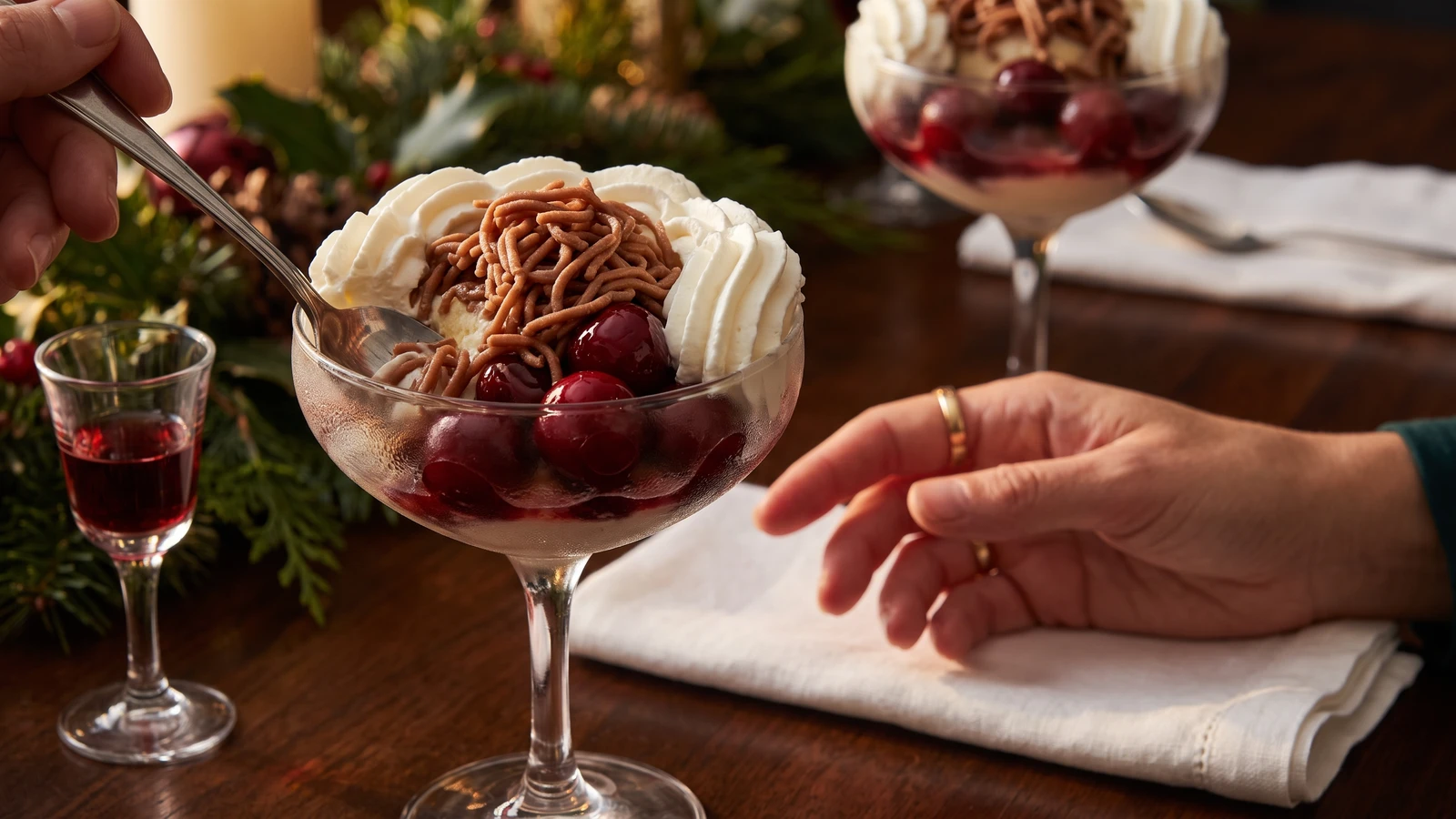
Vanilla ice, kirsch-bright cherries, chestnut purée pressed into vermicelli, and a border of Chantilly: Coupes Germaine teaches that a composed dessert succeeds by temperature, texture, and a dry chestnut purée.
Coupes Germaine (vanilla ice with kirsch cherries, chestnut threads, and sweetened vanilla whipped cream) teaches the discipline of contrast. Cold against soft, tart fruit against mellow chestnut, and an airy border of Chantilly against the density beneath it. Know one thing before touching the pan: the chestnut purée must be dry and stiff enough to fall from the press as separate vermicelli threads. If it emerges as paste, the dessert loses its character.
The original entry assumed a pâtissier with house vanilla ice, demi-sucre cherries waiting in the pantry, prepared chestnut purée, and a vermicelli press at hand. At home, good vanilla ice cream replaces the house ice, jarred sour cherries in light syrup replace the preserved demi-sucre fruit, and a fine-holed potato ricer does the work of the dedicated press. The brigade's separate stations are scaffolding and can go. The sequence, the cold service, and the chestnut's dry texture are the dish and must stay. One cook, one stove, one evening.
When it lands correctly, the coupe shows ivory ice beneath garnet cherries, a loose nest of chestnut-brown threads, and a proud white ring of Chantilly. Chill everything, drain the cherries thoroughly, and test the purée through the ricer before you assemble. That test is the step that decides the dessert.
Coupes Germaine belongs to the Parisian repertoire of named coupes, composed frozen desserts arranged to order in stemmed bowls and carried from grand dining rooms to bourgeois celebration tables. Its chestnut vermicelli echoes the visual grammar of Mont-Blanc, but vanilla ice and kirsch cherries make Germaine a distinct composition rather than a regional version of that dessert. Germaine is a dedicatory name, not a place, while the preserved cherries, chestnuts, and kirsch explain why the coupe sits so naturally at a winter table.
Quantity
1½ cups (375 ml / 250 g drained weight)
very well drained
Quantity
2 tablespoons (30 ml / 28 g)
Quantity
2 tablespoons (30 ml / 25 g)
use only if the cherries are packed in unsweetened juice
Quantity
1¼ cups (300 ml / 300 g)
not crème de marrons
Quantity
1 cup (240 ml / 240 g)
very cold
Quantity
2 tablespoons (30 ml / 15 g)
Quantity
1 teaspoon (5 ml / 5 g)
Quantity
2 cups (500 ml / about 400 g)
| Ingredient | Quantity |
|---|---|
| jarred sour or Morello cherries in light syrupvery well drained | 1½ cups (375 ml / 250 g drained weight) |
| kirsch | 2 tablespoons (30 ml / 28 g) |
| granulated sugar (optional)use only if the cherries are packed in unsweetened juice | 2 tablespoons (30 ml / 25 g) |
| unsweetened chestnut puréenot crème de marrons | 1¼ cups (300 ml / 300 g) |
| heavy creamvery cold | 1 cup (240 ml / 240 g) |
| icing sugar | 2 tablespoons (30 ml / 15 g) |
| pure vanilla extract | 1 teaspoon (5 ml / 5 g) |
| good vanilla ice cream | 2 cups (500 ml / about 400 g) |
Leave the cherries in a sieve for 10 minutes, then blot them gently so no loose syrup remains. Put them in a shallow bowl with the kirsch. If they were packed in unsweetened juice, add the granulated sugar; cherries from light syrup need no more. Cover and chill for 2 hours, turning them once. You want cherries scented through with kirsch, not fruit swimming in liquor.
Test a spoonful of chestnut purée through the fine plate of the ricer. It should emerge in distinct threads that hold their ridges. If it smears or drops as a soft rope, put the purée in a small heavy saucepan and stir over low heat for 5 to 8 minutes, until it resembles firm modelling clay and a spatula leaves a clean track across the pan. Ça se rattrape: if it remains pasty, dry it for another 2 minutes; if it becomes crumbly, knead in 1 teaspoon of the cherry macerating liquid. Cool it uncovered, then cover and chill for at least 30 minutes.
Reserve 1 tablespoon of the cold cream, then whip the remainder in a chilled bowl until the whisk begins leaving trails. Add the icing sugar and vanilla, and continue to firm but supple peaks. Chantilly must hold a piped border without looking grainy. If you take it too far, stop and fold in the reserved cream a teaspoon at a time until it smooths. Keep it cold.
Put four 240 to 300 ml stemmed coupe glasses in the freezer for 20 minutes. Fit a piping bag with a medium star tip and fill it with the Chantilly, then refrigerate it. Set the chilled chestnut purée and ricer nearby. This little arrangement replaces a pastry station and prevents the ice cream from softening while you search for equipment.
Let the vanilla ice cream stand just until it yields to the scoop but remains firm. Divide it among the chilled coupes, using about ½ cup in each, and spread it into an even base. Drain the cherries again, reserving their liquid, and distribute them over the ice cream without pouring syrup into the bowls. Loose syrup melts the ice and muddies the layers.
Fill the ricer with one-quarter of the chestnut purée and hold it just above the first coupe. Press steadily while moving in a small circle, letting the vermicelli fall into a loose nest that completely covers the cherries. Repeat with the remaining coupes. Do not tamp the threads down. If the ricer jams, the purée is too cold or dry; let it stand for 5 minutes, then work in a few drops of reserved cherry liquid and test again.
Pipe a generous border of Chantilly around the rim of each coupe, leaving the chestnut vermicelli visible at the centre. Wipe the outside of the glasses, set each on a small plate, and serve immediately while the vanilla ice remains firm and the cream holds its shape. À table!
1 serving (about 310g)
Culinary guides, cultural storytelling, and the editorial depth that makes cooking meaningful.
Discover Culinary ExplorerChef Juliette
Five almond preparations, one discipline: remove the skins cleanly, dry every kernel through, then cut, toast, or cloak it in pale caramel without letting its fragrant oils escape.

Chef Juliette
A pastry pantry lesson in one tray: filberts warmed only until their red skins release, rubbed clean, cooled, and chopped into a fragrant mise-en-place for cakes, creams, pralines, and petits fours.

Chef Juliette
The smallest pâtisserie discipline decides whether a cake leaves its mould intact: clarified butter in every corner, followed by the lightest veil of dry flour or fécule.

Chef Juliette
Four whites, one spotless bowl, and a patient change of speed: whisk gently until loosened, then briskly to glossy stiffness, with powdered sugar waiting if the foam begins to granulate.