
Chef Juliette
Coupes Clo-clo
Coupes Clo-clo marry vanilla ice, maraschino-soaked marrons glacés, and strawberry Chantilly in a festive glass: cold against cream, cherry perfume against chestnut, softness against a firm piped ridge.
A cooking platform built around craft, culture, and the stories behind what we eat.
Created by Chef Juliette
Based on No. 2796, Coupes d’Antigny, from Le Guide Culinaire (1907) by Auguste Escoffier
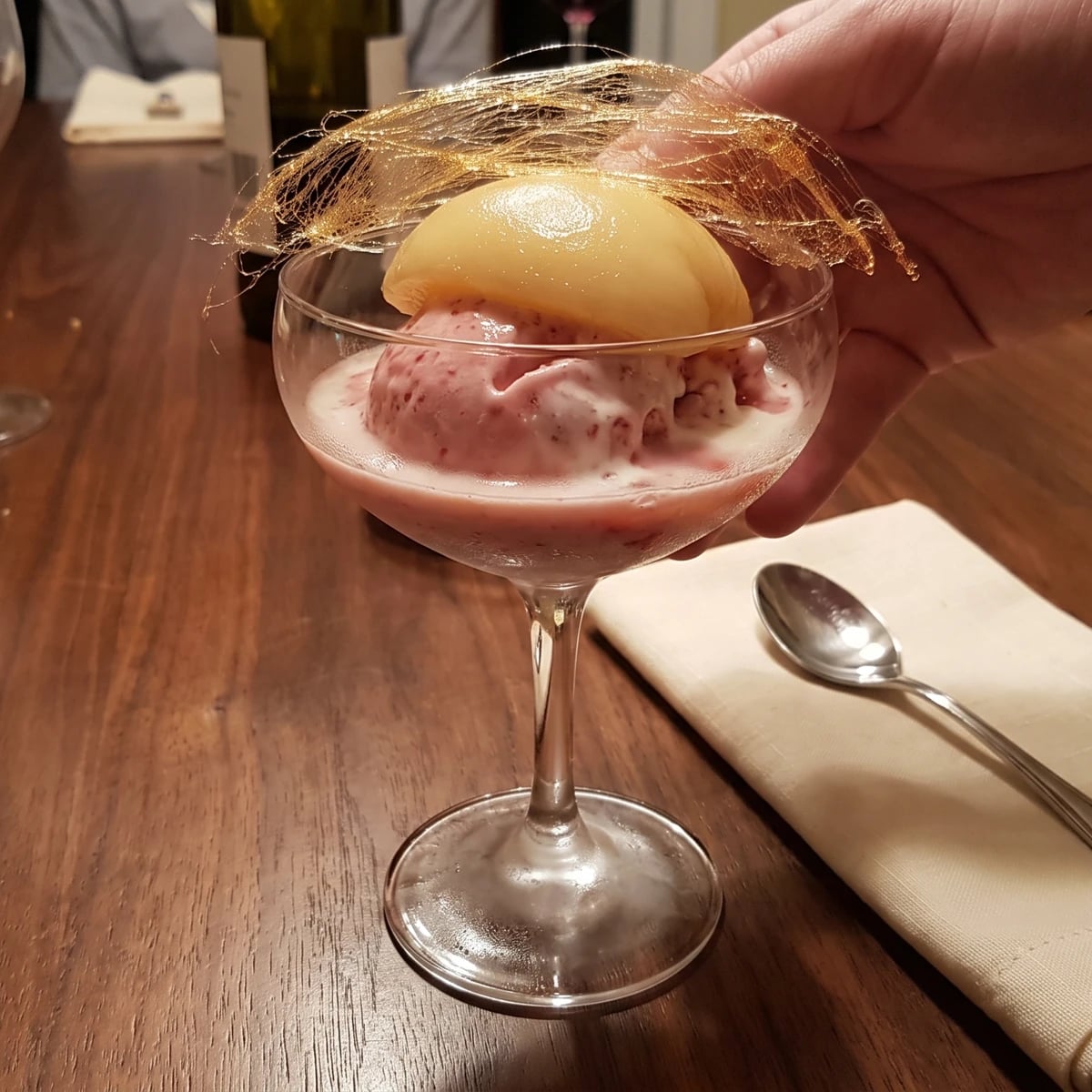
Coupes d’Antigny layers wild strawberry ice, fresh cream, vanilla-poached peach, and spun sugar into one cold lesson in timing: soften the ice carefully, then spin the brittle veil only when the table is ready.
Coupes d’Antigny (wild strawberry ice with vanilla-poached peach and spun sugar) teaches control of temperature and timing. The strawberry ice must be cold enough to hold the peach yet supple enough to accept uncooked crème fleurette; the sugar must be spun only when every coupe is waiting. Damp kills the threads. That is the one true thing to know before you touch the pan.
The original assumed a pastry brigade with Alpine-strawberry ice ready in the freezer, peaches cooling in vanilla syrup, fresh raw cream at hand, and a rack for spinning sugar at the last instant. For one cook, one stove, one evening, a countertop churner replaces the batch freezer, two oiled wooden spoon handles replace the rack, and pasteurized crème fleurette replaces unpasteurized cream for safety while staying uncooked. The separate stations were brigade scaffolding and can go; the wild-strawberry ice, fragrant pouring cream, poached half-peach, and last-second spun sugar are the dish and must stay.
The old direction to fill the bowls “three-parts” means three quarters full, not three parts ice to one part cream. Work just enough fleurette into the softened ice to make it velvety, set the peach dome above it, then spin the amber veil. If the caramel crystals or the ice softens too far, ça se rattrape, and the method catches both. The final discipline is simple: spin the sugar last and serve at once.
Coupes d’Antigny belongs to the named-coupe repertoire of the formal French dessert table, where ices, poached fruit, cream, and sugar work were held separately and assembled at service. Its geography lies in the larder: Alpine wild strawberries, Normandy’s fleurette, or the southern Crème Niçoise drawn from Alpine pastures, while Antigny functions as the formula’s proper name rather than a claim that the sweet belongs to any one of those regions. The vanilla-poached peach and spun-sugar veil turn fruit ice into a composed dessert while keeping cold berry, fresh cream, perfumed fruit, and brittle caramel distinct.
Quantity
2¼ cups (530 ml / 300 g)
hulled; thawed in the refrigerator if frozen
Quantity
½ cup (120 ml / 100 g)
Quantity
⅓ cup plus 1 tablespoon (95 ml / 95 g)
Quantity
½ cup (120 ml / 120 g)
well chilled and left unwhipped
Quantity
2 (about 300 g total)
ripe but firm
Quantity
3 cups (710 ml / 710 g)
Quantity
1½ cups (355 ml / 300 g)
Quantity
1
split lengthwise
Quantity
¾ cup (180 ml / 150 g)
Quantity
¼ cup (60 ml / 60 g), plus up to 2 tablespoons (30 ml / 30 g) if needed
Quantity
1 teaspoon (5 ml / 4 g)
| Ingredient | Quantity |
|---|---|
| fraises des bois, Alpine wild strawberries, or aromatic four-seasons strawberrieshulled; thawed in the refrigerator if frozen | 2¼ cups (530 ml / 300 g) |
| granulated sugar, for the strawberry ice | ½ cup (120 ml / 100 g) |
| water, for the strawberry ice | ⅓ cup plus 1 tablespoon (95 ml / 95 g) |
| pasteurized crème fleurette or 35% heavy creamwell chilled and left unwhipped | ½ cup (120 ml / 120 g) |
| medium yellow peachesripe but firm | 2 (about 300 g total) |
| water, for poaching | 3 cups (710 ml / 710 g) |
| granulated sugar, for poaching | 1½ cups (355 ml / 300 g) |
| vanilla beansplit lengthwise | 1 |
| granulated sugar, for spinning | ¾ cup (180 ml / 150 g) |
| water, for spinning | ¼ cup (60 ml / 60 g), plus up to 2 tablespoons (30 ml / 30 g) if needed |
| neutral oil, for the sugar-spinning handles | 1 teaspoon (5 ml / 4 g) |
Put the 100 g sugar and 95 ml water in a small saucepan. Warm gently, stirring only until the sugar dissolves, then remove it from the heat without reducing it. Cool completely. Purée the strawberries with the cold syrup and pass the mixture through a fine sieve, pressing firmly but leaving the seeds behind. Chill for at least 2 hours. The fruit never cooks, because its high, woodland perfume is the reason for using fraises des bois.
Churn the cold strawberry mixture until it mounds softly and resembles a firm sorbet, usually 20 to 25 minutes. Transfer it to a shallow covered container and freeze for about 2 hours, until firm but still workable. If it freezes solid, leave it in the refrigerator for 15 to 20 minutes before service rather than attacking it with heat; the texture will return.
Combine the 710 ml water and 300 g sugar in a saucepan. Scrape in the vanilla seeds, add the pod, and simmer for 5 minutes. Halve the peaches along their seams, remove the stones, and lower the halves into the syrup. Cover them with a cartouche, a round of parchment set directly on the liquid, and poach at the barest tremble for 6 to 12 minutes. They are ready when a knife enters without force but the halves still hold clean edges. Slip off the skins while warm, return the peaches to the syrup, cool, and refrigerate.
Chill four shallow glass coupes for at least 20 minutes. Drain the peach halves and blot them carefully, because syrup on their surfaces will dissolve the spun sugar. Cover the work surface with parchment. Extend two wooden spoon handles over the counter edge, anchor them securely, and rub the exposed handles with the neutral oil. Set two forks beside them. Every tool used for spinning must be completely dry.
Put the strawberry ice in a chilled bowl and work it briefly with a sturdy spatula. Fold in the cold crème fleurette in three additions, stopping when the ice is velvety, vividly strawberry-scented, and soft enough to mound. Do not whip the cream, and do not let the mixture become pourable. If it softens too far, freeze the bowl for 10 to 15 minutes and fold once more. Ça se rattrape. Fill each chilled coupe three quarters full, then set one peach half on top, rounded side upward. Hold the assembled coupes in the freezer while the sugar is spun, no longer than 10 minutes.
Combine the 150 g sugar and 60 ml water in a small stainless-steel saucepan. Heat gently until clear, washing any stray crystals from the sides with a wet pastry brush. Once the syrup boils, stop stirring and cook it to 155 to 160°C, when it is pale amber. If crystals begin forming before the syrup colors, cover the pan for 30 seconds so condensation washes them down. If it seizes completely, remove it from the heat, let it cool, add the extra water, and dissolve it again. Never add water to hot caramel. Remove the pale caramel from the heat and wait about 1 minute, until a fork lifted from it trails fine threads. Hold two forks back to back, dip their tips into the caramel, and sweep them briskly over the oiled handles. If the sugar falls in droplets, wait a few seconds; if it forms thick ropes, warm it for 5 seconds.
Gather the cooled threads lightly between dry fingers and divide them into four loose veils. Set one veil over each peach without pressing it into the damp fruit. Bring the coupes straight to the table. If humidity makes a veil collapse, discard it and spin a fresh one from the remaining warm caramel; damp sugar cannot be dried back into threads. This last-second fragility is not decoration added to the dish. It is the dish. À table!
1 serving (about 255g)
Culinary guides, cultural storytelling, and the editorial depth that makes cooking meaningful.
Discover Culinary Explorer
Chef Juliette
Coupes Clo-clo marry vanilla ice, maraschino-soaked marrons glacés, and strawberry Chantilly in a festive glass: cold against cream, cherry perfume against chestnut, softness against a firm piped ridge.

Chef Juliette
Coupes Dame Blanche set a vanilla-poached peach over snowy almond-milk ice, hiding Bar-le-Duc currant jam beneath its dome and circling it with a bright piped cord of lemon ice.

Chef Juliette
Coupes Denise set coffee-dark Moka ice against rum bonbons and softly drooping Chantilly, proving that a composed frozen dessert depends less on ornament than on temperature, proportion, and the confidence to use a spoon.

Chef Juliette
Vanilla ice cream, cherries chilled until their syrup gleams, and raspberry-pink Chantilly piled high: a named French coupe whose success rests on one last, gentle fold.