
Chef Juliette
Various Almond Preparations
Five almond preparations, one discipline: remove the skins cleanly, dry every kernel through, then cut, toast, or cloak it in pale caramel without letting its fragrant oils escape.
A cooking platform built around craft, culture, and the stories behind what we eat.
Created by Chef Juliette
Based on No. 2733, Mont-Blanc aux Marrons, from Le Guide Culinaire (1907) by Auguste Escoffier
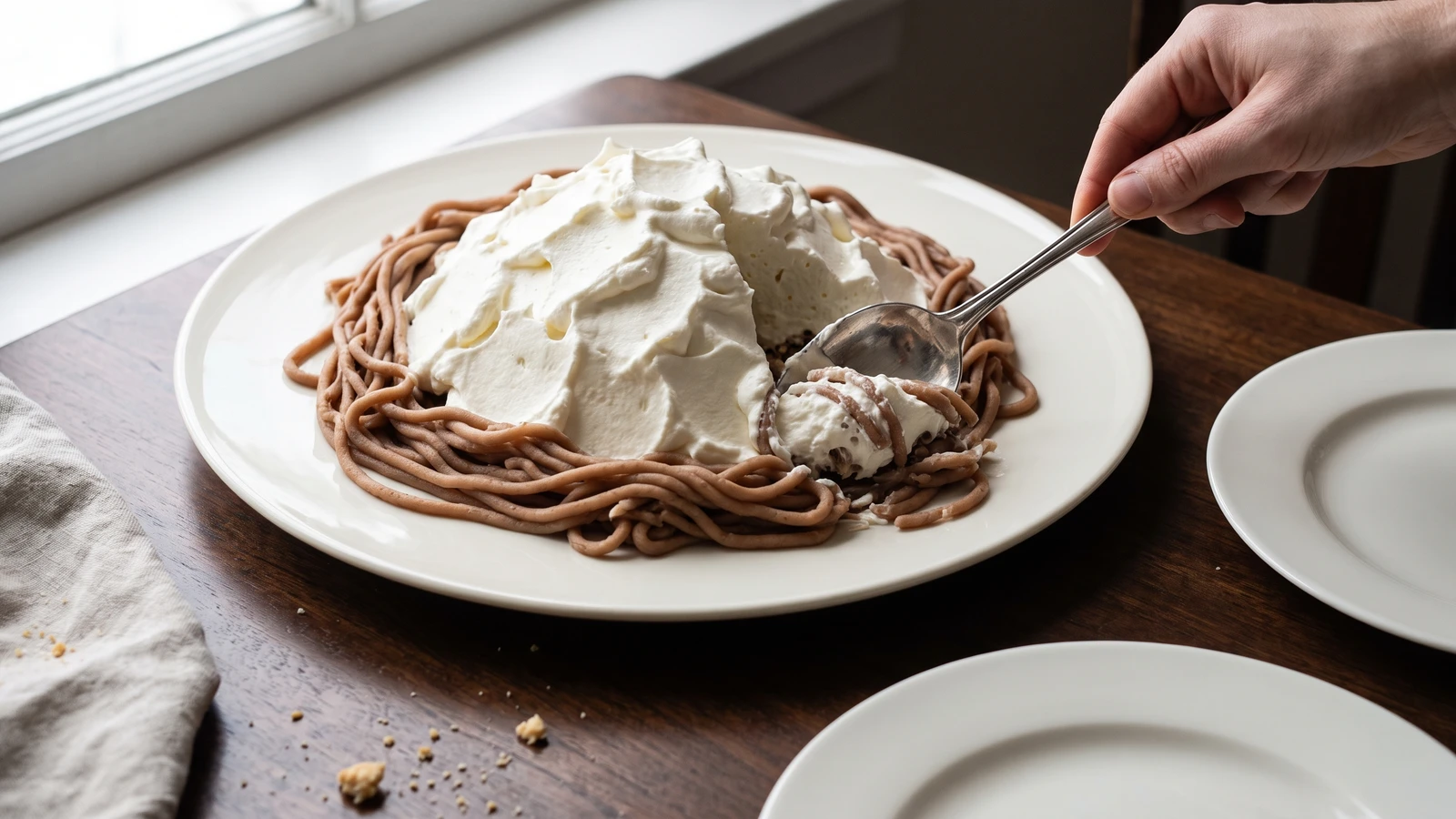
A snowy French classic built on texture: vanilla chestnuts fall in loose vermicelli around a jagged heart of Chantilly, generous enough for a holiday table and manageable in one evening.
Mont-Blanc aux Marrons (vanilla chestnut strands with whipped cream) teaches one true thing: texture is not decoration here, it is the dish. The chestnuts must fall in distinct vermicelli, soft enough to eat with a spoon but firm enough to keep every ridge. Press them flat and you lose the mountain before the cream arrives.
The classical entry assumed peeled chestnuts, a tamis (coarse drum sieve), an even border mould, and enough hands to catch and repack the purée before turning it out. At home, a medium-disk potato ricer and an inverted ramekin build the same border directly on the platter. Packing and unmoulding were scaffolding for the professional mould, so they go; cooking the chestnuts in sweetened vanilla milk, passing them once into vermicelli, and raising a jagged center of crème Chantilly (vanilla-sweetened whipped cream) are the dish, so they stay.
Because the entry gives no household amounts, this version is set for six without adding the meringue, liqueur, or chocolate found in other Mont-Blanc preparations. One cook, one stove, one evening. The step that decides everything is simple: press the chestnuts while they're warm and correctly moist, then let the vermicelli fall untouched.
Mont-Blanc aux marrons belongs to French pâtisserie, but its chestnut-and-cream grammar is shared with the Italian Monte Bianco of Piedmont and the Aosta Valley, so no single city owns it cleanly. Chestnut purée moved from Alpine tables into Parisian pastry work, where passing it into vermicelli gave the dessert the ridged appearance of its namesake mountain. This classical French construction forms the chestnuts into a border with jagged Chantilly at its center, correcting the notion that every Mont-Blanc must hide its cream beneath a closed dome.
Quantity
3⅓ cups (790 ml / 500 g)
Quantity
2 cups (480 ml / 495 g)
Quantity
½ cup (120 ml / 100 g)
for the chestnuts
Quantity
1
split lengthwise, seeds scraped and divided, pod reserved
Quantity
1⅔ cups (400 ml / 400 g)
Quantity
⅓ cup (80 ml / 40 g)
sifted
| Ingredient | Quantity |
|---|---|
| peeled, cooked, unsweetened whole chestnuts | 3⅓ cups (790 ml / 500 g) |
| whole milk | 2 cups (480 ml / 495 g) |
| superfine sugarfor the chestnuts | ½ cup (120 ml / 100 g) |
| vanilla beansplit lengthwise, seeds scraped and divided, pod reserved | 1 |
| cold heavy cream, preferably 36% fat | 1⅔ cups (400 ml / 400 g) |
| confectioners' sugarsifted | ⅓ cup (80 ml / 40 g) |
Combine the milk, superfine sugar, half the vanilla seeds, and the vanilla pod in a heavy saucepan. Warm gently, stirring until the sugar dissolves, then add the chestnuts. Hold them at a bare simmer for 18 to 25 minutes, partially covered, until a chestnut crushes without resistance and the milk tastes deeply of vanilla. Never let the milk boil hard. If it begins to catch, pour the chestnuts and unscorched milk into a clean saucepan without scraping the bottom, then continue over gentler heat.
Remove the vanilla pod and drain the chestnuts over a bowl, reserving every drop of the cooking milk. Let the chestnuts shed surface moisture for 5 minutes, but keep them warm. Press one through the ricer as a test: it should emerge in continuous threads that hold clear ridges. If it crumbles, toss the chestnuts with 1 tablespoon (15 ml / 15 g) of reserved milk and test again; if it slumps into paste, dry the chestnuts in the clean saucepan over low heat for 2 to 3 minutes. Correct the moisture now, because the vermicelli cannot be repaired by pressing it harder.
Set an inverted 4-inch (10 cm) straight-sided ramekin in the middle of a broad serving platter, wrapping its sides with a strip of parchment so it will lift cleanly. Working while the chestnuts remain warm, load the ricer in small batches and hold it about 4 inches (10 cm) above the platter. Press slowly while moving around the ramekin, letting the vermicelli fall into a generous ring about 9 inches (23 cm) across. Layer the strands loosely until all the chestnut is used. Never pat, comb, or press the surface flat. If the first fall crumbles or collapses, lift that patch away, correct the remaining chestnuts with reserved milk or gentle drying, and pass it again. Ça se rattrape.
Leave the chestnut border undisturbed for 15 minutes, then chill it for 30 minutes so the warm purée cannot soften the Chantilly. Cover it only with a large inverted bowl that doesn't touch the strands; wrapping directly against them will crush the vermicelli. Once firm, lift the central ramekin straight upward and peel away the parchment toward the empty center.
Reserve 2 tablespoons (30 ml / 30 g) of the cold cream. Whisk the rest in a chilled bowl with the confectioners' sugar and remaining vanilla seeds until it holds generous medium peaks: firm enough to stand jaggedly, still supple enough to curl from the spoon. Stop before the surface turns grainy. If it does begin to roughen, fold in the reserved liquid cream a spoonful at a time until smooth. Ça se rattrape.
Spoon the Chantilly into the empty center with two large spoons, building it upward in an irregular, jagged mound. Leave the peaks exactly as they fall. No piping, no smoothing, and no sugar dusting; the ivory cream is already the snow. Serve promptly, taking each helping across both the chestnut border and the Chantilly. À table!
1 serving (about 235g)
Culinary guides, cultural storytelling, and the editorial depth that makes cooking meaningful.
Discover Culinary ExplorerChef Juliette
Five almond preparations, one discipline: remove the skins cleanly, dry every kernel through, then cut, toast, or cloak it in pale caramel without letting its fragrant oils escape.

Chef Juliette
A pastry pantry lesson in one tray: filberts warmed only until their red skins release, rubbed clean, cooled, and chopped into a fragrant mise-en-place for cakes, creams, pralines, and petits fours.

Chef Juliette
The smallest pâtisserie discipline decides whether a cake leaves its mould intact: clarified butter in every corner, followed by the lightest veil of dry flour or fécule.

Chef Juliette
Four whites, one spotless bowl, and a patient change of speed: whisk gently until loosened, then briskly to glossy stiffness, with powdered sugar waiting if the foam begins to granulate.