Chef Juliette
Mayonnaise de Volaille
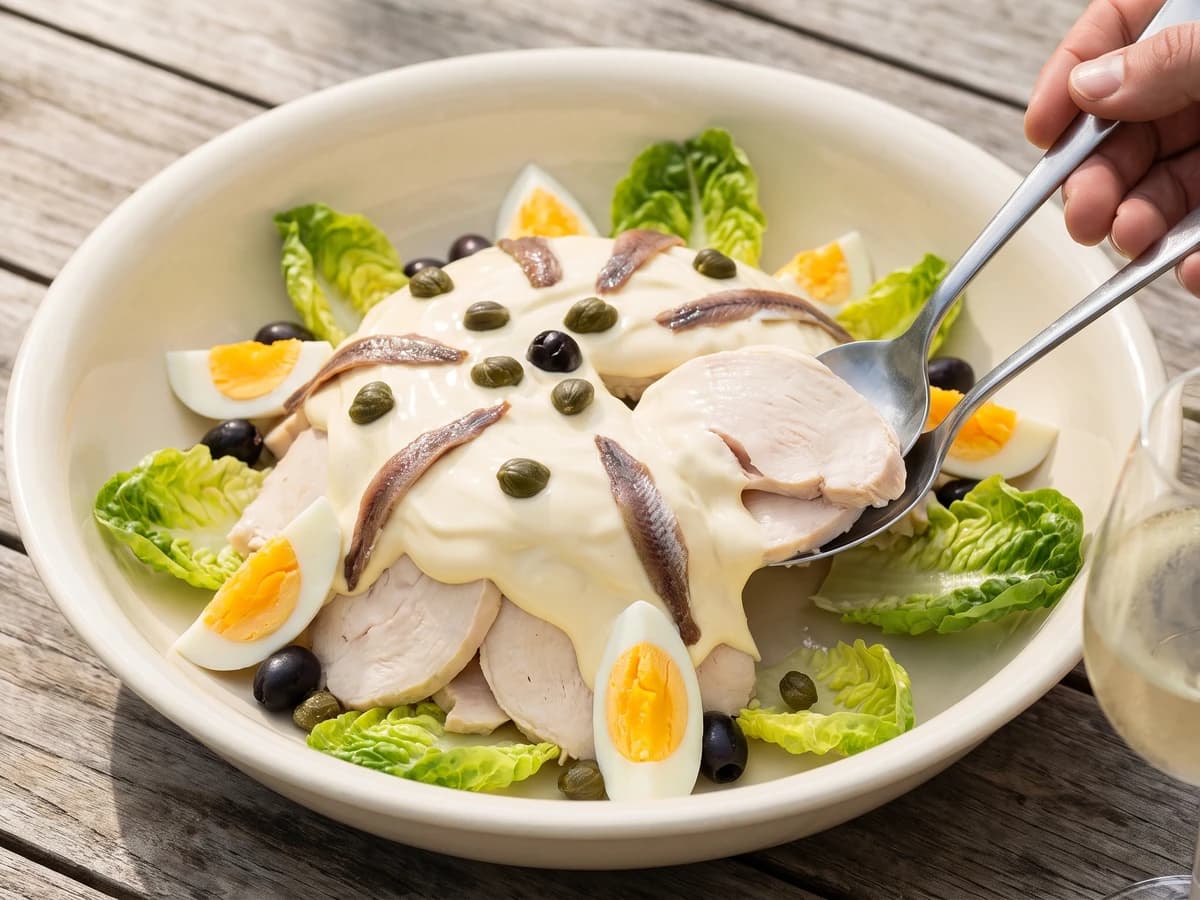
Cold roast chicken, ciseled lettuce, and a shining coat of homemade mayonnaise, arranged with capers, olives, anchovies, eggs, and lettuce hearts, then tossed at the table as the canon intends.
A cooking platform built around craft, culture, and the stories behind what we eat.
Created by Chef Juliette
Based on No. 2725, Macédoine of Cooled Fruit, from Le Guide Culinaire (1907) by Auguste Escoffier
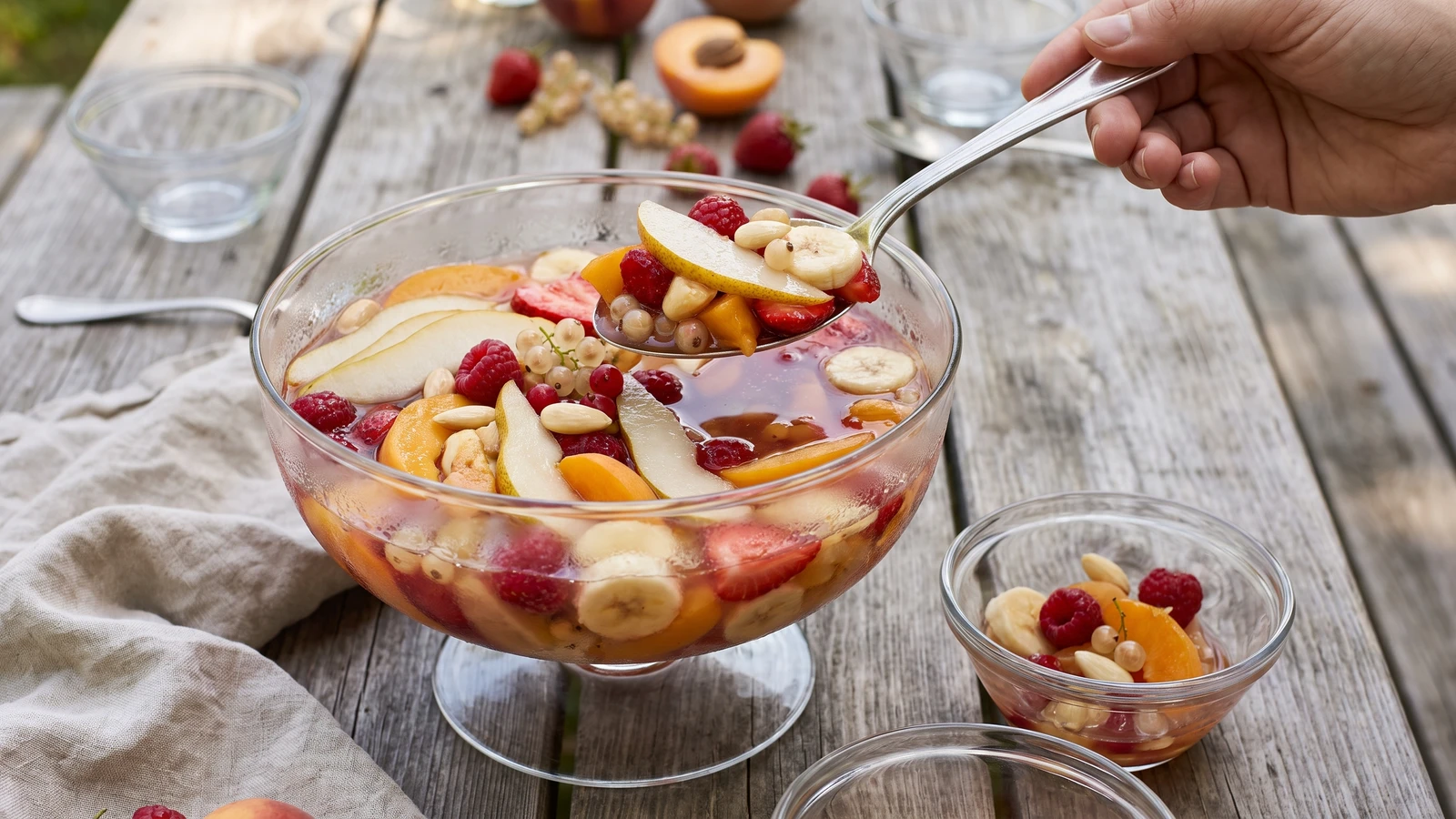
Macédoine de fruits rafraîchie gathers ripe pears, stone fruit, berries, currants, and almonds under chilled kirsch syrup, then lets time and gentle turning make a glossy, fragrant fruit salad for the outdoor table.
Macédoine de fruits rafraîchie (cooled mixed fruit) teaches the discipline of maceration: syrup should season ripe fruit and draw out its perfume, never drown it. The one true thing is that everything must be cold before it meets. Warm syrup softens the berries and turns the banana pasty, while cold syrup leaves each fruit itself and gathers their juices into a fragrant glaze.
The original assumed a pastry section with sirop à 30° (syrup at 30 degrees on the saccharometer) already made, a measuring instrument at hand, and a timbale held continuously in cracked ice. Here, 135 grams of sugar to 100 grams of water gives the intended density without special equipment, while a chilled glass bowl and the refrigerator replace the ice station. The constant ice bed was brigade scaffolding and can go. The hour or two of maceration, with gentle turning from time to time, is the dish and must stay.
When the Macédoine is right, every slice glistens, the currants remain tart little sparks, and the kirsch scents the syrup without bullying the fruit. Choose ripe fruit that still holds its shape, then cool the syrup completely before cutting anything. That is the step that matters most.
Macédoine de fruits belongs to Parisian classical service, where a changing assortment of fruit was gathered in a timbale, dressed with measured syrup, and held over ice before the dining room called for it. The usual explanation links macédoine to Macedonia's varied peoples, though the etymology is debated; in French kitchens the word came to signal mixture and orderly cutting in savory vegetables as well as dessert fruit. Because the formula follows the market rather than a fixed larder, it passed readily from formal service to bourgeois home tables, with Kirsch or Maraschino preserving the classical finish.
Quantity
⅔ cup (160 ml / 135 g)
Quantity
scant ½ cup (100 ml / 100 g)
Quantity
2 tablespoons (30 ml / 28 g)
Quantity
1 medium, about 1 cup (240 ml / 170 g)
ripe but firm, peeled, cored, and thinly sliced
Quantity
1 large, about 1 cup (240 ml / 175 g)
ripe but firm, peeled, pitted, and thinly sliced
Quantity
3 small, about 1 cup (240 ml / 150 g)
pitted and thinly sliced
Quantity
1 small, about ¾ cup (180 ml / 100 g)
peeled and sliced
Quantity
1 cup (240 ml / 150 g)
hulled, with small berries left whole and large berries halved
Quantity
1 cup (240 ml / 125 g)
picked over
Quantity
⅔ cup (160 ml / 100 g)
stripped from their stems
Quantity
¼ cup (60 ml / 35 g)
halved lengthwise
| Ingredient | Quantity |
|---|---|
| granulated sugar | ⅔ cup (160 ml / 135 g) |
| water | scant ½ cup (100 ml / 100 g) |
| Kirsch or Maraschino | 2 tablespoons (30 ml / 28 g) |
| Williams pearripe but firm, peeled, cored, and thinly sliced | 1 medium, about 1 cup (240 ml / 170 g) |
| yellow peachripe but firm, peeled, pitted, and thinly sliced | 1 large, about 1 cup (240 ml / 175 g) |
| apricotspitted and thinly sliced | 3 small, about 1 cup (240 ml / 150 g) |
| bananapeeled and sliced | 1 small, about ¾ cup (180 ml / 100 g) |
| strawberrieshulled, with small berries left whole and large berries halved | 1 cup (240 ml / 150 g) |
| raspberriespicked over | 1 cup (240 ml / 125 g) |
| mixed white and red currantsstripped from their stems | ⅔ cup (160 ml / 100 g) |
| skinned fresh sweet almonds or blanched raw sweet almondshalved lengthwise | ¼ cup (60 ml / 35 g) |
Put the water in a small saucepan, add the sugar, and warm gently until every crystal dissolves. Bring the syrup to one clean simmer, then remove it immediately; 30° describes density, not temperature, and prolonged boiling would make the syrup too concentrated. Cool it for 15 minutes, then refrigerate until completely cold before stirring in the Kirsch or Maraschino. If the cooled syrup turns tacky or forms crystals, add 1 tablespoon (15 ml / 15 g) cold water, warm only until smooth, and chill it again. Ça se rattrape.
Chill a 3-quart nonreactive serving bowl. Only begin cutting once the syrup is cold. Peel, core, and slice the pear; peel, pit, and slice the peach; pit and slice the apricots; then peel and slice the banana. Keep the slices about ¼ inch (6 mm) thick so they macerate evenly without losing their shape. Although many savory macédoines are diced, this source calls for sliced fruit, and the source governs.
Add the strawberries, raspberries, white and red currants, and skinned almonds to the chilled bowl. Fold everything together twice with a broad spoon or flexible spatula, lifting from underneath rather than stirring in circles. The aim is a true mixture with every fruit visible, not a crushed berry compote.
Pour the cold, kirsched syrup evenly over the fruit and fold gently until every piece glistens. Cover and refrigerate for 1 to 2 hours, turning the fruit carefully every 30 minutes as the source directs. The syrup will loosen as it draws juice from the fruit. If a deep pool develops because the fruit was exceptionally ripe, lift the fruit into another cold bowl with a slotted spoon, then return only enough liquid to coat it generously. Ça se rattrape.
Give the Macédoine one final gentle turn and serve it from the chilled bowl, spooning a little of the fragrant syrup into each portion without drowning the fruit. For an outdoor table, nest the serving bowl briefly in a larger bowl of ice; for a picnic, carry it upright in a well-chilled cooler and bring it out only when everyone is ready. À table!
1 serving (about 315g)
Culinary guides, cultural storytelling, and the editorial depth that makes cooking meaningful.
Discover Culinary ExplorerChef Juliette
Cold roast chicken, ciseled lettuce, and a shining coat of homemade mayonnaise, arranged with capers, olives, anchovies, eggs, and lettuce hearts, then tossed at the table as the canon intends.

Chef Juliette
Cold roast or poached chicken with fine ribbons of lettuce, dressed at the final moment with oil and vinegar: a composed salad whose freshness depends entirely on timing.

Chef Juliette
Five leaves, one living rule: laitue, romaine, chicorée, mâche, or pissenlit must be washed, dried, and dressed only as they go to the table, while every leaf still carries its light vinaigrette.

Chef Juliette
Salade de Betteraves proves that baking, not boiling, is the whole argument: concentrated garnet sweetness, tender baked onion, sharp mustard, and herbs cut into a weeknight salad worth making ahead.