
Chef Juliette
Various Almond Preparations
Five almond preparations, one discipline: remove the skins cleanly, dry every kernel through, then cut, toast, or cloak it in pale caramel without letting its fragrant oils escape.
A cooking platform built around craft, culture, and the stories behind what we eat.
Created by Chef Juliette
Based on No. 2723, Ile Flottante, from Le Guide Culinaire (1907) by Auguste Escoffier
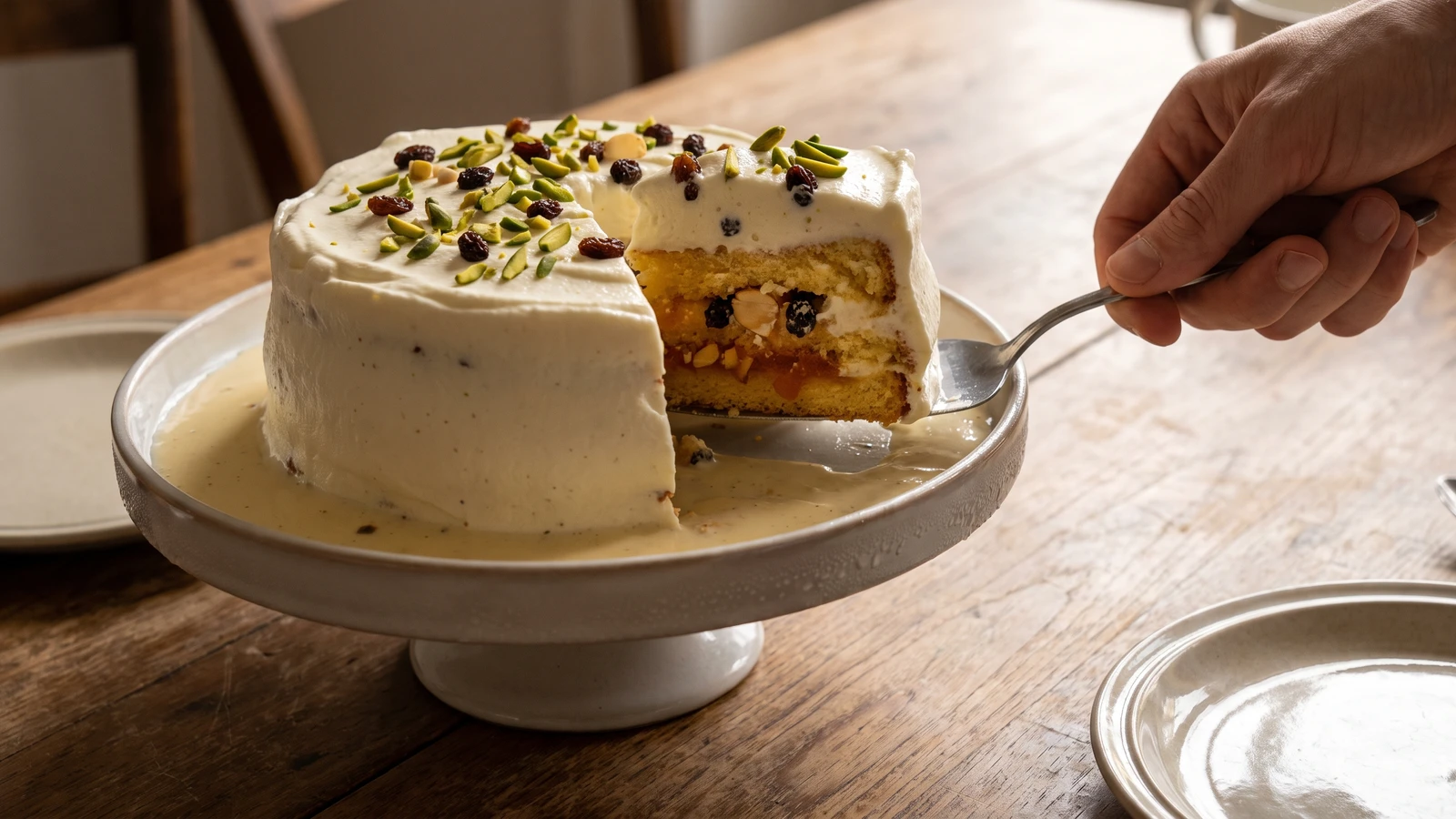
This biscuit-form Île flottante rebuilds dry Savoy sponge with kirsch, maraschino, apricot jam, currants, and almonds, then masks it in Chantilly and sets the whole island in cool vanilla custard.
Île flottante (floating island of layered Savoy biscuit) teaches that dryness can be an ingredient. Before you touch a pan, know this: the biscuit must be dry enough to drink the kirsch and maraschino without dissolving beneath them. A freshly tender sponge turns to paste; a properly rested one becomes fragrant, supple, and strong enough to carry its layers.
The original assumes a pastry station with a stale Biscuit de Savoie, chilled crème anglaise, finished Chantilly, and a tazza waiting for service. For six at home, the biscuit is baked in a 15 cm tin; if it hasn't had a day to dry, the sliced rounds spend twenty minutes in a low oven, and a shallow rimmed cake stand replaces the tazza so the custard stays around the island. Those are the only changes, portion and service furniture. The liqueurs, apricot jam, currants, almonds, reconstruction, Chantilly mask, and custard remain because they are the dish. One cook, one stove, one evening.
Cut into it and the white cream gives way to amber seams of jam, dark currants, pale almonds, and sponge carrying the perfume of two cherry liqueurs. Cool vanilla custard pools around every serving. The one step that decides the whole dessert is drying the biscuit before it meets the liqueur.
This form of Île flottante belongs to the formal Parisian dining-room repertoire, though its structural heart, biscuit de Savoie, comes from Savoie. The codified presentation rebuilt a dry sponge with liqueurs, preserves, dried fruit, and nuts, then set the Chantilly-covered island in crème anglaise or raspberry syrup. In common current usage the name is often attached to poached meringue, also called œufs à la neige; this biscuit island records a separate branch of the canon, not an error.
Quantity
1 tablespoon (15 ml / 14 g)
softened, for the tin
Quantity
4
separated
Quantity
⅝ cup (150 ml / 125 g)
divided
Quantity
¾ cup (180 ml / 90 g)
sifted
Quantity
⅓ cup (80 ml / 40 g)
sifted
Quantity
⅛ teaspoon (0.6 ml / 0.8 g)
Quantity
2 cups plus 2 tablespoons (510 ml / 525 g)
divided
Quantity
1
split lengthwise
Quantity
6
Quantity
½ cup (120 ml / 100 g)
Quantity
1 pinch
Quantity
¼ cup (60 ml / 58 g)
Quantity
¼ cup (60 ml / 64 g)
Quantity
¾ cup (180 ml / 240 g)
warmed and sieved
Quantity
½ cup (120 ml / 75 g)
divided
Quantity
½ cup (120 ml / 60 g)
finely chopped
Quantity
2 cups (480 ml / 480 g)
Quantity
⅓ cup (80 ml / 40 g)
sifted
Quantity
1 teaspoon (5 ml / 5 g)
Quantity
¼ cup (60 ml / 30 g)
cut into slivers
| Ingredient | Quantity |
|---|---|
| unsalted buttersoftened, for the tin | 1 tablespoon (15 ml / 14 g) |
| large eggsseparated | 4 |
| caster sugardivided | ⅝ cup (150 ml / 125 g) |
| cake floursifted | ¾ cup (180 ml / 90 g) |
| cornstarchsifted | ⅓ cup (80 ml / 40 g) |
| fine salt | ⅛ teaspoon (0.6 ml / 0.8 g) |
| whole milkdivided | 2 cups plus 2 tablespoons (510 ml / 525 g) |
| vanilla beansplit lengthwise | 1 |
| large egg yolks | 6 |
| caster sugar | ½ cup (120 ml / 100 g) |
| fine salt | 1 pinch |
| Kirsch | ¼ cup (60 ml / 58 g) |
| maraschino liqueur | ¼ cup (60 ml / 64 g) |
| smooth apricot jamwarmed and sieved | ¾ cup (180 ml / 240 g) |
| dried currantsdivided | ½ cup (120 ml / 75 g) |
| blanched almondsfinely chopped | ½ cup (120 ml / 60 g) |
| cold heavy whipping cream | 2 cups (480 ml / 480 g) |
| icing sugarsifted | ⅓ cup (80 ml / 40 g) |
| pure vanilla extract | 1 teaspoon (5 ml / 5 g) |
| unsalted pistachioscut into slivers | ¼ cup (60 ml / 30 g) |
Heat the oven to 175°C or 350°F. Butter a deep 15 cm round cake tin and line its base and sides with parchment. Beat the yolks with half the caster sugar until pale, thick, and able to fall from the whisk in a ribbon. In a clean bowl, whip the whites with the salt to soft peaks, then add the remaining sugar gradually and continue only until the whites are glossy and hold a medium peak. Fold one-third of the whites into the yolks to loosen them, then fold in the rest without pressing out their air. Sift the flour and cornstarch over the mixture in three additions and fold just until no dry pockets remain.
Transfer the batter to the tin, smooth the top lightly, and bake for 30 to 35 minutes. The biscuit is ready when it is evenly gold, springs back under a fingertip, and a fine skewer leaves the centre clean. Cool in the tin for 10 minutes, then turn it onto a rack and remove the parchment. Let it cool completely. For the best texture, leave it loosely covered at room temperature until the next day; do not seal it airtight, because the point is to lose moisture.
Set aside 2 tablespoons of the milk and keep it cold. Scrape the vanilla seeds into the remaining milk, add the pod, and bring it just below a simmer. Cover, remove from the heat, and infuse for 10 minutes. Whisk the yolks, sugar, and pinch of salt until smooth, then pour in the hot milk gradually while whisking. Return everything to low heat and stir constantly until the crème anglaise (English custard) reaches 82 to 84°C or coats the back of a spoon while a finger drawn through it leaves a clean path. If fine curds appear, remove it from the heat immediately, strain it into a cold bowl, and blend in a spoonful of the reserved milk. Ça se rattrape. Hard scrambled curds have gone beyond rescue, so keep the heat gentle. Cool the custard over an ice bath, cover its surface, and chill for at least 2 hours.
Combine the Kirsch and maraschino liqueur in a small jug. Warm and sieve the apricot jam so it is perfectly smooth, then let it cool until fluid but no longer hot. Reserve 2 tablespoons of the currants for the finish. Keep the remaining currants, chopped almonds, and slivered pistachios in separate bowls so the stacking can proceed without delay.
Trim only the driest cap from the biscuit, then use a long serrated knife to cut it horizontally into six thin rounds, keeping them in order. If the biscuit was baked today, arrange the slices on racks and dry them in a 120°C or 250°F oven for 15 to 20 minutes, turning once; they should feel dry and resilient without taking more colour. Cool completely. Brush both sides repeatedly with the combined liqueurs, pausing between passes so the liquid travels inward. Saturate the biscuit, but leave no puddles. If a slice tears, place it where it belongs and use the jam as adhesive during stacking. Ça se rattrape.
Place the bottom round on a shallow rimmed pedestal dish or cake stand. Coat it with a thin, complete layer of apricot jam, then scatter over one-fifth of the filling currants and chopped almonds. Repeat with the remaining rounds, aligning each carefully so the original outline of the biscuit returns. Coat the top with the last of the jam. Press very gently to settle the layers, then chill for 30 minutes. The thin slicing, saturation, jam, fruit, nuts, and reconstruction are the dish itself; keep every layer.
Whip the cold cream with the icing sugar and vanilla until the crème Chantilly (sweetened vanilla cream) holds a smooth medium peak. It must spread without running and remain supple enough to coat the cake without tearing it. If the cream turns grainy, stop beating and fold in a spoonful of the reserved cold milk until it becomes smooth again, then finish by hand. Ça se rattrape.
Cover the reconstructed biscuit completely with a generous, even layer of Chantilly, filling every seam and smoothing the surface with an offset spatula. Scatter the slivered pistachios and reserved currants over the cream, allowing them to fall naturally rather than arranging them one by one. Chill the finished island for at least 1 hour so the layers settle and the Chantilly firms enough to slice cleanly.
Remove the vanilla pod and whisk the chilled crème anglaise until smooth. If it has tightened in the cold, add the remaining reserved milk a little at a time until it pours in a thick ribbon. Just before serving, pour the custard around the base of the cake, not over the Chantilly, until the island sits in a generous ivory pool. Cut with a thin knife wiped between servings, giving each guest both layered biscuit and custard. À table!
1 serving (about 360g)
Culinary guides, cultural storytelling, and the editorial depth that makes cooking meaningful.
Discover Culinary ExplorerChef Juliette
Five almond preparations, one discipline: remove the skins cleanly, dry every kernel through, then cut, toast, or cloak it in pale caramel without letting its fragrant oils escape.

Chef Juliette
A pastry pantry lesson in one tray: filberts warmed only until their red skins release, rubbed clean, cooled, and chopped into a fragrant mise-en-place for cakes, creams, pralines, and petits fours.

Chef Juliette
The smallest pâtisserie discipline decides whether a cake leaves its mould intact: clarified butter in every corner, followed by the lightest veil of dry flour or fécule.

Chef Juliette
Four whites, one spotless bowl, and a patient change of speed: whisk gently until loosened, then briskly to glossy stiffness, with powdered sugar waiting if the foam begins to granulate.