
Chef Juliette
Various Almond Preparations
Five almond preparations, one discipline: remove the skins cleanly, dry every kernel through, then cut, toast, or cloak it in pale caramel without letting its fragrant oils escape.
A cooking platform built around craft, culture, and the stories behind what we eat.
Created by Chef Juliette
Based on No. 2716, Poires à la Religieuse, from Le Guide Culinaire (1907) by Auguste Escoffier
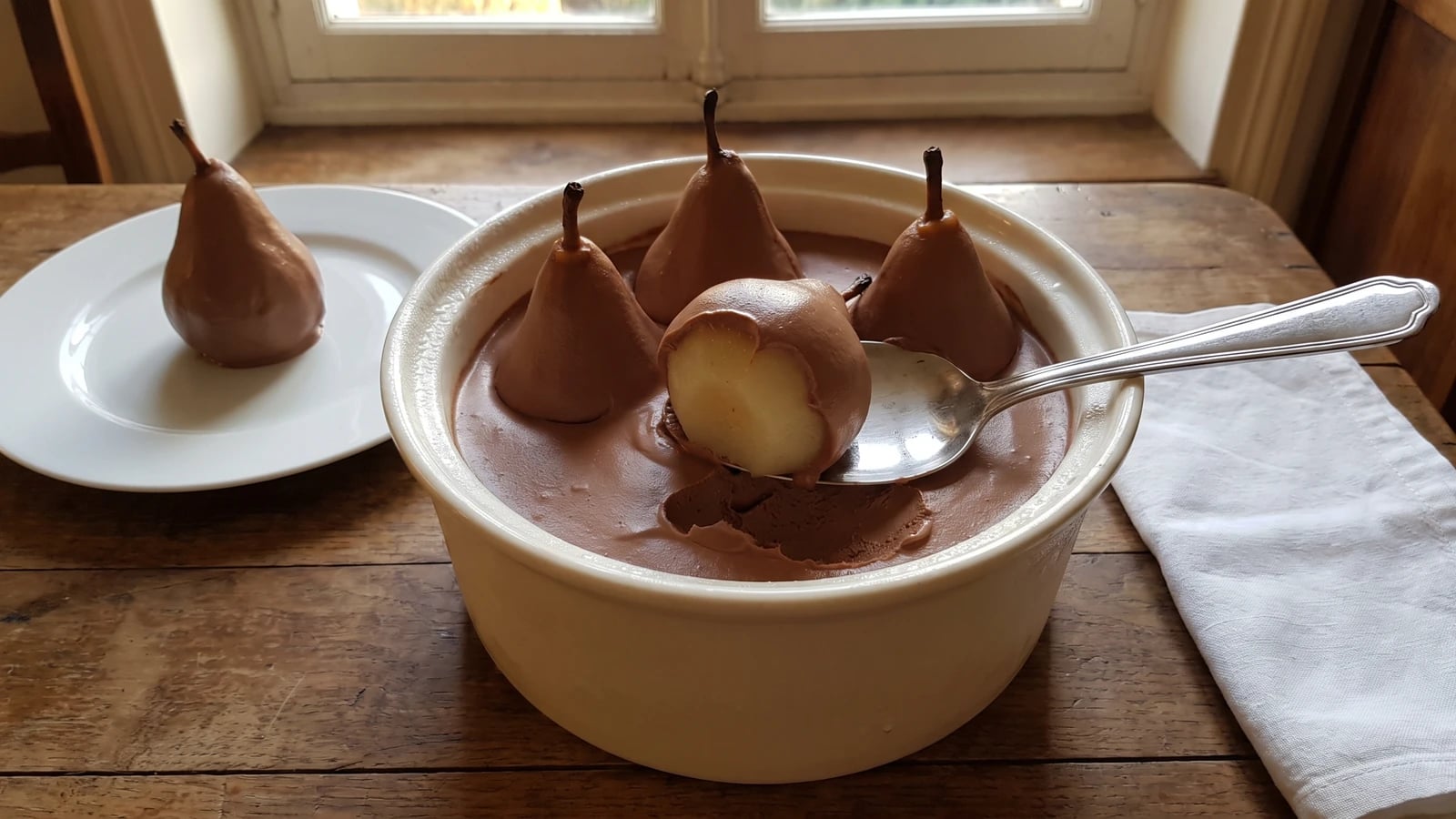
Four vanilla-poached pears disappear beneath a thin chocolate Bavarois and emerge from the cold under one tender veil. Pour while the cream still flows, then let the refrigerator finish the work.
Poires à la Religieuse (vanilla-poached pears beneath chilled chocolate cream) teaches one thing above all: temperature is an ingredient. The pears must be thoroughly cold, while the Bavarois, a custard lightened with whipped cream and softly set with gelatin, must still flow in a broad ribbon. Pour it warm and the cream loses its lift; wait too long and it sets in ridges.
The original recipe assumed a pastry station where poached fruit, custard, and whipped cream could arrive cold and ready at the same moment, plus a porcelain timbale chosen precisely to match the pears. At home, four small pears and one snug porcelain serving dish do the same work. The separate pastry hands and brigade quantity are scaffolding, so they go. The vanilla syrup, the chocolate Bavarois, the fluid pour, and the full two hours in the cold are the dish itself, so they stay. One cook, one stove, one evening.
When it is right, each pear sits under a seamless chocolate covering, tender enough for a spoon and cool enough to hold its shape. The step that decides everything is the pour: fold the Bavarois while it is cool but supple, then cover the pears immediately.
Poires à la Religieuse belongs to the French classical entremets repertoire rather than to one provincial table; its practical home was the pastry station of Parisian dining rooms, where poached fruit and Bavarois were prepared separately and joined before service. Its porcelain timbale was part cooking logic and part presentation, keeping the pears upright while the soft chocolate cream settled around them. Despite the shared name, this is not a variation of the familiar choux religieuse, but a distinct chilled pear dessert from the same fondness for pictorial menu names.
Quantity
4 (about 1 lb / 450 g total)
peeled with stems intact
Quantity
3 cups (720 ml / 720 g)
Quantity
1 cup (240 ml / 200 g)
Quantity
1
split lengthwise
Quantity
1½ teaspoons (7 ml / 5 g)
Quantity
2 tablespoons (30 ml / 30 g)
Quantity
1¼ cups (300 ml / 305 g)
Quantity
4 (about ¼ cup / 72 g)
Quantity
¼ cup (60 ml / 50 g)
Quantity
⅔ cup (160 ml / 115 g)
finely chopped
Quantity
1 cup (240 ml / 240 g)
well chilled
| Ingredient | Quantity |
|---|---|
| small firm-ripe pears, preferably Forelle or small Boscpeeled with stems intact | 4 (about 1 lb / 450 g total) |
| water | 3 cups (720 ml / 720 g) |
| granulated sugar for the syrup | 1 cup (240 ml / 200 g) |
| vanilla beansplit lengthwise | 1 |
| powdered gelatin | 1½ teaspoons (7 ml / 5 g) |
| cold water for blooming the gelatin | 2 tablespoons (30 ml / 30 g) |
| whole milk | 1¼ cups (300 ml / 305 g) |
| large egg yolks | 4 (about ¼ cup / 72 g) |
| granulated sugar for the Bavarois | ¼ cup (60 ml / 50 g) |
| dark chocolate, 64 to 70 percent cacaofinely chopped | ⅔ cup (160 ml / 115 g) |
| heavy creamwell chilled | 1 cup (240 ml / 240 g) |
Scrape the vanilla seeds into a saucepan and add the pod, 3 cups water, and 1 cup sugar. Bring to a boil just long enough to dissolve the sugar. Meanwhile, peel the pears neatly, leaving the stems attached, and remove each core through the base with a small melon baller or the point of a teaspoon. Keep the walls intact so the pears remain upright and whole.
Lower the pears into the vanilla syrup and place a parchment round directly on the surface to keep them beneath the liquid. Hold the syrup at the barest tremble for 15 to 25 minutes, turning the pears occasionally, until a small knife enters the thickest part with only faint resistance. A hard boil bruises the fruit, while overcooking makes it slump beneath the Bavarois. If one pear softens before the others, lift it out immediately and let the rest continue; ça se rattrape.
Remove the pan from the heat and let the pears cool in their syrup for 30 minutes so the vanilla reaches the centre. Transfer them to the refrigerator until completely cold, about 45 minutes. Drain them thoroughly, blot the surfaces dry, and trim the bases only enough to make them stand. Arrange them upright in a snug 1.2 to 1.5 litre porcelain timbale or straight-sided serving dish whose depth roughly matches their height. Return the dish to the cold.
Sprinkle the gelatin over the 2 tablespoons cold water and leave it to bloom for 5 minutes. Heat the milk until small bubbles appear at the edge. Whisk the yolks with the ¼ cup sugar until smooth, then gradually whisk in the hot milk. Return everything to the saucepan and cook over gentle heat, stirring constantly, until the crème anglaise (pouring custard) coats the spoon and reaches 180°F to 183°F (82°C to 84°C). Never let it boil. If a few egg flecks catch at the edge, remove the pan at once, whisk in 1 tablespoon of the measured cold cream, then strain; a slight curdle can be rescued, but fully scrambled custard must be remade.
Put the chopped chocolate and bloomed gelatin in a bowl, then strain the hot crème anglaise over them. Leave it untouched for 1 minute, then whisk from the centre outward until smooth and glossy. Cool the chocolate base to about 86°F (30°C), stirring occasionally. Whip the remaining cold cream only to soft peaks, fold one-third into the chocolate to loosen it, then fold in the rest. The finished Bavarois must fall from the spatula in a broad ribbon and level itself within seconds. If it starts setting into ridges, set the bowl briefly over lukewarm water and fold just until it flows again. Ça se rattrape.
Take the cold pears from the refrigerator and immediately pour the Bavarois over their crowns, letting it run down each pear and settle around them in one smooth sheet. Guide uncovered patches with the back of a spoon, but do not keep working the surface once it begins to hold a trace. Refrigerate undisturbed for at least 2 hours. Cover the dish only after the surface has set, so wrapping cannot mark the chocolate.
Serve the Poires à la Religieuse directly from their chilled porcelain timbale; this dessert is not unmolded. Slide a broad spoon beneath each pear and carry some of the softly set chocolate Bavarois with it. The fruit should yield without collapsing, and the cream should hold a tender spoon mark rather than bounce like firm jelly. À table!
1 serving (about 305g)
Culinary guides, cultural storytelling, and the editorial depth that makes cooking meaningful.
Discover Culinary ExplorerChef Juliette
Five almond preparations, one discipline: remove the skins cleanly, dry every kernel through, then cut, toast, or cloak it in pale caramel without letting its fragrant oils escape.

Chef Juliette
A pastry pantry lesson in one tray: filberts warmed only until their red skins release, rubbed clean, cooled, and chopped into a fragrant mise-en-place for cakes, creams, pralines, and petits fours.

Chef Juliette
The smallest pâtisserie discipline decides whether a cake leaves its mould intact: clarified butter in every corner, followed by the lightest veil of dry flour or fécule.

Chef Juliette
Four whites, one spotless bowl, and a patient change of speed: whisk gently until loosened, then briskly to glossy stiffness, with powdered sugar waiting if the foam begins to granulate.