
Chef Juliette
Various Almond Preparations
Five almond preparations, one discipline: remove the skins cleanly, dry every kernel through, then cut, toast, or cloak it in pale caramel without letting its fragrant oils escape.
A cooking platform built around craft, culture, and the stories behind what we eat.
Created by Chef Juliette
Based on No. 2714, Poires Melba, from Le Guide Culinaire (1907) by Auguste Escoffier
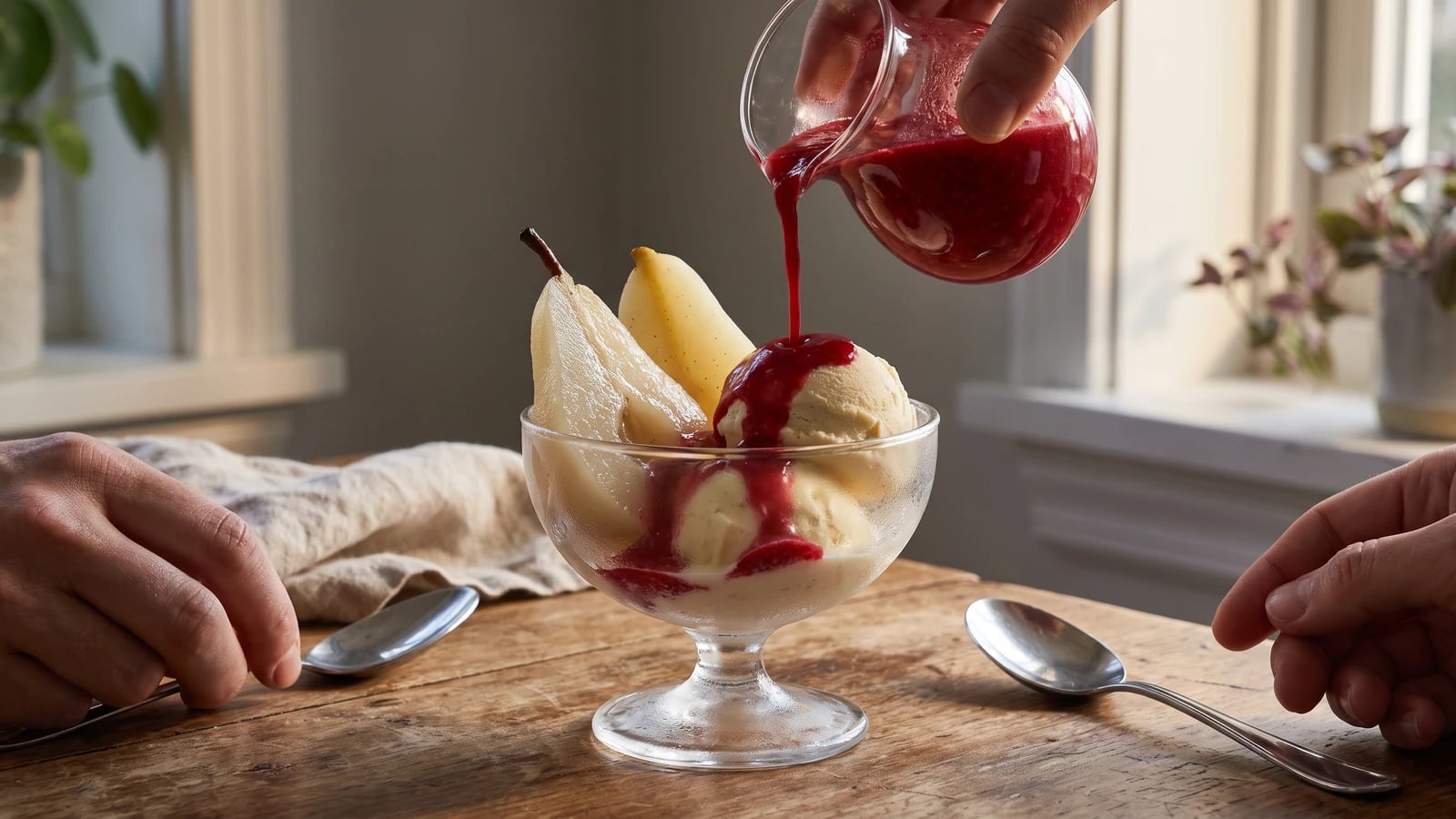
Vanilla-poached pear halves, chilled and laid over dense vanilla ice cream, then generously coated with raw raspberry purée: the Melba grammar translated from peach to pear without losing its cold, fragrant clarity.
Poires Melba (vanilla-poached pears on vanilla ice with raw raspberry purée) teaches a clean pastry-kitchen truth: contrast survives only when each element keeps its own character. The pear must be tender yet shapely, the ice cream properly cold, and the raspberry uncooked, bright, and tart enough to cut the sweetness. C'est la même grammaire as Pêches Melba (No. 2699), with pear carried over exactly as the source directs.
The original recipe assumed a pastry section with vanilla syrup, house ice cream, raspberry purée, and a timbale already cold. At home, one saucepan, a blender and sieve, good bought vanilla ice cream, and four chilled coupes do the same work. Holding syrup by the vat and churning ice for service are brigade scaffolding, so they can go; vanilla poaching, raw purée, and the order of assembly are the dish, so they stay. One cook, one stove, one evening.
The one step that matters is the poach. Pull the pears when a small knife enters with a whisper of resistance, because they soften as they cool in syrup. Take them to collapse and no clever arrangement can give their shape back.
Pêches Melba (No. 2699) belongs to the French grand-kitchen repertoire as it traveled through London's hotel dining rooms, pairing vanilla-poached peaches with vanilla ice and raw raspberry purée in honor of the singer Nellie Melba. Poires Melba is the canon's pear variation: the fruit changes, but vanilla syrup, vanilla ice, and the uncooked raspberry coating keep the construction intact. The source entry's brevity is revealing, because Melba names a compositional grammar understood by the pastry kitchen, not merely raspberry sauce spooned over any frozen dessert.
Quantity
4 (about 1½ pounds / 680 g)
Quantity
3 cups (710 ml / 710 g)
Quantity
1½ cups (355 ml / 300 g)
Quantity
1
Quantity
2½ cups (590 ml / 300 g)
frozen berries thawed and well drained
Quantity
2 cups (475 ml / about 400 g)
Quantity
1 home-scale assembly formula (No. 2699)
peaches replaced with the vanilla-poached pears exactly as directed
| Ingredient | Quantity |
|---|---|
| firm-ripe Bosc or Conference pears | 4 (about 1½ pounds / 680 g) |
| water | 3 cups (710 ml / 710 g) |
| caster sugar | 1½ cups (355 ml / 300 g) |
| vanilla bean | 1 |
| fresh raspberries, or frozen raspberriesfrozen berries thawed and well drained | 2½ cups (590 ml / 300 g) |
| vanilla ice cream | 2 cups (475 ml / about 400 g) |
| Pêches Melbapeaches replaced with the vanilla-poached pears exactly as directed | 1 home-scale assembly formula (No. 2699) |
Put the water and sugar in a snug saucepan. Split the vanilla bean lengthwise, scrape its seeds into the pan, and add the pod. Warm over medium heat, stirring only until the sugar has completely dissolved, then bring the syrup to a bare simmer. If crystals gather around the rim, cover the pan for one minute so condensation washes them down. If the syrup does crystallize, add ¼ cup (60 ml / 60 g) water from the measured syrup and warm gently until clear again. Ça se rattrape.
Peel the pears, halve them through the stems, and remove each core neatly with a melon baller or teaspoon. Slip the halves into the simmering syrup and cover them directly with a parchment cartouche so their exposed surfaces stay wet. Hold the syrup at the faintest tremble for 15 to 25 minutes, turning the pears once, until a small knife enters the thickest part with slight resistance. Lift each half as it becomes ready rather than making the tender ones wait for the stubborn ones.
Take the pan off the heat and leave the pears in their syrup for 30 minutes so the vanilla reaches the fruit without further hard cooking. Transfer the pears and enough syrup to cover them into a shallow container, then chill for at least 2 hours. Drain the cold pears well before serving, reserving a little syrup to adjust the raspberry purée. A wet pear melts the ice beneath it, so blot the cut surface lightly if syrup still clings.
Blend the raspberries until completely liquid, then pass them through a fine-mesh sieve, pressing with the back of a ladle until only dry seeds remain. Keep the purée raw. That fresh acidity is what prevents the dessert from tasting merely sweet. If it is too thick to flow, loosen it with 1 tablespoon (15 ml / 15 g) of cold pear syrup; if thawed berries have made it watery, let the purée drain in the sieve for 5 minutes. Don't cook it to thicken it, because the rawness is the dish.
Chill four dessert coupes or one deep serving bowl. Let the vanilla ice cream stand just long enough to scoop cleanly, about 5 minutes, while keeping the pears and purée cold. If the ice cream begins to slump or shine heavily at the edges, return it to the freezer for 10 minutes. The assembly waits for the ice cream, never the other way round.
Use the canonical order of Pêches Melba (No. 2699): place ½ cup (120 ml / about 100 g) vanilla ice cream in each chilled coupe, arrange two drained pear halves over it, and coat generously with the raw raspberry purée. Serve immediately, while the ice cream is firm, the pear is cold and yielding, and the purée remains vividly itself. À table!
1 serving (about 330g)
Culinary guides, cultural storytelling, and the editorial depth that makes cooking meaningful.
Discover Culinary ExplorerChef Juliette
Five almond preparations, one discipline: remove the skins cleanly, dry every kernel through, then cut, toast, or cloak it in pale caramel without letting its fragrant oils escape.

Chef Juliette
A pastry pantry lesson in one tray: filberts warmed only until their red skins release, rubbed clean, cooled, and chopped into a fragrant mise-en-place for cakes, creams, pralines, and petits fours.

Chef Juliette
The smallest pâtisserie discipline decides whether a cake leaves its mould intact: clarified butter in every corner, followed by the lightest veil of dry flour or fécule.

Chef Juliette
Four whites, one spotless bowl, and a patient change of speed: whisk gently until loosened, then briskly to glossy stiffness, with powdered sugar waiting if the foam begins to granulate.