Chef Juliette
Mayonnaise de Volaille
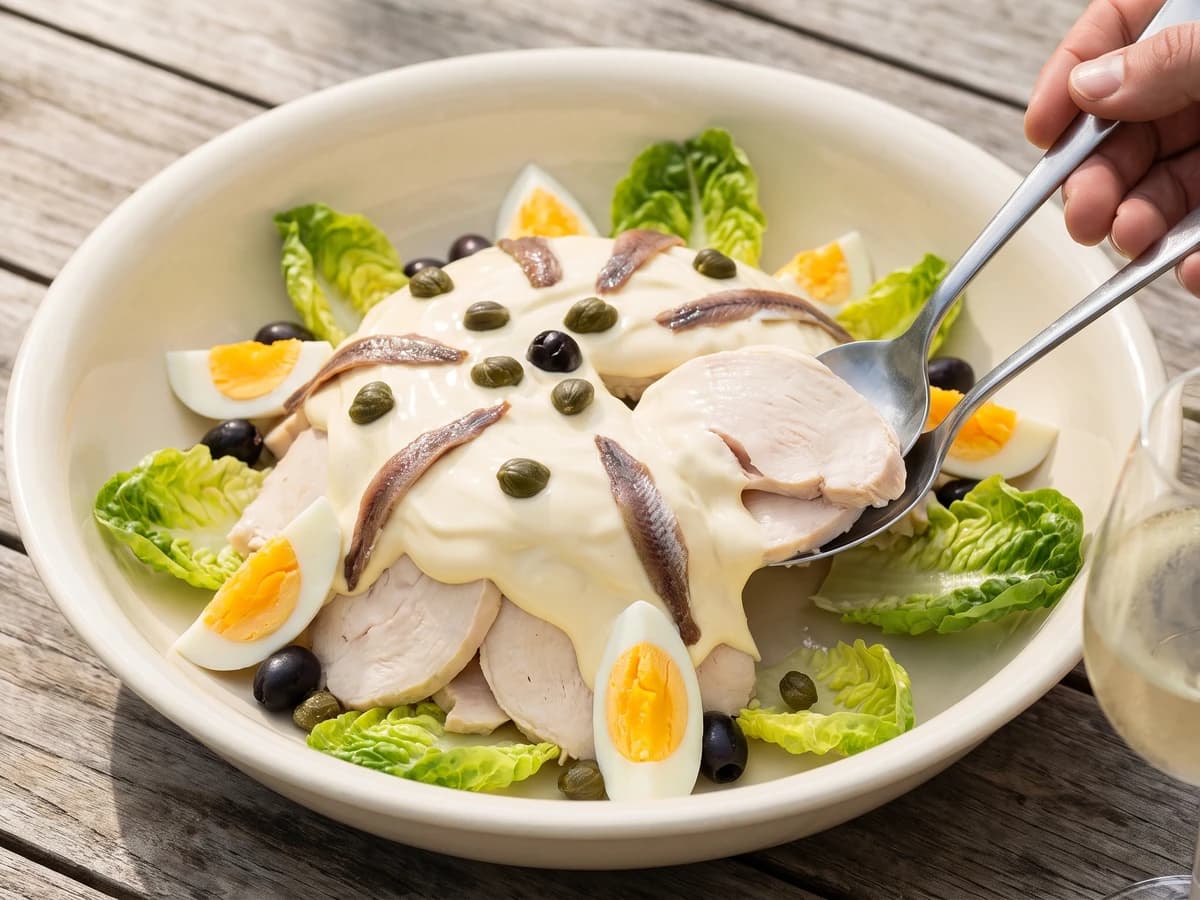
Cold roast chicken, ciseled lettuce, and a shining coat of homemade mayonnaise, arranged with capers, olives, anchovies, eggs, and lettuce hearts, then tossed at the table as the canon intends.
A cooking platform built around craft, culture, and the stories behind what we eat.

Created by Chef Juliette
Based on No. 2713, Poires Mary-Garden, from Le Guide Culinaire (1907) by Auguste Escoffier
Whole pears, poached until satin-tender and cooled in syrup, stand over bright raspberry Melba sauce and softened cherries beneath a crown of Chantilly, a cold composed dessert built on restraint.
Poires Mary-Garden (syrup-poached pears with raspberry Melba sauce, softened half-sugared cherries, and crème Chantilly, sweetened vanilla whipped cream) teaches control of water in a cold dessert. The pear must be tender but intact, the cherries softened but not waterlogged, the raspberry sauce fluid but not runny. That is the one true thing before you touch a pan: gentle poaching and disciplined draining make this dessert, while extra decoration only obscures it.
The original entry is a line of brigade shorthand. It assumes cold poached pears, Melba sauce, preserved cherries, Chantilly, and a timbale are already at hand, each prepared by its own station. A home kitchen needs no such scaffolding. One narrow saucepan and a parchment cartouche replace the standing poaching bath, while a shallow footed bowl replaces the service silver. The quantities here make four portions, and the separate preparations are arranged in a sequence one cook can finish and chill in an evening. One cook, one stove, one evening.
At the table, the pears are pale and cool against raspberry crimson, the cherries give a concentrated bite, and Chantilly softens the fruit without burying it. Watch the poach above all: keep the syrup at a bare tremble and cool the pears in it. That is where their satin texture is won.
Poires Mary-Garden belongs to the Parisian grand-kitchen repertoire, where composed fruits were named for celebrated performers and carried to the dessert table in elegant timbales. Its namesake, Mary Garden, was a Scottish-born soprano closely associated with the Opéra-Comique in Paris, and the dish reflects the theatrical supper culture that joined poached fruit to the raspberry sauce known as Melba. The pears and half-sugared cherries are not incidental additions to pêche Melba: they define a separate cold fruit composition, crowned with crème Chantilly rather than ice cream.
Quantity
4 medium (about 1¾ lb / 800 g total)
stems left intact
Quantity
4 cups (950 ml / 950 g)
Quantity
1¾ cups (415 ml / 350 g)
Quantity
2 cups (475 ml / 250 g)
frozen berries thawed but not drained
Quantity
⅓ cup (80 ml / 40 g)
Quantity
½ cup (120 ml / 100 g)
Quantity
2 cups (475 ml / 475 g)
Quantity
1 cup (240 ml / 240 g)
well chilled
Quantity
2 tablespoons (30 ml / 15 g)
Quantity
½ teaspoon (2.5 ml / 2 g)
| Ingredient | Quantity |
|---|---|
| firm-ripe Bosc or Conference pearsstems left intact | 4 medium (about 1¾ lb / 800 g total) |
| water for the poaching syrup | 4 cups (950 ml / 950 g) |
| granulated sugar | 1¾ cups (415 ml / 350 g) |
| fresh or frozen raspberriesfrozen berries thawed but not drained | 2 cups (475 ml / 250 g) |
| confectioners' sugar for the Melba sauce | ⅓ cup (80 ml / 40 g) |
| half-sugared cherries (semi-candied cherries) | ½ cup (120 ml / 100 g) |
| tepid water for softening the cherries | 2 cups (475 ml / 475 g) |
| heavy creamwell chilled | 1 cup (240 ml / 240 g) |
| confectioners' sugar for the crème Chantilly | 2 tablespoons (30 ml / 15 g) |
| pure vanilla extract | ½ teaspoon (2.5 ml / 2 g) |
Combine the poaching water and granulated sugar in a narrow saucepan that holds the pears snugly. Warm gently, stirring only until the sugar dissolves, then bring the syrup to a brief boil. Lower the heat. Peel each pear neatly, leave the stem attached, and remove the core through the base with a small melon baller. Slip each pear into the syrup as soon as it is peeled so the flesh stays pale. Cover the surface with a parchment cartouche to keep the exposed curves wet.
Hold the syrup at the barest tremble and poach the pears for 15 to 25 minutes, turning them carefully every few minutes. Test through the widest part with a thin skewer: it should enter with slight resistance, because the fruit continues softening as it cools. A rolling boil roughens the surface and can split the narrow necks. If the syrup begins boiling, pull the pan off the heat for 30 seconds, lower the flame, and resume. If one pear ripens before the others, lift it out early and cool it in a small bowl of syrup. Ça se rattrape.
Remove the pan from the heat and let the pears cool in their syrup for 30 minutes. Transfer the pears and enough syrup to cover them to a container, keep the cartouche against the fruit, and refrigerate for at least 1½ hours. Cooling in syrup keeps the flesh moist and seasons it through; cooling uncovered gives the pears a dry, darkened skin.
Blend the raspberries with the confectioners' sugar until completely puréed, then press the mixture through a fine-mesh sieve to remove every seed. The Melba sauce should fall from a spoon in a broad ribbon and settle into a glossy pool. If it is too thick, loosen it with cold pear syrup, one teaspoon at a time. If thawed berries have made it watery, reduce one-quarter of the sauce gently by half, cool it completely, then stir it back into the raw portion. This preserves the fresh raspberry character while restoring the body.
Bring the tepid water to about 38 to 40°C (100 to 104°F). Add the half-sugared cherries and leave them for 3 minutes, then test one. It should be supple through the centre but still hold its shape; give them no more than 2 additional minutes if needed. Drain thoroughly and blot gently before folding them into the Melba sauce. Softened, not soaked to rags. If they have become fragile, do not stir them through the sauce. Arrange them individually during assembly instead, ça se rattrape.
Reserve 2 tablespoons of the cold cream. Whip the remaining cream with the confectioners' sugar and vanilla until it forms smooth medium peaks that hold a curl without looking stiff. If the cream starts to look grainy, stop the mixer and fold in the reserved cream one teaspoon at a time until smooth. Ça se rattrape. If the texture is already right, fold in only enough reserved cream to leave the Chantilly supple and pipeable. Transfer it to a piping bag fitted with a medium star tip and keep it cold.
Lift the pears from their syrup and drain them on a rack for 10 minutes, then blot the bases and upper curves lightly. Spoon the cherry-studded Melba sauce into a shallow footed serving bowl, the home equivalent of the service timbale, and stand the pears upright in it. Pipe a fluted collar of crème Chantilly around each base and a small rosette against each pear. The separate brigade batches were scaffolding; pale pears over Melba sauce, softened cherries, and piped Chantilly are the dish, and all four remain.
Chill the assembled Poires Mary-Garden for 20 to 30 minutes, just long enough for the sauce and cream to settle together. Serve one pear per person with a generous spoonful of Melba sauce, several cherries, and its share of Chantilly. Do not drown the pear with extra syrup; its work is already done. À table!
1 serving (about 350g)
Culinary guides, cultural storytelling, and the editorial depth that makes cooking meaningful.
Discover Culinary ExplorerChef Juliette
Cold roast chicken, ciseled lettuce, and a shining coat of homemade mayonnaise, arranged with capers, olives, anchovies, eggs, and lettuce hearts, then tossed at the table as the canon intends.

Chef Juliette
Cold roast or poached chicken with fine ribbons of lettuce, dressed at the final moment with oil and vinegar: a composed salad whose freshness depends entirely on timing.

Chef Juliette
Five leaves, one living rule: laitue, romaine, chicorée, mâche, or pissenlit must be washed, dried, and dressed only as they go to the table, while every leaf still carries its light vinaigrette.

Chef Juliette
Salade de Betteraves proves that baking, not boiling, is the whole argument: concentrated garnet sweetness, tender baked onion, sharp mustard, and herbs cut into a weeknight salad worth making ahead.