
Chef Juliette
Various Almond Preparations
Five almond preparations, one discipline: remove the skins cleanly, dry every kernel through, then cut, toast, or cloak it in pale caramel without letting its fragrant oils escape.
A cooking platform built around craft, culture, and the stories behind what we eat.
Created by Chef Juliette
Based on No. 2712, Poires Marquise, from Le Guide Culinaire (1907) by Auguste Escoffier
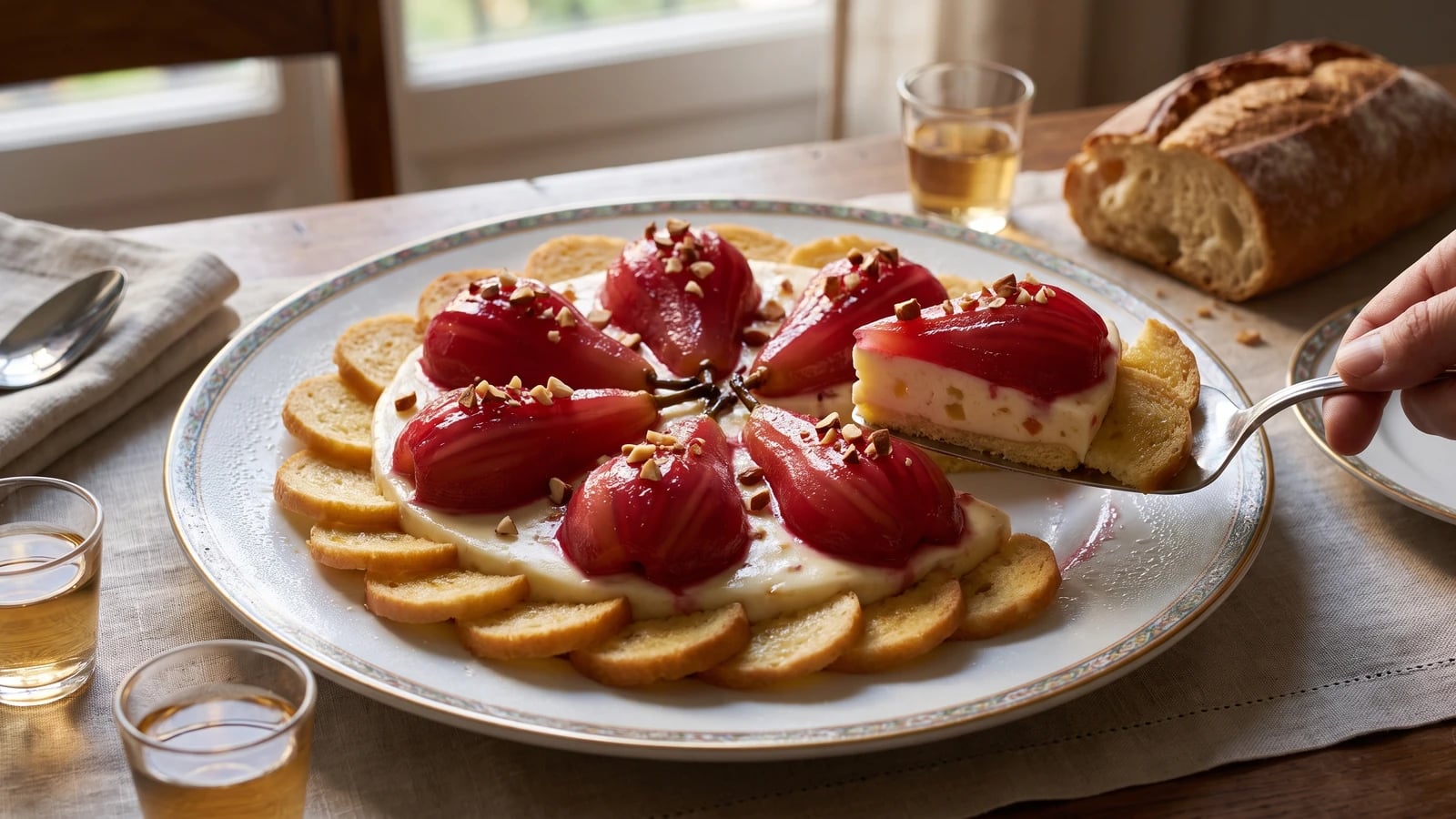
Poires Marquise teaches the patience of a proper cold glaze: vanilla-poached pears lacquered ruby, almond-crusted, and set over chilled Diplomatic Pudding with a precise border of apple-jelly croûtons.
Poires Marquise (jelly-glazed pears on a molded custard pudding) teaches the patience of a proper cold glaze. The pears must be chilled and absolutely dry, while the raspberry-flavoured redcurrant jelly must be thick enough to cling but fluid enough to brush. One coat beads and slides. Four or five thin coats make the ruby lacquer the dish requires.
The original did not need a saucier, a stock never off the fire, or a salamander. Its brigade luxury was a pastry station with poached fruit, stiff jellies, burnt almonds, and a finished Diplomatic Pudding ready at command. Here an 18 cm manqué mould replaces the banquet mould, two good market jellies form the glaze, and a small measure of gelatin firms commercial apple jelly so its croûtons cut cleanly. The gelatin and compact schedule are scaffolding. Repeated glazing and the order of assembly are the dish, so they stay.
Croûtons here means triangular pieces of set apple jelly, not fried bread. The pudding chills while you poach the pears and prepare the almonds, which brings the old arrangement within reach of one cook, one stove, one evening of active work. The decisive step is drying and chilling the pears before the first brush of jelly. Do that properly, and the glaze behaves.
Poires Marquise belongs to the Parisian grand-kitchen repertoire of cold entremets, composed sweets in which poached fruit, molded pudding, and cut jelly were assembled into a formal whole. It traveled naturally to bourgeois celebration tables because every component could be prepared ahead, though the repeated glazing still rewarded a practiced hand. Its croûtons are not bread: in this sweet use the word names the triangular apple-jelly pieces bordering the turned-out pudding.
Quantity
3 (about 1 1/4 pounds / 570 g)
peeled, halved lengthwise, and cored
Quantity
4 cups (960 ml / 960 g)
Quantity
1 1/2 cups (360 ml / 300 g)
Quantity
1
split lengthwise and scraped
Quantity
1 tablespoon (15 ml / 15 g)
Quantity
5 cups loosely packed (1.2 L / 250 g)
crusts trimmed and cut into 3/4-inch / 2-cm cubes
Quantity
1/2 cup (120 ml / 85 g)
finely diced
Quantity
3 tablespoons (45 ml / 42 g)
Quantity
1 3/4 cups (420 ml / 430 g)
Quantity
1/2 cup (120 ml / 120 g)
Quantity
1/3 cup (80 ml / 67 g)
Quantity
3
Quantity
2
Quantity
1/4 teaspoon (1.25 ml / 1.5 g)
Quantity
1 tablespoon (15 ml / 14 g)
softened, for the mould
Quantity
1 cup (240 ml / 300 g)
Quantity
1/2 cup (120 ml / 150 g)
Quantity
3/4 cup (180 ml / 90 g)
Quantity
1/4 cup (60 ml / 50 g)
Quantity
1 tablespoon (15 ml / 15 g)
Quantity
3/4 cup (180 ml / 225 g)
Quantity
1 1/2 teaspoons (7.5 ml / 4.5 g)
Quantity
2 tablespoons (30 ml / 30 g)
| Ingredient | Quantity |
|---|---|
| firm-ripe Bartlett or Comice pearspeeled, halved lengthwise, and cored | 3 (about 1 1/4 pounds / 570 g) |
| water | 4 cups (960 ml / 960 g) |
| granulated sugar for poaching | 1 1/2 cups (360 ml / 300 g) |
| vanilla beansplit lengthwise and scraped | 1 |
| fresh lemon juice | 1 tablespoon (15 ml / 15 g) |
| day-old briochecrusts trimmed and cut into 3/4-inch / 2-cm cubes | 5 cups loosely packed (1.2 L / 250 g) |
| mixed candied fruitfinely diced | 1/2 cup (120 ml / 85 g) |
| kirsch | 3 tablespoons (45 ml / 42 g) |
| whole milk | 1 3/4 cups (420 ml / 430 g) |
| heavy cream | 1/2 cup (120 ml / 120 g) |
| granulated sugar for the Diplomatic Pudding | 1/3 cup (80 ml / 67 g) |
| large eggs | 3 |
| large egg yolks | 2 |
| fine sea salt | 1/4 teaspoon (1.25 ml / 1.5 g) |
| unsalted buttersoftened, for the mould | 1 tablespoon (15 ml / 14 g) |
| redcurrant jelly | 1 cup (240 ml / 300 g) |
| seedless raspberry jelly | 1/2 cup (120 ml / 150 g) |
| blanched almonds | 3/4 cup (180 ml / 90 g) |
| granulated sugar for the burnt almonds | 1/4 cup (60 ml / 50 g) |
| water for the burnt almonds | 1 tablespoon (15 ml / 15 g) |
| clear apple jelly | 3/4 cup (180 ml / 225 g) |
| unflavored powdered gelatin | 1 1/2 teaspoons (7.5 ml / 4.5 g) |
| cold water for blooming the gelatin | 2 tablespoons (30 ml / 30 g) |
Sprinkle the gelatin over the cold water and leave it for 5 minutes, until every grain has swollen. Warm the apple jelly over low heat just until fluid, remove it from the heat, and whisk in the bloomed gelatin until completely dissolved. Strain it into a plastic-lined 15 cm square dish to form a layer about 6 mm deep. Refrigerate for at least 4 hours. If the jelly bends when cut, chill it for another 20 minutes or give it 8 minutes in the freezer; it must be firm enough to hold a sharp triangle.
Combine the candied fruit and kirsch and leave them for 20 minutes. Butter an 18 cm by 5 cm-deep manqué mould generously. Arrange the brioche and drained candied fruit evenly inside, saving any kirsch left in the bowl. Heat the milk and cream until small bubbles gather at the edge. Whisk the eggs, yolks, sugar, salt, and reserved kirsch until smooth, then pour in the hot milk mixture gradually while whisking. Strain this custard over the brioche. Press gently so every cube drinks, then leave it for 15 minutes. Dry corners of bread now become hard corners later, so turn any stubborn pieces into the custard before baking.
Heat the oven to 325°F / 160°C. Set the mould in a deep roasting pan and pour hot water around it to reach halfway up the sides. Bake in this bain-marie for 45 to 55 minutes, until the outer edge is set and the centre trembles as one piece when nudged. An instant-read thermometer should register about 175°F / 80°C at the centre. If the custard swells or bubbles at the edge, add a little cool water to the bath and lower the oven by 20°F / 10°C. Cool the Diplomatic Pudding in its mould for 30 minutes, then refrigerate it for at least 4 hours.
Combine the water, poaching sugar, vanilla pod and seeds, and lemon juice in a wide saucepan. Bring it to a boil, stirring only until the sugar dissolves, then lower it to the gentlest simmer. Add the pear halves and cover their surface with a round of parchment so they remain submerged. Poach for 12 to 20 minutes, according to ripeness, until a small knife enters the thickest part with slight resistance. Cool the pears in the syrup for 30 minutes, then drain them cavity-side down on a rack and refrigerate uncovered for at least 1 hour. Their surfaces must feel cold and dry, not slick with syrup.
Toast the almonds in a dry pan over medium heat until biscuit-gold, then tip them onto a plate. Combine the almond sugar and water in the pan and cook without stirring until the syrup becomes a deep amber caramel. Add the toasted almonds, turn them quickly through the caramel, and spread them on parchment to cool. Chop them into small irregular pieces once hard. Burnt here means dark caramel, not black almonds; if the caramel smells acrid, begin again, because bitterness will follow every pear to the table.
Melt the redcurrant and raspberry jellies together over low heat. Bring them to a brisk simmer for 3 to 5 minutes, stirring and skimming away any foam, until a drop placed on a cold plate thickens promptly and holds a rounded edge. Strain the glaze, then let it cool until it flows from the brush like warm honey. If it remains watery, simmer it for another minute. If it sets before the pears are ready, warm it gently with a teaspoon of pear syrup.
Blot the chilled pears once more and place them cavity-side down on a rack over a tray. Brush each one with a very thin coat of red glaze, refrigerate for 5 minutes, then repeat until the surface carries four to six clear, ruby layers. Work on one pear at a time for the final coat and sprinkle it immediately with the chopped burnt almonds before the jelly sets. If the first coat beads or slips, stop. Ça se rattrape: blot and chill the pears again, let the glaze thicken for several minutes, then begin with a thinner coat. One heavy pass will only slide into the tray.
Run a thin knife around the edge of the chilled Diplomatic Pudding. Dip the base of the mould in warm water for 5 seconds, dry it, place a round serving dish on top, and invert decisively. If it holds, repeat the warm dip rather than pulling at the pudding. Turn out the apple jelly and cut it with a warm knife into neat triangles about 3 cm wide. Arrange these apple-jelly croûtons in an overlapping border around the base. Set the six glazed pear halves radially on top, tips pointing toward the centre. Keep the finished dessert chilled until 10 minutes before serving. À table!
1 serving (about 420g)
Culinary guides, cultural storytelling, and the editorial depth that makes cooking meaningful.
Discover Culinary ExplorerChef Juliette
Five almond preparations, one discipline: remove the skins cleanly, dry every kernel through, then cut, toast, or cloak it in pale caramel without letting its fragrant oils escape.

Chef Juliette
A pastry pantry lesson in one tray: filberts warmed only until their red skins release, rubbed clean, cooled, and chopped into a fragrant mise-en-place for cakes, creams, pralines, and petits fours.

Chef Juliette
The smallest pâtisserie discipline decides whether a cake leaves its mould intact: clarified butter in every corner, followed by the lightest veil of dry flour or fécule.

Chef Juliette
Four whites, one spotless bowl, and a patient change of speed: whisk gently until loosened, then briskly to glossy stiffness, with powdered sugar waiting if the foam begins to granulate.