
Chef Juliette
Various Almond Preparations
Five almond preparations, one discipline: remove the skins cleanly, dry every kernel through, then cut, toast, or cloak it in pale caramel without letting its fragrant oils escape.
A cooking platform built around craft, culture, and the stories behind what we eat.
Created by Chef Juliette
Based on No. 2710, Poires à la Florentine, from Le Guide Culinaire (1907) by Auguste Escoffier
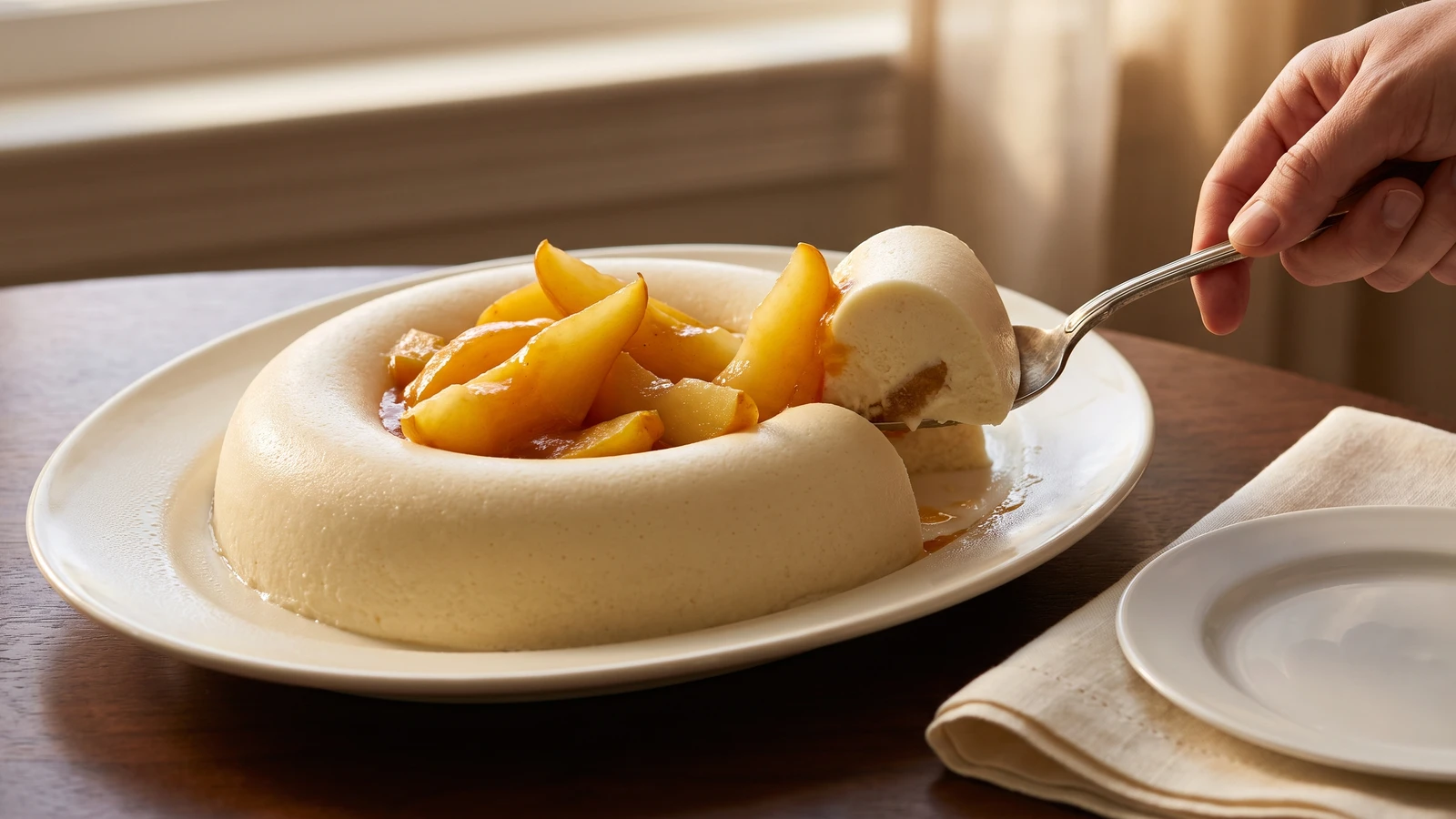
A chilled ring of creamy semolina Bavarois holding tender pears in vanilla apricot purée, turned out only when the table is ready because its delicate set softens as it stands.
Poires à la Florentine, stewed pears in vanilla apricot purée inside a Bavarois de semoule (chilled semolina cream) ring, teaches the discipline of temperature. The one true thing to know before touching a pan is that the instruction to unmould at the last moment is structural, not theatrical. The Bavarois is intentionally tender, and it begins to soften once it leaves the cold.
The original entry assumed a pastry station with the Bavarois and apricot purée already prepared, an oiled border mould waiting in the cold room, and a free pair of hands at service. At home, a one-litre savarin mould, powdered gelatin, the refrigerator, and smooth apricot preserves sieved with pear syrup do the same work. I have folded those separate brigade preparations into one sequence and reduced the quantity to six servings. That preparation was scaffolding. The ring of semolina cream, the stewed pears, the vanilla apricot binding, and the last-minute turn-out are the dish itself, so all four stay. One cook, one stove, one evening.
When it is right, the ring is ivory and softly set, the pears keep their shape, and the apricot purée clings in a clear amber coat rather than running across the platter. The decisive moment comes before moulding: fold in the cream only when the semolina base is cool enough not to melt it but still supple enough to accept it smoothly.
Poires à la Florentine belongs to the codified dining-room repertoire of Parisian grand kitchens, where cold moulded sweets were assembled from prepared pastry bases and turned out immediately before service. Its structure follows classical pâtisserie practice precisely: a Bavarois border supplies the shape, stewed fruit fills the centre, and apricot purée serves as both sauce and liaison. Here the name does not carry the usual savoury Florentine formula associated with spinach; the entry defines it instead through semolina, pears, apricot, and vanilla.
Quantity
1 teaspoon (5 ml / 4 g)
for the mould
Quantity
2 teaspoons (10 ml / 6 g)
Quantity
3 tablespoons (45 ml / 45 g)
for blooming the gelatin
Quantity
2 cups (480 ml / 495 g)
Quantity
⅓ cup (80 ml / 55 g)
Quantity
⅓ cup (80 ml / 65 g)
Quantity
⅛ teaspoon (0.6 ml / 0.7 g)
Quantity
¾ cup (180 ml / 180 g)
Quantity
4 medium (about 2 pounds / 900 g before trimming)
peeled, cored, and cut into wedges
Quantity
2 cups (480 ml / 480 g)
for stewing the pears
Quantity
½ cup (120 ml / 100 g)
Quantity
2 tablespoons (30 ml / 30 g)
Quantity
⅔ cup (160 ml / 210 g)
Quantity
1
split lengthwise
| Ingredient | Quantity |
|---|---|
| neutral oilfor the mould | 1 teaspoon (5 ml / 4 g) |
| unflavoured powdered gelatin | 2 teaspoons (10 ml / 6 g) |
| cold waterfor blooming the gelatin | 3 tablespoons (45 ml / 45 g) |
| whole milk | 2 cups (480 ml / 495 g) |
| fine semolina | ⅓ cup (80 ml / 55 g) |
| superfine sugar | ⅓ cup (80 ml / 65 g) |
| fine sea salt | ⅛ teaspoon (0.6 ml / 0.7 g) |
| cold heavy cream | ¾ cup (180 ml / 180 g) |
| firm-ripe pearspeeled, cored, and cut into wedges | 4 medium (about 2 pounds / 900 g before trimming) |
| waterfor stewing the pears | 2 cups (480 ml / 480 g) |
| granulated sugar | ½ cup (120 ml / 100 g) |
| fresh lemon juice | 2 tablespoons (30 ml / 30 g) |
| smooth apricot preserves | ⅔ cup (160 ml / 210 g) |
| vanilla beansplit lengthwise | 1 |
Brush the inside of a one-litre border or savarin mould with the neutral oil, then wipe it almost dry with kitchen paper. The source calls for an oiled mould, but it means the faintest film, not a visible slick. Sprinkle the gelatin evenly over the cold water and leave it for 5 to 10 minutes, until every granule is swollen and no dry patches remain.
Bring the milk, superfine sugar, and salt to a bare simmer in a heavy saucepan. Shower in the semolina slowly while whisking without pause, then lower the heat and cook for 8 to 10 minutes, stirring into the corners, until the grains are fully swollen and the mixture falls from the spoon in a thick ribbon. The semolina must become tender now because chilling will set it, not finish cooking it. If lumps form, lift the pan from the heat and whisk firmly; stubborn ones can be smoothed with one or two brief pulses of an immersion blender. Ça se rattrape.
Remove the semolina from the heat, add the bloomed gelatin, and stir until it has dissolved completely. Transfer the mixture to a wide bowl and let it cool for 20 to 30 minutes, stirring occasionally so the edges do not set first. Whip the cold cream to soft folds that hold their shape but still bend from the whisk. When the semolina feels barely warm and remains fluid, fold in one-third of the cream to loosen it, then fold in the rest. If the base is warm enough to melt the cream, wait. If it has begun setting into little ropes, stand the bowl briefly over warm water and whisk it smooth before folding. This temperature is the dish.
Spoon the Bavarois into the prepared mould, working it firmly into the curved base and around the central tube so no air pockets remain. Level the surface, tap the mould once against a folded towel, and cover it without touching the cream. Chill for at least 6 hours, preferably overnight, until the ring is set through but still yields slightly when pressed.
Combine the water, granulated sugar, and lemon juice in a saucepan just wide enough to hold the pears. Bring it to a simmer and stir until the sugar dissolves, then add the pear wedges and cover with a round of baking paper or a lid left slightly ajar. Keep the liquid at the gentlest tremble for 8 to 15 minutes, depending on the pears, until a small knife enters easily but the wedges still hold their shape. Lift them out carefully and cool them in a single layer. Reserve ¼ cup (60 ml / 60 g) of the poaching syrup. If a few wedges become too soft, place them at the bottom of the finished centre and save the firm pieces for the top.
Put the apricot preserves and reserved pear syrup in a small saucepan. Scrape in the vanilla seeds, add the pod, and bring the mixture to a bare simmer for 3 minutes. Cover, remove from the heat, and infuse for 10 minutes, then discard the pod and press the sauce through a fine sieve. It should be glossy and thick enough to coat a pear wedge. If it runs like syrup, reduce it briefly before adding the fruit; if it sits like jam, loosen it with another spoonful of pear syrup. Cool completely, then fold it gently through the pears so they are cohered by the purée rather than drowned in it.
Chill the serving platter before you begin. Gently ease the outer and inner edges of the Bavarois away from the mould with a fingertip, place the platter over it, and invert both together. If the ring does not release, wrap the mould for 5 to 10 seconds in a cloth wrung out in warm water, then try again; prolonged heat will soften the surface. Spoon the pear wedges into the centre, letting the vanilla apricot purée gleam between them, and serve at once. The ring will soften as it stands, exactly as the original entry warns. À table!
1 serving (about 390g)
Culinary guides, cultural storytelling, and the editorial depth that makes cooking meaningful.
Discover Culinary ExplorerChef Juliette
Five almond preparations, one discipline: remove the skins cleanly, dry every kernel through, then cut, toast, or cloak it in pale caramel without letting its fragrant oils escape.

Chef Juliette
A pastry pantry lesson in one tray: filberts warmed only until their red skins release, rubbed clean, cooled, and chopped into a fragrant mise-en-place for cakes, creams, pralines, and petits fours.

Chef Juliette
The smallest pâtisserie discipline decides whether a cake leaves its mould intact: clarified butter in every corner, followed by the lightest veil of dry flour or fécule.

Chef Juliette
Four whites, one spotless bowl, and a patient change of speed: whisk gently until loosened, then briskly to glossy stiffness, with powdered sugar waiting if the foam begins to granulate.