
Chef Juliette
Various Almond Preparations
Five almond preparations, one discipline: remove the skins cleanly, dry every kernel through, then cut, toast, or cloak it in pale caramel without letting its fragrant oils escape.
A cooking platform built around craft, culture, and the stories behind what we eat.
Created by Chef Juliette
Based on No. 2694, Pêches Aiglon, from Le Guide Culinaire (1907) by Auguste Escoffier
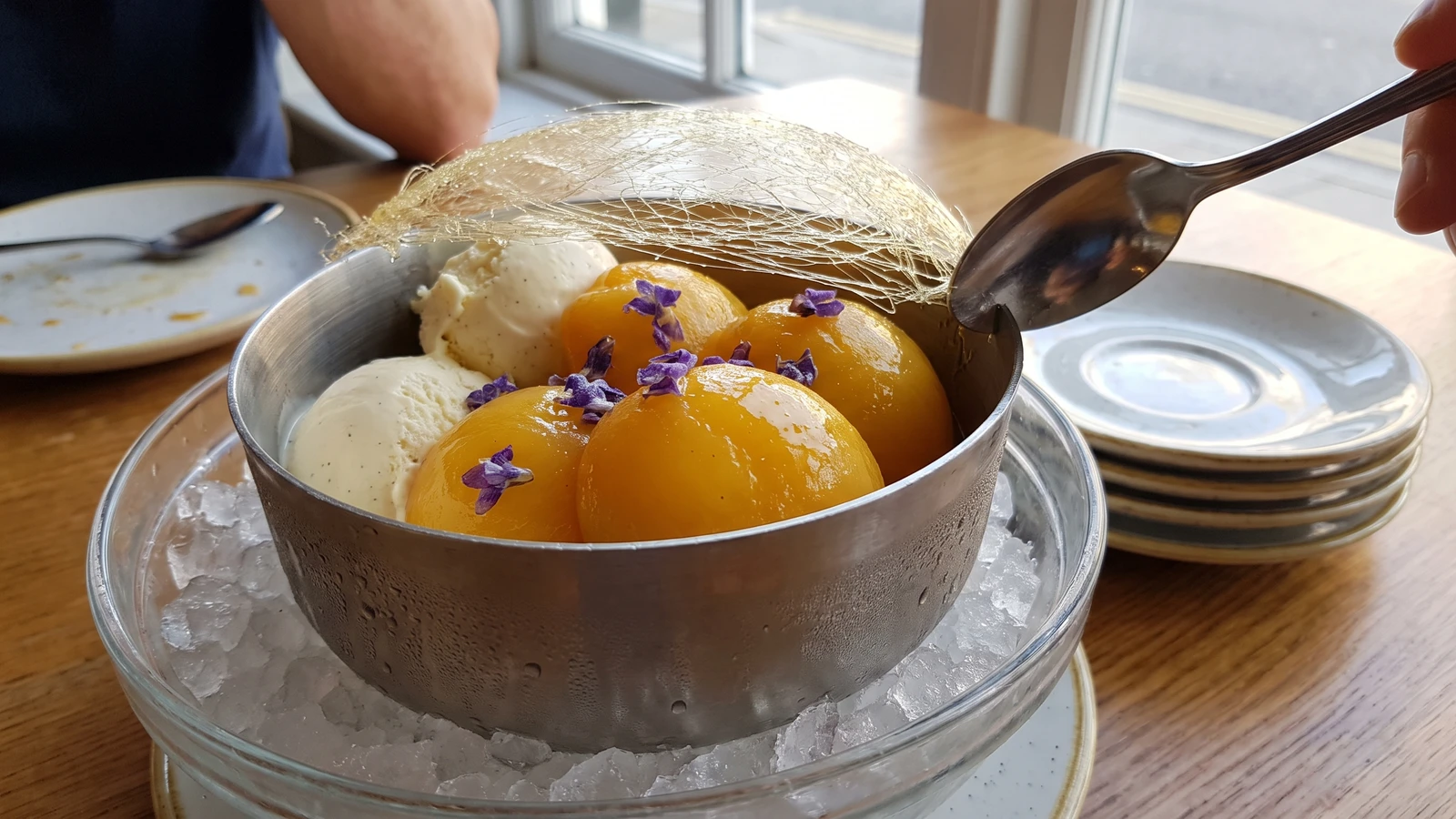
Four vanilla-poached peaches settle into a cold bed of vanilla ice cream, bright with crystallised violets and covered at the last moment by spun sugar fine enough to crack under the serving spoon.
Pêches Aiglon (vanilla-poached peaches on vanilla ice) teaches that cold is structure, not decoration. Before touching a pan, know the one truth of it: a warm or syrup-wet peach will melt the ice cream and dissolve the spun sugar, so every element must be cold, drained, and waiting before assembly.
The original assumed a pastry brigade, a false-bottomed silver timbale whose hidden compartment held broken ice, and enough hands to carve an eagle from a block of ice while another cook spun sugar. A freezer-cold stainless-steel bowl nested in crushed ice is the honest home timbale, and a good dense vanilla ice cream replaces the brigade batch. The carved eagle is service scaffolding and goes; the cold timbale, crystallised violets, and spun-sugar veil are the dish and stay. The labor shrinks because four guests don't need an ice sculpture, not because the composition asks for less. One cook, one stove, one evening.
When Pêches Aiglon reaches the table, the peaches should gleam against ivory ice cream, the violets should flash purple through the pale gold sugar, and the first serving spoon should crack the veil cleanly. Cool the peaches completely in their vanilla syrup, then drain them until their surfaces are dry; that is the step that decides the dish.
Pêches Aiglon belongs to the named showpiece desserts of the Parisian grand-kitchen repertoire, not to any one peach-growing region. Aiglon means “eaglet,” and the original eagle carved from ice made the title's imperial allusion literal while the silver timbale demonstrated command of frozen service. Classical manuals carried the composition beyond grand dining rooms, and the home table can keep its true structure, vanilla-poached fruit, vanilla ice, violets, and spun sugar, without preserving the sculpture.
Quantity
4 (about 1½ lb / 680 g total)
ripe but firm
Quantity
3 cups (710 ml / 710 g)
Quantity
1½ cups (360 ml / 300 g)
Quantity
1
split lengthwise and scraped
Quantity
1 pint (475 ml / about 425 g)
Quantity
¼ cup (60 ml / 30 g)
Quantity
1 cup (240 ml / 200 g)
Quantity
¼ cup plus 2 tablespoons (90 ml / 90 g)
divided
Quantity
1 tablespoon (15 ml / 20 g)
Quantity
1 teaspoon (5 ml / 4 g)
Quantity
8 cups (1.9 L / about 1.1 kg)
| Ingredient | Quantity |
|---|---|
| medium yellow peachesripe but firm | 4 (about 1½ lb / 680 g total) |
| water, for the vanilla syrup | 3 cups (710 ml / 710 g) |
| granulated sugar, for the vanilla syrup | 1½ cups (360 ml / 300 g) |
| vanilla beansplit lengthwise and scraped | 1 |
| dense vanilla ice cream | 1 pint (475 ml / about 425 g) |
| crystallised violets | ¼ cup (60 ml / 30 g) |
| granulated sugar, for the spun sugar | 1 cup (240 ml / 200 g) |
| water, for the spun sugardivided | ¼ cup plus 2 tablespoons (90 ml / 90 g) |
| glucose syrup | 1 tablespoon (15 ml / 20 g) |
| neutral oil, for the sugar-working utensils | 1 teaspoon (5 ml / 4 g) |
| crushed ice, for chilling the timbale | 8 cups (1.9 L / about 1.1 kg) |
Place a shallow 1½-quart (1.4 L) stainless-steel serving bowl in the freezer. Set a wider bowl nearby for the crushed-ice bed, but don't pack it yet; dry metal against dry cold keeps the ice cream firm, while melting ice introduced too early only leaves you a wet table.
Put the 3 cups water and 1½ cups sugar in a saucepan just wide enough to hold the peaches snugly. Add the vanilla seeds and pod, bring slowly to a boil, and stir only until the sugar dissolves. Simmer for 5 minutes, then lower the heat until the syrup barely trembles. This vanilla syrup is the foundation of Pêches Aiglon, so let the pod infuse throughout the poaching and cooling.
Peel the peaches carefully with a serrated peeler. If the skins cling, score a shallow cross at the base, lower the fruit into boiling water for 20 seconds, then cool it briefly in iced water and slip off the skin. Set the peaches in the vanilla syrup and cover them with a round of parchment so they remain submerged. Poach at a bare tremble, turning once, until a fine knife enters near the stem with slight resistance, 8 to 14 minutes depending on ripeness. Lift each peach as it becomes tender rather than waiting for the others; if one splits, keep it intact and later place the split side down.
Return all four peaches to the syrup, take the pan off the heat, and let them cool in it for 45 minutes. Transfer the covered pan to the refrigerator and chill for at least 2 hours. Twenty minutes before serving, drain the peaches on a rack set over a tray, then blot them gently. They must be cold and nearly dry outside; if syrup still beads on the surface, give them another 10 minutes on the rack.
Line a deep roasting tin with parchment and bridge two wooden-spoon handles across it, about 8 inches (20 cm) apart. Wipe the handles lightly with the neutral oil. Put the spun-sugar sugar, ¼ cup of its measured water, and the glucose in a spotless small saucepan. Stir over low heat only until dissolved, then stop stirring and cook to 311°F (155°C), when the syrup is pale straw-colored. If crystals form at the sides while the syrup remains clear, cover the pan for 60 seconds so condensation washes them down. If the whole pan turns grainy, remove it, let it cool completely, add the reserved 2 tablespoons water, and dissolve it again over low heat. Ça se rattrape. Let the cooked sugar stand for about 1 minute, until a fork dipped into it trails fine threads rather than droplets. Flick the fork rapidly back and forth over the handles, building a broad, airy sheet. Once completely cool, gather the threads gently into a veil large enough to cover the peaches. If the syrup thickens before you have enough, warm it over low heat for a few seconds and continue.
Pack the crushed ice into the wider bowl and nest the frozen metal timbale securely inside it. Let the vanilla ice cream soften only until a spoon can draw a clean trough through it, then spread it across the bottom in a layer about ¾ inch (2 cm) thick. Make four shallow hollows to steady the fruit. If the ice cream turns glossy or begins to slump, return the inner bowl to the freezer for 10 minutes before continuing.
Blot the peaches once more and settle them upright in the vanilla ice cream. Strew the crystallised violets generously over the fruit and ice cream, then drape the spun-sugar veil loosely over the whole timbale. Carry it straight to the table while the sugar is crisp and the ice cream holds its shape. À table!
1 serving (about 335g)
Culinary guides, cultural storytelling, and the editorial depth that makes cooking meaningful.
Discover Culinary ExplorerChef Juliette
Five almond preparations, one discipline: remove the skins cleanly, dry every kernel through, then cut, toast, or cloak it in pale caramel without letting its fragrant oils escape.

Chef Juliette
A pastry pantry lesson in one tray: filberts warmed only until their red skins release, rubbed clean, cooled, and chopped into a fragrant mise-en-place for cakes, creams, pralines, and petits fours.

Chef Juliette
The smallest pâtisserie discipline decides whether a cake leaves its mould intact: clarified butter in every corner, followed by the lightest veil of dry flour or fécule.

Chef Juliette
Four whites, one spotless bowl, and a patient change of speed: whisk gently until loosened, then briskly to glossy stiffness, with powdered sugar waiting if the foam begins to granulate.