
Chef Juliette
Various Almond Preparations
Five almond preparations, one discipline: remove the skins cleanly, dry every kernel through, then cut, toast, or cloak it in pale caramel without letting its fragrant oils escape.
A cooking platform built around craft, culture, and the stories behind what we eat.
Created by Chef Juliette
Based on No. 2691, Oranges Rubannées, from Le Guide Culinaire (1907) by Auguste Escoffier
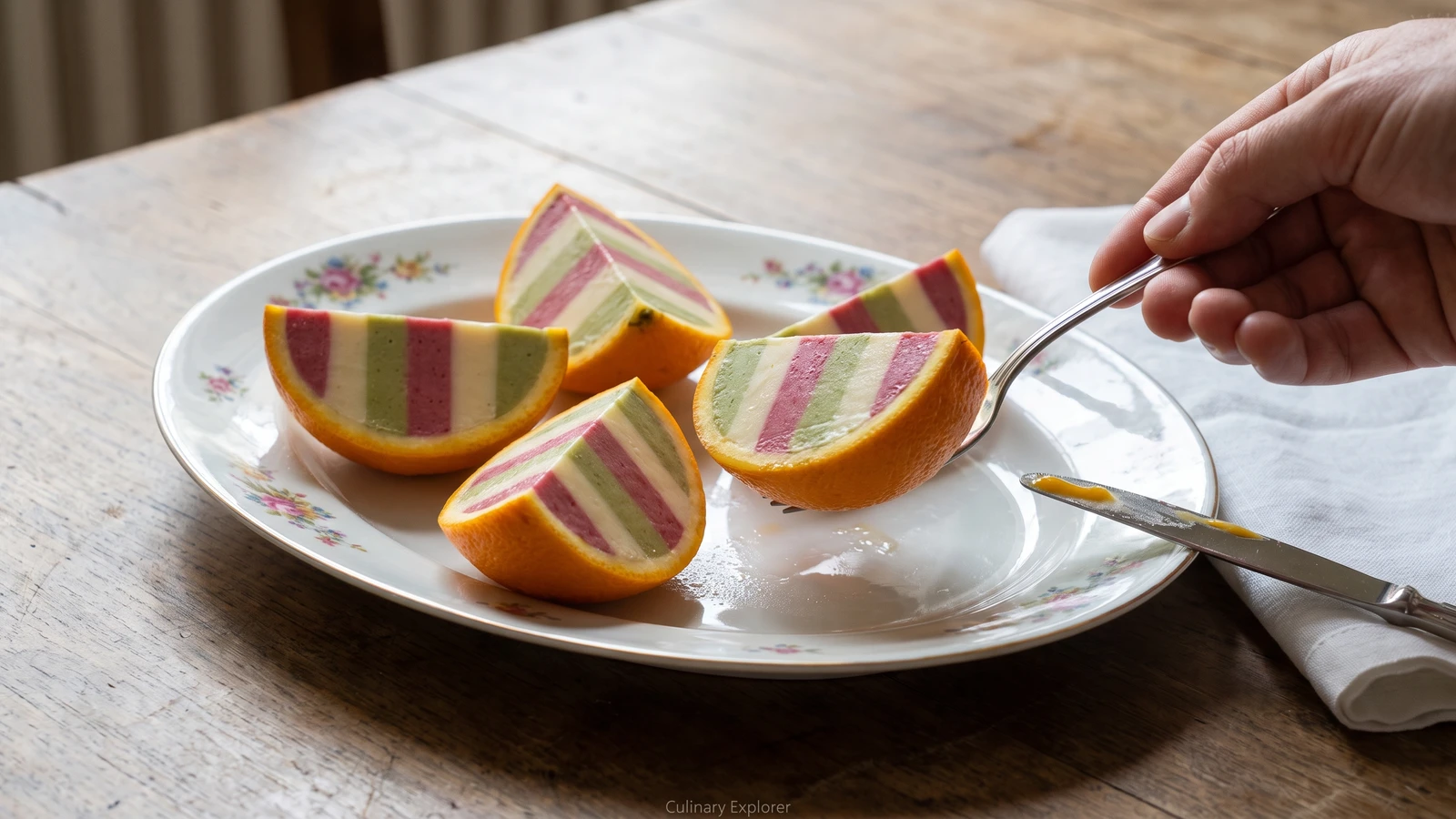
Oranges Rubannées turn a whole orange into its own striped mould: six clean ribbons of raspberry, vanilla, and pistachio blanc-mange, chilled firm and cut at the table to reveal the pattern.
Oranges Rubannées (ribboned oranges) teach one thing above all: a layer must be cold and firm before the next one touches it. The reward is wonderfully theatrical without fuss, an ordinary orange quartered at the table to show clean bands of ivory vanilla, berry pink, and pistachio green. Cooking well is not cooking fancy; here, patience makes the pattern.
The original entry assumed an entremets station with several differently coloured blanc-manges waiting in the cold, plus enough hands to fill a banquet quantity. A home kitchen needs neither. I make one almond-and-cream blanc-mange, divide it among three bowls, flavour each separately, and hold four hollowed oranges upright in a muffin tin. What changed is the brigade scaffolding and the quantity. What stays is the dish: true blanc-mange, real cream, whole orange shells, regular ribbons, and the final quartering. One cook, one stove, one evening.
Cool every flavoured portion until it remains fluid but is no longer warm. If one sets in its bowl before its turn, gentle warm water will return it to liquid. Ça se rattrape. The step that decides the dish is simpler still: test each ribbon with a fingertip, and don't pour the next until nothing clings.
Oranges Rubannées belong to the Parisian grand-kitchen repertoire of cold entremets, where fruit skins served as natural moulds and exact layers displayed the discipline of the pastry station. The revealing detail is that the filled oranges were never meant to remain whole: quartering exposed their ribbons, and the resulting wedges could also garnish larger cold entremets.
Quantity
5 large
4 for filling and 1 spare
Quantity
2 cups (480 ml / 495 g)
divided
Quantity
1 cup (240 ml / 240 g)
Quantity
⅓ cup (80 ml / 67 g)
Quantity
4 teaspoons (20 ml / 12 g)
Quantity
⅛ teaspoon (0.6 ml / 0.7 g)
Quantity
1 teaspoon (5 ml / 4 g)
Quantity
3 tablespoons (45 ml / 45 g)
Quantity
2 tablespoons (30 ml / 32 g)
Quantity
1 drop
Quantity
1 drop
| Ingredient | Quantity |
|---|---|
| large navel oranges4 for filling and 1 spare | 5 large |
| unsweetened almond milkdivided | 2 cups (480 ml / 495 g) |
| heavy cream | 1 cup (240 ml / 240 g) |
| granulated sugar | ⅓ cup (80 ml / 67 g) |
| powdered gelatin | 4 teaspoons (20 ml / 12 g) |
| fine sea salt | ⅛ teaspoon (0.6 ml / 0.7 g) |
| pure vanilla extract | 1 teaspoon (5 ml / 4 g) |
| smooth seedless raspberry purée | 3 tablespoons (45 ml / 45 g) |
| unsweetened pistachio paste | 2 tablespoons (30 ml / 32 g) |
| red gel food colouring (optional) | 1 drop |
| green gel food colouring (optional) | 1 drop |
Choose four oranges that stand reasonably upright and keep the fifth in reserve. Cut a neat lid about 2 cm wide from the stem end of each orange. With a small serrated spoon or grapefruit knife, loosen the segments from the pith and lift out the flesh in pieces, then draw out the loose membranes without thinning the white pith or piercing the rind. Rinse the cavities briefly with cold water, drain them upside down, and dry them thoroughly. Residual juice can soften the first ribbon. Stand the shells securely in a muffin tin or individual ramekins.
Fill one average shell with water, pour that water into a measuring jug, and divide the volume by six. This is the amount of blanc-mange needed for each ribbon in that shell; most large oranges take 20 to 30 ml per layer. Empty and dry the shell again. Use the same measured amount for every layer so the bands remain regular.
Pour ¼ cup (60 ml) of the measured almond milk into a small bowl and sprinkle the gelatin evenly over its surface. Leave it undisturbed for 8 to 10 minutes, until every grain has swollen and the mixture resembles a soft sponge. Dry pockets of gelatin make rubbery specks, so don't heap the powder in one place.
Combine the remaining almond milk, the cream, sugar, and salt in a saucepan. Heat gently, stirring, until the sugar dissolves and the mixture is hot but not boiling. Take the pan from the heat, add the bloomed gelatin, and whisk until completely dissolved. Pour the blanc-mange through a fine sieve, then cool it over a bowl of cold water, stirring occasionally, until it is fluid and no warmer than room temperature. If it begins setting around the edges, lift it from the cold water and whisk gently until smooth.
Divide the blanc-mange equally among three small bowls. Stir the vanilla into the first. Whisk the raspberry purée into the second a teaspoon at a time, adding the red colouring only if the fruit gives too pale a pink. Blend the pistachio paste into the third, adding the green colouring only if needed. Stir without raising bubbles; trapped foam leaves holes across the cut ribbons. If the pistachio paste resists, smooth it first with a spoonful of its blanc-mange, then return that mixture to the bowl.
Spoon one measured raspberry layer into every orange and refrigerate the shells, perfectly level, for 15 to 25 minutes. The surface is ready when it feels firm and nothing clings to a lightly placed fingertip. Add an equal vanilla layer, chill again, then add pistachio. Repeat the sequence once more, keeping every portion cool and fluid before it touches the set layer beneath. If a new colour begins sinking into the old one, stop immediately, lift off the still-fluid mixture with a teaspoon, and chill the shell another 15 minutes. Warm the rescued mixture over barely warm water, let it cool, and pour again. Ça se rattrape.
Cover the muffin tin without letting the covering touch the blanc-mange and refrigerate the completed oranges for at least 4 hours, preferably overnight. They are ready when the centre feels firm under gentle pressure. Don't freeze them to hurry the setting; the blanc-mange can release water as it thaws, blurring the very ribbons you worked to preserve.
Keep the oranges cold until serving. Dip a thin, sharp knife in hot water, wipe it dry, and cut each orange lengthwise in half with one firm downward stroke. Wipe and warm the blade again, then divide each half into two wedges. Don't saw through the blanc-mange, which drags the colours across one another. Arrange four striped quarters per person and serve at once. À table!
1 serving (about 225g)
Culinary guides, cultural storytelling, and the editorial depth that makes cooking meaningful.
Discover Culinary ExplorerChef Juliette
Five almond preparations, one discipline: remove the skins cleanly, dry every kernel through, then cut, toast, or cloak it in pale caramel without letting its fragrant oils escape.

Chef Juliette
A pastry pantry lesson in one tray: filberts warmed only until their red skins release, rubbed clean, cooled, and chopped into a fragrant mise-en-place for cakes, creams, pralines, and petits fours.

Chef Juliette
The smallest pâtisserie discipline decides whether a cake leaves its mould intact: clarified butter in every corner, followed by the lightest veil of dry flour or fécule.

Chef Juliette
Four whites, one spotless bowl, and a patient change of speed: whisk gently until loosened, then briskly to glossy stiffness, with powdered sugar waiting if the foam begins to granulate.