Culinary Explorer

A cooking platform built around craft, culture, and the stories behind what we eat.
Discover Culinary Explorer
Fraises “Rêve de Bébé”

Fraises “Rêve de Bébé”

Created by Chef Juliette

Based on No. 2682, Fraises “Rêve de Bébé”, from Le Guide Culinaire (1907) by Auguste Escoffier

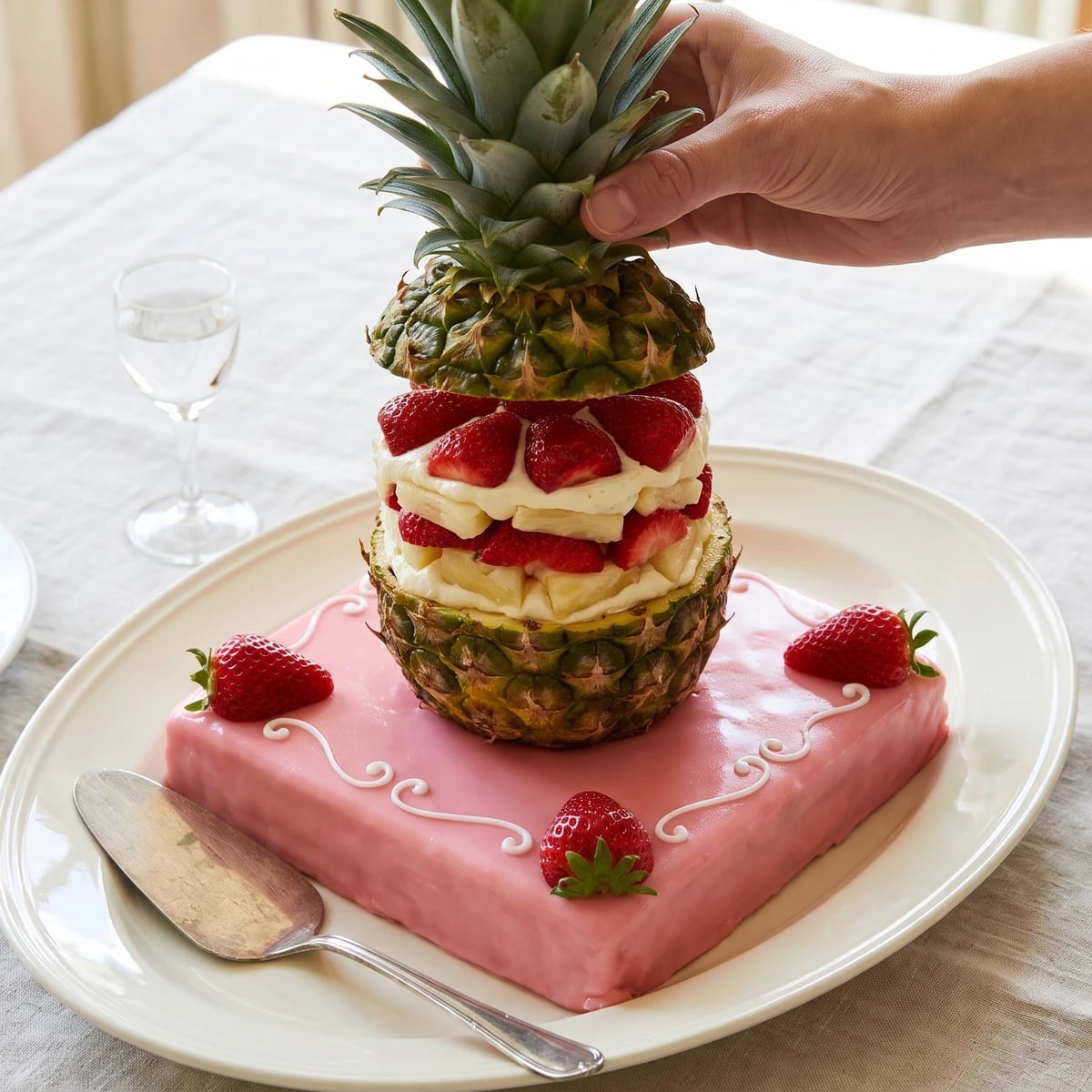
Fraises “Rêve de Bébé” turns a ripe pineapple into a chilled celebration: kirsch-scented fruit, juice-macerated strawberries, and vanilla Chantilly layered at the last moment over a pink-fondant Génoise cushion.

Desserts
French
Special Occasion
Celebration
Birthday
1 hr
Active Time
5 min cook3 hr 5 min total
Yield1 celebration centerpiece (6 servings)

Fraises “Rêve de Bébé” (Baby’s Dream strawberries) teaches cold assembly. Its pineapple shell, liqueured fruit, Chantilly, and fondant-glazed Génoise are each stable alone and short-lived together. Know the one true thing before you warm the fondant: build the layers only when the table is ready, because waiting turns distinct fruit and cream into a sweet puddle.

The source entry assumed a pastry station with finished Pâte à Génoise Fine (No. 2376), fondant and glace royale at hand, a display-only dry-paste plinth, and enough hands to hollow, glaze, macerate, whip, and assemble near service. One cook needs none of that scaffolding. This six-serving version replaces the dry-paste base with a sturdy cake board and the brigade’s whisking arm with an electric mixer. What remains unchanged is the dish itself: half the pineapple sliced with kirsch, maraschino, and sugar; half pressed for the juice that receives the strawberries; real vanilla Chantilly between every layer; pink fondant beneath it all.

Very cold, it gives you tart berries, floral pineapple, dry cherry warmth, and ivory cream against the sweet Génoise cushion. Keep the shell, fruits, Chantilly, and cushion separately chilled until the guests are seated. That last-minute layering is the step that decides everything.

Fraises “Rêve de Bébé” belongs to the Parisian grand-kitchen tradition of named entremets, where pastry cooks turned chilled fruit, liqueurs, cream, and decorated cake into edible table architecture. Its pineapple shell and fondant-glazed Génoise place it at a formal celebration table rather than in any one regional larder, while kirsch and maraschino reflect the cosmopolitan pantry of French hotel and banquet service. The fanciful name can mislead: this is no nursery sweet, since the two liqueurs are structural flavors rather than decoration.

The technique, the tradition, and the story behind every dish.

Discover Culinary Explorer

Ingredients

finished square cushion of Pâte à Génoise Fine

Quantity

1 finished 6-inch (15 cm) square by 2-inch (5 cm) thick Pâte à Génoise Fine (No. 2376) (about 1 lb 2 oz / 500 g)

large, very ripe pineapple

Quantity

1 (about 3½ to 4 lb / 1.6 to 1.8 kg)

ripe strawberries

Quantity

2½ cups (about 12 oz / 350 g)

hulled and halved or quartered

large ripe strawberries

Quantity

4

left whole with their green caps

kirsch

Quantity

2 tablespoons (30 ml / 28 g)

maraschino liqueur

Quantity

1 tablespoon (15 ml / 14 g)

granulated sugar

Quantity

2 tablespoons (30 ml / 25 g)

cold heavy cream

Quantity

1 cup (240 ml / 240 g)

confectioners’ sugar

Quantity

2 tablespoons (30 ml / 15 g)

pure vanilla extract

Quantity

1 teaspoon (5 ml / 5 g)

white fondant pâtissier, or pouring fondant

Quantity

1 cup (240 ml / 300 g)

pink gel food coloring

Quantity

1 to 2 drops

white glace royale, or royal icing

Quantity

¼ cup (60 ml / 75 g)

at medium piping consistency

warm water (optional)

Quantity

1 tablespoon (15 ml / 15 g)

Equipment Needed

  • 6-inch (15 cm) square rigid cake board
  • Wire rack and rimmed tray
  • Small sharp knife and melon baller
  • Fine-mesh sieve or food mill
  • Electric hand mixer or stand mixer
  • Small offset spatula
  • Instant-read thermometer
  • Piping bag with a small round tip
  • Slotted spoon

Instructions

  1. 1

    Hollow the pineapple

    Wash and dry the pineapple. Cut off the leafy top in a slice about 1 inch (2.5 cm) thick, keeping it intact as the lid. Run a small sharp knife inside the rind without piercing it, leaving a wall about ⅜ inch (1 cm) thick, then lift out the flesh with a melon baller or sturdy spoon. Remove only the hard central core and divide the usable pulp into two equal portions. Turn the shell upside down on a rack for ten minutes, then refrigerate the shell and lid. If the knife punctures the base, don’t abandon the centerpiece. Ça se rattrape: place a small chilled glass or ramekin inside the shell and build the layers in that.

    The rind must remain whole because it is both vessel and theatre. Work in shallow cuts, rotating the fruit, rather than trying to free all the pulp in one heroic stroke.
  2. 2

    Macerate the fruits

    Cut one half of the pineapple pulp into neat, bite-sized slices. Toss it with the kirsch, maraschino, and granulated sugar, then cover and chill for 60 to 90 minutes. Chop the remaining pulp, crush or pulse it briefly, and press it firmly through a fine sieve to extract its juice. Pour the juice over the prepared strawberries and refrigerate them for only the final 30 to 45 minutes. The pineapple gets both liqueurs and sugar; the strawberries get pineapple juice alone, exactly as the dish requires. If the berries begin to soften at their edges, drain them immediately and spread them on a cold tray. They’ll still layer cleanly.

  3. 3

    Build the Génoise cushion

    Fix the finished Pâte à Génoise Fine (No. 2376) to a 6-inch (15 cm) square cake board with a dab of fondant. Set the empty pineapple briefly in the center to mark its footprint, then cut a shallow hollow about ½ inch (1.25 cm) deep, following the shape of its base. Stop well before the bottom of the cake; the hollow should steady the fruit, not swallow it. Set the cushion on a wire rack over a tray.

    The source’s dry-paste base was structural scaffolding for formal service. A rigid cake board performs the same job without asking a home cook to manufacture an ornamental plinth.
  4. 4

    Glaze it pink

    Warm the fondant pâtissier in a bowl over barely simmering water, stirring slowly, until it flows in a thick ribbon and reaches about 95°F (35°C). Tint it shell pink with one drop of coloring, adding the second only if needed. Pour it over the Génoise cushion and guide it across the top and sides with a small offset spatula. If it sits in ridges, stir warm water into the remaining fondant one teaspoon at a time; if it races off in a translucent sheet, let it cool and thicken before applying a second thin coat. Once the surface is set and dry to a light touch, pipe a restrained border and corner details with the white glace royale.

  5. 5

    Whip the Chantilly

    Set aside 2 tablespoons of the cold cream as insurance. Whip the remainder in a chilled bowl until the whisk begins leaving soft trails, then sift in the confectioners’ sugar and add the vanilla. Continue only until the Chantilly holds medium-soft peaks that bend at their tips; it must spread between fruit layers without turning stiff or grainy. If it begins to look rough, stop and fold in the reserved cream a spoonful at a time until smooth. We don’t apologize for cream, and we don’t beat it into butter by impatience.

  6. 6

    Layer at service

    When the guests are ready, set the chilled shell, both fruits, and Chantilly together. Lift the pineapple and strawberries from their liquids with a slotted spoon, allowing only the excess to drip away; they should remain glossy and fragrant, not dry. Spoon a layer of kirsch-maraschino pineapple into the shell, spread a thin coat of Chantilly over it, add a layer of strawberries, then another coat of Chantilly. Repeat these successive, alternating layers until the shell is generously filled. Work lightly so the fruit remains distinct. If the cream starts slipping because any component has warmed, return everything to the refrigerator for ten minutes, then continue.

  7. 7

    Crown and serve

    Replace the pineapple lid and settle the filled shell upright in the hollow of the pink Génoise cushion. Position one whole strawberry at each corner, using a dot of glace royale to hold it if necessary. Carry the centerpiece to the table very cold and cut the Génoise into six pieces after presenting it whole, spooning some of the layered fruit and Chantilly beside each piece. Never let the assembled dessert wait. À table!

Chef Tips

  • Choose the pineapple by scent, not by leaf-pulling tricks. Its base should smell distinctly floral and sweet, the rind should show some gold beneath the green, and the fruit should yield only slightly under a thumb.
  • Kirsch is dry cherry brandy; maraschino is a clear cherry liqueur with a softer almond note. Neither is the red syrup from a jar of cocktail cherries, and the alcohol remains uncooked in this dessert.
  • Use fondant pâtissier, the pourable confectioners’ glaze sold by pastry suppliers, not rolled cake covering. Warm it gently and keep it opaque. Excessive heat destroys its shine and leaves a brittle coat.
  • This dessert truly belongs to strawberry season. Hard, scentless berries will remain hard and scentless under cream. For a winter celebration, make Poires Belle-Hélène and let Fraises “Rêve de Bébé” wait for proper fruit.
  • Use a long serrated knife for the Génoise and a deep serving spoon for the pineapple filling. Each guest should receive cake, both fruits, and Chantilly; separating them misses the pleasure of the construction.

Advance Preparation

  • The timing assumes that the Pâte à Génoise Fine (No. 2376) is already finished. Prepare it up to one day ahead, wrap it once completely cool, and keep it at a cool room temperature.
  • The Génoise cushion can be hollowed, glazed, and decorated up to 8 hours ahead. Keep it covered in a cool, dry place rather than refrigerating it, since condensation dulls fondant.
  • The pineapple shell and liqueured pulp can be prepared up to 4 hours ahead and refrigerated separately. Hull and cut the strawberries up to 2 hours ahead, but add the pineapple juice no more than 45 minutes before serving.
  • The Chantilly can be whipped up to 1 hour ahead and kept very cold. Give it two gentle strokes with a hand whisk if it relaxes, but assemble the pineapple only when the table is ready.

Frequently Asked Questions

Nutrition Information

1 serving (about 415g)

Calories
755 calories
Total Fat
19 g
Saturated Fat
11 g
Trans Fat
1 g
Unsaturated Fat
7 g
Cholesterol
195 mg
Sodium
210 mg
Total Carbohydrates
137 g
Dietary Fiber
4 g
Sugars
112 g
Protein
9 g

Note: Chef personas and recipes are created with AI assistance. Cook with care: follow safe food-handling practices, check doneness with a thermometer when needed, and adapt for allergies and your kitchen.

Where cooking meets culture.

Culinary guides, cultural storytelling, and the editorial depth that makes cooking meaningful.

Discover Culinary Explorer

More from Entremets (Sweets) - Cold Fruit Entremets

Browse the full collection