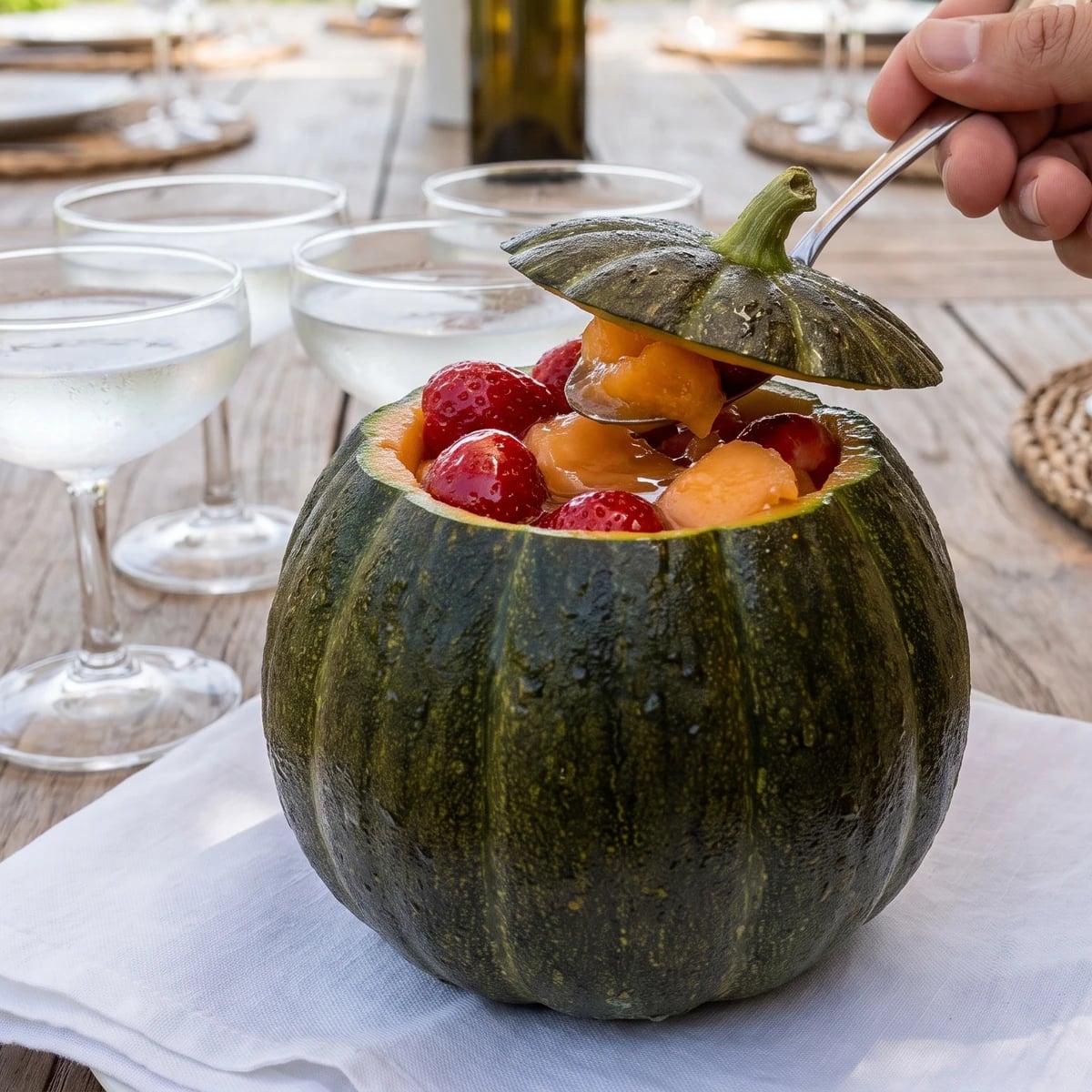
A dark Noir des Carmes melon becomes its own serving bowl, holding sugared orange pulp and strawberries steeped in aromatic Lérina until fruit, liqueur, and rind taste as one.
Salads
French
Dinner Party
Outdoor Dining
Make Ahead
30 min
Active Time
0 min cook•2 hr 30 min total
Yield4 servings
Fraises Lérina (strawberries steeped in Lérina inside a chilled melon) teaches the value of macération, a measured steeping that perfumes fruit without softening it into compote. The one true thing to know before you touch a knife is this: the two hours on ice are the dish. They give the liqueur time to pass from the strawberries into the melon while the closed rind holds every aroma inside.
The original gives no fixed berry count because the melon itself sets the measure, and it assumes a cold pantry with ice ready and a platter dispatched at the last moment. For home, that becomes one well-chilled melon for four, a deep bowl packed with ordinary ice, and one refrigerator shelf. There is no saucier's scaffolding to imitate here. The cold hold and the final napkin are the technique, so both stay. Use Noir des Carmes when you can; if it cannot be had, a small firm Charentais preserves the fragrant orange flesh and hollowed presentation, though the rind will not have the original's dramatic near-black color.
Keep the strawberries dry, steep them only long enough to take the Lérina, then give the filled melon its full two hours under its cap. Shorten that rest and you have dressed fruit in a clever container. Wait, and the melon itself takes the perfume. One cook, one refrigerator shelf, one evening.
Fraises Lérina belongs to the classical French cold entremets table, but its geographical anchor is the Île Saint-Honorat in the Lérins archipelago off Cannes, where the abbey's monks make the aromatic herbal liqueur that gives the dish its name. Its vessel is Noir des Carmes, a dark-rinded French muskmelon with orange flesh, hollowed so the fruit serves as both ingredient and covered bowl. What may look like decorative service is functional: the closed rind and surrounding ice keep the Lérina's perfume around the strawberries and melon throughout their rest.
The technique, the tradition, and the story behind every dish.
Noir des Carmes melon, or firm small Charentais melon
Quantity
1 small melon (about 2 lb / 900 g)
thoroughly chilled
small ripe strawberries
Quantity
1½ cups (360 ml / 225 g)
hulled and dried; larger berries halved
powdered sugar
Quantity
2 tablespoons (30 ml / 16 g)
sifted
Lérina herbal liqueur
Quantity
¼ cup (60 ml / 65 g)
ice
Quantity
6 cups (1.4 L / about 900 g), plus more if needed
Ingredient
Quantity
Noir des Carmes melon, or firm small Charentais melonthoroughly chilled
1 small melon (about 2 lb / 900 g)
small ripe strawberrieshulled and dried; larger berries halved
1½ cups (360 ml / 225 g)
powdered sugarsifted
2 tablespoons (30 ml / 16 g)
Lérina herbal liqueur
¼ cup (60 ml / 65 g)
ice
6 cups (1.4 L / about 900 g), plus more if needed
Equipment Needed
•3½-inch (9 cm) sharp paring knife
•Dessert spoon
•Two medium nonreactive bowls
•2-quart (2-liter) deep bowl for the ice
•Serving platter and folded white napkin
Instructions
1
Cut the melon bung
Wash and dry the cold melon, keeping its stalk intact. Set it upright in a folded towel so it cannot roll. With a small sharp knife, cut a circle about 3 inches (7.5 cm) wide around the stalk, angling the blade inward toward the center as you work. Lift out this bung-shaped cap and reserve it. The inward angle matters because it gives the cap a ledge to rest on instead of dropping into the fruit. If the cut went too straight and the cap sits loosely, lay it lightly over the opening rather than pressing it down. Ça se rattrape.
2
Scoop and sugar
Remove every seed and loose strand with a dessert spoon. Scoop out all usable melon pulp with the same spoon, working close to the rind without piercing it, and place the irregular pieces in a cold bowl. Cut only the largest pieces into bites, keeping the spooned shape of the rest. Sprinkle the powdered sugar evenly over the pulp and fold gently until no dry pockets remain. Do not mash it. The sugar should glaze the melon and draw only a little juice.
A dessert spoon is the honest tool from the original preparation. A melon baller makes neat ornaments, but this dish wants tender spoonfuls with enough broken surface to receive the liqueur.
3
Macerate the strawberries
Put the thoroughly dry strawberries in a second cold bowl and pour over the Lérina. Turn them carefully with a spoon, then leave them in the refrigerator for 15 minutes, turning once halfway through. This is the macération: enough time for the berries to take the herbal perfume, not enough to collapse. If very ripe fruit releases a flood of juice, drain the berries briefly and reserve no more than ¼ cup (60 ml) of the liquid for filling the melon. The rest can be chilled separately and spooned over at service.
4
Fill and ice
Layer the sugared melon pulp and macerated strawberries inside the hollow rind, spooning the reserved Lérina liquid between the layers. Fill to the rim without compressing the fruit. Melons vary, which is why the original calls for the required number of strawberries rather than a fixed brigade measure; if a spoonful will not fit, chill it separately instead of forcing it into the shell. Replace the stalk cap. Set the melon upright in a deep bowl and pack the ice around it to halfway up the sides, keeping ice and meltwater outside the melon. Refrigerate for the full 2 hours. This rest cannot be shortened: the cold rind needs that long to take the Lérina's perfume.
5
Present at once
Lift the melon from the ice only when everyone is ready for it. Drain away the meltwater, dry the base, and set the closed melon upright on a folded white napkin laid over a serving platter; the napkin steadies the round fruit and catches its condensation. Carry it to the table closed, lift the cap there, and spoon the strawberries, melon, and fragrant liquor into four chilled dessert bowls or coupes. À table!
Chef Tips
•Noir des Carmes is the first choice: small, ribbed, nearly black-green outside, and fragrant orange within. Choose one that smells ripe at the stalk but remains firm enough to survive hollowing. A soft melon will buckle under the spoon.
•Lérina is not a decorative splash. Its herbal perfume names the dish, so a generic fruit liqueur changes the preparation rather than replacing an incidental ingredient. Use it with restraint; the strawberries should smell of fruit first and Lérina second.
•Wash the strawberries before hulling, then dry them completely. Water left in the hollow shoulders of a berry dilutes the liqueur and leaves a thin puddle inside the melon.
•Add no mint, citrus, cream, or ornamental sugar. The cap, the dark rind, and the jewel-colored fruit are the entire presentation. Cooking well is not cooking fancy.
Advance Preparation
•Begin about 2½ hours before serving. The melon should spend exactly 2 hours filled, capped, packed in ice, and refrigerated after the brief strawberry macération.
•Do not assemble it the night before. A longer rest makes the strawberries soft and draws too much water from the melon. Leftovers can be covered and refrigerated, but serve them within 24 hours.
Frequently Asked Questions
Nutrition Information
1 serving (about 190g)
Calories
95 calories
Total Fat
0 g
Saturated Fat
0 g
Trans Fat
0 g
Unsaturated Fat
0 g
Cholesterol
0 mg
Sodium
20 mg
Total Carbohydrates
22 g
Dietary Fiber
2 g
Sugars
20 g
Protein
1 g
Where cooking meets culture.
Culinary guides, cultural storytelling, and the editorial depth that makes cooking meaningful.