
Chef Juliette
Various Almond Preparations
Five almond preparations, one discipline: remove the skins cleanly, dry every kernel through, then cut, toast, or cloak it in pale caramel without letting its fragrant oils escape.
A cooking platform built around craft, culture, and the stories behind what we eat.
Created by Chef Juliette
Based on No. 2674, Fraises Femina, from Le Guide Culinaire (1907) by Auguste Escoffier
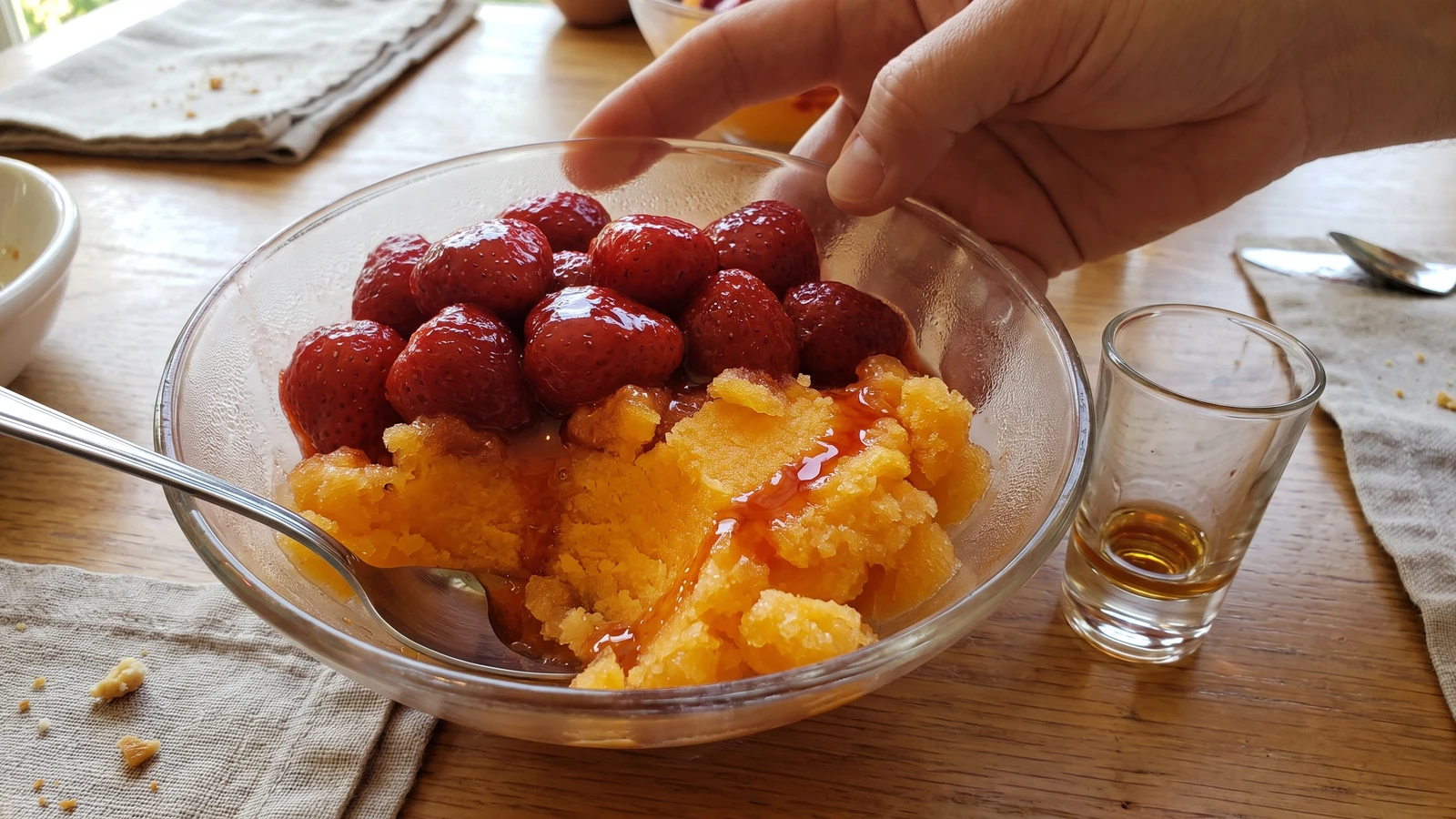
Cold strawberries, orange ice, and one hour of patience: Fraises Femina teaches the essential economy of this dessert, where the Grand Marnier syrup seasons the ice instead of being left behind in the bowl.
Fraises Femina (Grand Marnier-macerated strawberries on orange ice) teaches one true thing before you touch a pan: the macerating liqueur is not runoff. It is the dessert's sauce, carrying fresh strawberry juice, dissolved sugar, orange, and Cognac, and every drop must be worked into the ice.
The grand kitchen assumed a pâtissier's canister of orange ice already frozen and cracked ice waiting to hold the fruit through service. At home, a shallow metal pan and food processor make the ice, while one bowl nested inside another keeps the strawberries properly cold. Here the brigade quantity becomes four generous servings. The stocked freezer and elaborate service are scaffolding; the hour of maceration and the reclamation of its liqueur are the dish itself. One cook, one stove, one evening.
At the table, the orange ice should remain softly crystalline beneath strawberries that gleam ruby-red with their syrup. The decisive moment comes just before serving, when the liqueur meets the frozen ice. Add it gradually and work quickly; if the mixture slumps, ten minutes in the freezer restores it.
Fraises Femina belongs to the named entremets of Parisian grand dining rather than to a provincial strawberry tradition; its title reflects the fashionable society language once used to christen dishes in the classical repertoire. Grand-Marnier Curaçao, a Cognac-based orange liqueur, gives the fruit the deeper citrus note that distinguishes it from ordinary sugared strawberries. The construction is practical as well as elegant: the berries perfume the liqueur, then that fragrant syrup seasons the orange ice, so nothing valuable is discarded.
Quantity
⅓ cup (80 ml / 80 g)
Quantity
⅓ cup (80 ml / 65 g)
Quantity
1 wide strip
cut without white pith
Quantity
1 cup (240 ml / 245 g)
freshly squeezed and finely strained
Quantity
3½ cups (830 ml / 500 g)
hulled; small berries left whole and large berries halved
Quantity
¼ cup (60 ml / 50 g)
Quantity
¼ cup (60 ml / 60 g)
use Grand Marnier Cordon Rouge
| Ingredient | Quantity |
|---|---|
| water | ⅓ cup (80 ml / 80 g) |
| granulated sugar | ⅓ cup (80 ml / 65 g) |
| orange peelcut without white pith | 1 wide strip |
| fresh orange juicefreshly squeezed and finely strained | 1 cup (240 ml / 245 g) |
| fine ripe strawberrieshulled; small berries left whole and large berries halved | 3½ cups (830 ml / 500 g) |
| superfine sugar | ¼ cup (60 ml / 50 g) |
| Grand-Marnier Curaçaouse Grand Marnier Cordon Rouge | ¼ cup (60 ml / 60 g) |
Combine the water, granulated sugar, and orange peel in a small saucepan. Warm gently, stirring only until the sugar dissolves, then simmer for one minute without reducing it. Remove the peel and cool the syrup completely before stirring in the strained orange juice. Chill the base for 30 minutes; it should taste slightly sweeter than you want at the table because freezing quiets sweetness.
Pour the chilled base into a shallow 20 cm metal pan and freeze for about 1½ hours, until a firm border surrounds a slushy centre. Break it up with a fork, process until smooth, and return it to the pan. Cover the surface directly with parchment and freeze for another 1½ to 2 hours. If your freezer turns it into a hard block, let it stand for 5 to 8 minutes before breaking it up; nothing is lost.
One hour before serving, place the strawberries in a chilled nonreactive bowl. Sprinkle them evenly with the superfine sugar, pour over the Grand-Marnier Curaçao, and turn them gently without bruising them. Cover the bowl and nest it inside a larger bowl filled with ice. Macerate for exactly one hour, turning once halfway through, until the sugar has dissolved and the liqueur is ruby-red while the berries still hold their shape.
At serving time, set a fine sieve over a chilled bowl and drain the strawberries for 2 minutes without pressing them. Break the orange ice into chunks and place it in the chilled food processor. Pulse while gradually pouring in every drop of the macerating liqueur, stopping as soon as the ice is evenly coloured and spoonable. That syrup is the dish. If the alcohol softens the ice into a pourable mixture, spread it back in the cold pan and freeze for 10 to 15 minutes, stirring once. Ça se rattrape.
Spread a generous 1.5 cm layer of the liqueur-seasoned orange ice across the bottom of four chilled bowls or timbales. Set the strawberries on top, dividing them without packing or pressing them into the ice. Bring the dessert to the table immediately, while the berries are glossy and the ice remains softly crystalline. À table!
1 serving (about 250g)
Culinary guides, cultural storytelling, and the editorial depth that makes cooking meaningful.
Discover Culinary ExplorerChef Juliette
Five almond preparations, one discipline: remove the skins cleanly, dry every kernel through, then cut, toast, or cloak it in pale caramel without letting its fragrant oils escape.

Chef Juliette
A pastry pantry lesson in one tray: filberts warmed only until their red skins release, rubbed clean, cooled, and chopped into a fragrant mise-en-place for cakes, creams, pralines, and petits fours.

Chef Juliette
The smallest pâtisserie discipline decides whether a cake leaves its mould intact: clarified butter in every corner, followed by the lightest veil of dry flour or fécule.

Chef Juliette
Four whites, one spotless bowl, and a patient change of speed: whisk gently until loosened, then briskly to glossy stiffness, with powdered sugar waiting if the foam begins to granulate.