Chef Juliette
Mayonnaise de Volaille
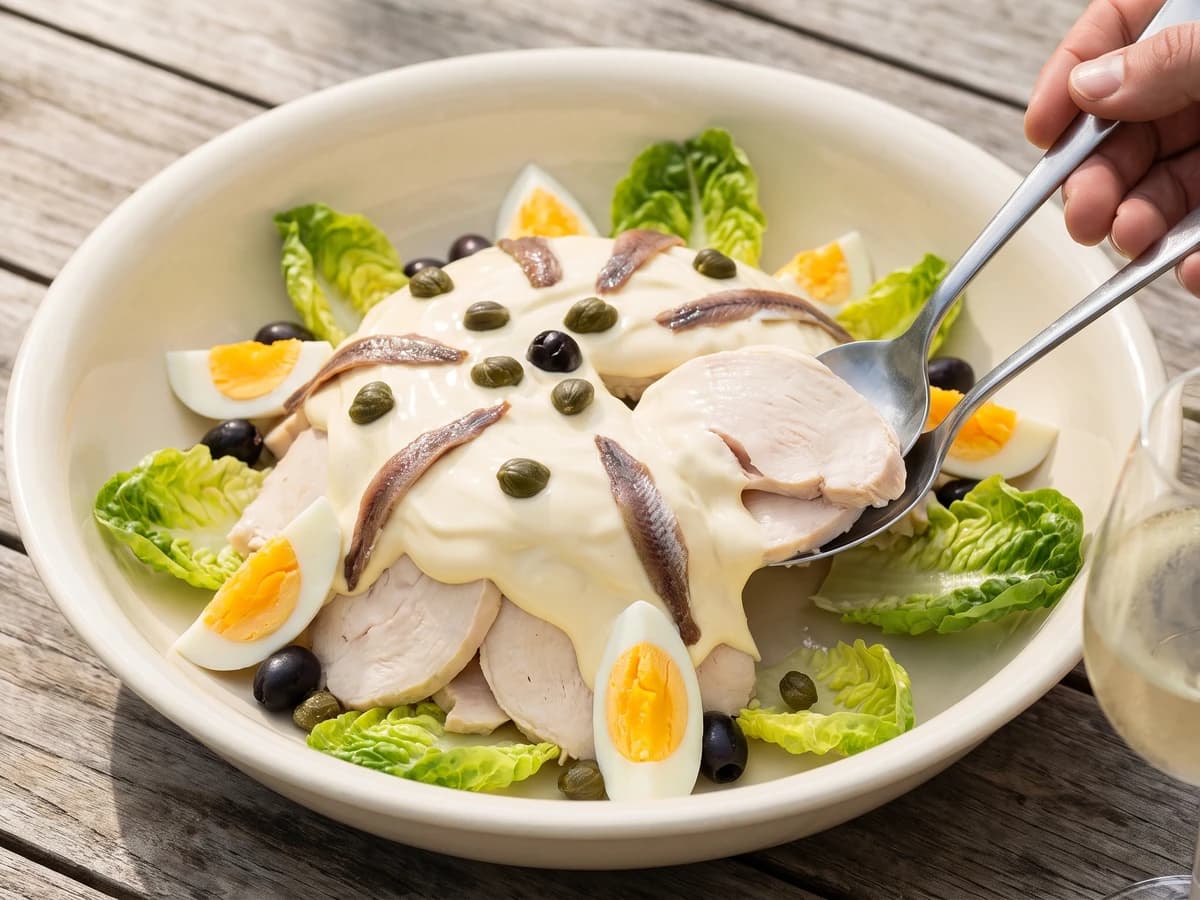
Cold roast chicken, ciseled lettuce, and a shining coat of homemade mayonnaise, arranged with capers, olives, anchovies, eggs, and lettuce hearts, then tossed at the table as the canon intends.
A cooking platform built around craft, culture, and the stories behind what we eat.
Created by Chef Juliette
Based on No. 2672, Cerises au Claret, from Le Guide Culinaire (1907) by Auguste Escoffier
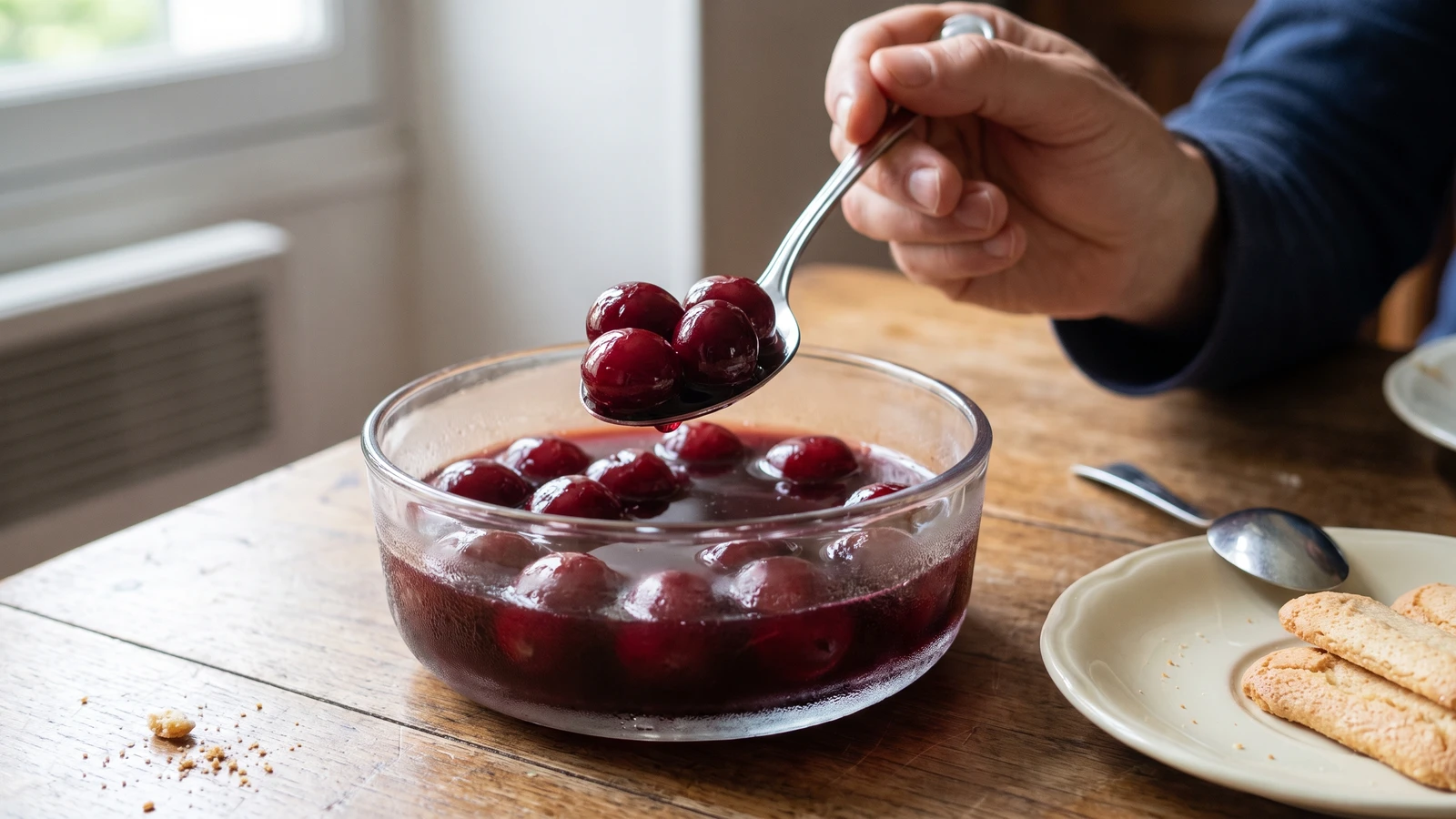
Firm cherries, ten minutes in cinnamon-scented Bordeaux, then a cold gloss of reduced wine and red-currant jelly: a poised fruit dessert whose whole success depends on never letting the poach boil.
Cerises au Claret (cherries poached in Bordeaux wine) teaches restraint: the wine must become hot enough to poach the fruit, but never hot enough to boil it. Ten quiet minutes leave the cherries plump and intact, scented with cinnamon; boiling bursts the skins, roughens the flesh, and drives the wine toward bitterness.
The original entry assumed a silver timbale closed at the side of a live fire, with a cook free to judge that gentle margin by sight. For four servings, a narrow stainless-steel saucepan with a snug lid and the lowest burner gives the same sheltered heat. The silver vessel and hearth are brigade scaffolding and can go; the covered ten-minute poach, cooling the fruit in its syrup, reducing that syrup by one-third, and adding one spoonful of red-currant jelly for every six spoonfuls of reduction are the dish and must stay. Because the source leaves both quantity and sweetness to professional judgment, this home formula fixes them at 560 grams of cherries, 475 milliliters of wine, and 70 grams of sugar. One cook, one stove, one evening.
Serve Cerises au Claret thoroughly cold, the wine syrup just thick enough to gleam around the fruit, with crisp biscuits à la cuillère waiting on their own plate. Before you touch the pan, choose one that holds the cherries snugly, then promise them this: the poaching liquid will never cross into a boil. That is the step that decides everything.
Cerises au Claret belongs to the classical French entremets de fruits table, particularly the formal dining rooms that served chilled fruit preparations after the savory courses, rather than to Bordeaux household cooking. The title preserves claret, the English table name for red Bordeaux, showing how French classical formulas traveled through English-language dining rooms and manuals. Red-currant jelly is not a casual garnish here: it is the classical finishing agent that gives reduced wine a light glaze without turning the cherries into jam.
Quantity
4 cups (950 ml / 560 g)
rinsed and dried, pits intact, stalk ends trimmed
Quantity
2 cups (475 ml / 470 g)
enough to just cover the cherries in a narrow pan
Quantity
⅓ cup (80 ml / 70 g)
Quantity
1 small piece, about 1 inch (2.5 cm)
Quantity
About ¼ cup (60 ml / 80 g), using 1 tablespoon (15 ml / 20 g) for every 6 tablespoons (90 ml / about 90 g) reduced syrup
Quantity
8 biscuits (about 60 g)
served separately
| Ingredient | Quantity |
|---|---|
| ripe sweet cherriesrinsed and dried, pits intact, stalk ends trimmed | 4 cups (950 ml / 560 g) |
| dry red Bordeaux wine (claret)enough to just cover the cherries in a narrow pan | 2 cups (475 ml / 470 g) |
| superfine sugar | ⅓ cup (80 ml / 70 g) |
| cinnamon stick | 1 small piece, about 1 inch (2.5 cm) |
| red-currant jelly | About ¼ cup (60 ml / 80 g), using 1 tablespoon (15 ml / 20 g) for every 6 tablespoons (90 ml / about 90 g) reduced syrup |
| biscuits à la cuillère (crisp ladyfinger biscuits)served separately | 8 biscuits (about 60 g) |
Choose a narrow 1½-quart (1.4 L) saucepan in which the cherries will sit snugly in no more than two layers. Cut only the dry tip from each stalk, leaving the stalk attached and the cherry unpitted, then settle the fruit gently in the pan. The intact fruit keeps its shape and its juice during poaching; tell your guests about the pits when you serve it.
Stir the Bordeaux and sugar together in a measuring jug until the sugar has mostly dissolved. Pour the sweetened wine over the cherries and add the small piece of cinnamon. The wine should just cover the fruit; if it does not, move everything to a narrower pan rather than diluting the claret with water.
Set the pan over medium-low heat until pinprick bubbles gather at the edge, then turn the burner to its lowest setting, cover tightly, and poach for 10 minutes. Hold the wine near 175 to 185°F (80 to 85°C), with a quiet surface and no bubbles breaking through the center. This restraint is the dish. If the wine begins to boil, lift the pan from the heat immediately, uncover it for 30 seconds, then finish the poach covered and off the heat or over the gentlest burner. Ça se rattrape. Do not stir; give the closed pan one careful rotation halfway through instead.
Remove the pan from the heat, discard the cinnamon, and let the cherries cool completely in their poaching syrup, about 45 minutes. Cover and chill them in the same syrup for at least 1½ hours. Cooling in the wine is not idle waiting: the fruit takes on the claret's flavor as its flesh settles.
Set a fine-mesh sieve over a bowl and drain the cherries without pressing them, then return the fruit to the cold. Measure the syrup and calculate two-thirds of its volume. Return it to the clean saucepan and simmer uncovered until it reaches that mark, usually 8 to 12 minutes. For example, 2 cups (475 ml) of drained syrup should finish at 1⅓ cups (315 ml). This reduction is the flavor foundation, so judge it by volume rather than guessing at its thickness.
Measure the reduced syrup once more. For every 6 tablespoons (90 ml) of reduction, whisk in exactly 1 tablespoon (15 ml) red-currant jelly over low heat, only until the jelly dissolves and the syrup becomes clear and glossy. Do not continue boiling after the jelly goes in, or its pectin can set the glaze too firmly. If that happens after cooling, warm the syrup gently and whisk in 1 teaspoon (5 ml) cold water at a time until it flows from the spoon in a light sheet.
Cool the finished syrup completely, then pour it over the cherries and turn them once with a spoon so every skin takes on a garnet gloss. Cover and chill for at least 1 hour. Serve the Cerises au Claret quite cold, spooning a little syrup around each portion, with two crisp biscuits à la cuillère per person on a separate plate. Remind everyone that the cherries retain their pits. À table!
1 serving (about 255g)
Culinary guides, cultural storytelling, and the editorial depth that makes cooking meaningful.
Discover Culinary ExplorerChef Juliette
Cold roast chicken, ciseled lettuce, and a shining coat of homemade mayonnaise, arranged with capers, olives, anchovies, eggs, and lettuce hearts, then tossed at the table as the canon intends.

Chef Juliette
Cold roast or poached chicken with fine ribbons of lettuce, dressed at the final moment with oil and vinegar: a composed salad whose freshness depends entirely on timing.

Chef Juliette
Five leaves, one living rule: laitue, romaine, chicorée, mâche, or pissenlit must be washed, dried, and dressed only as they go to the table, while every leaf still carries its light vinaigrette.

Chef Juliette
Salade de Betteraves proves that baking, not boiling, is the whole argument: concentrated garnet sweetness, tender baked onion, sharp mustard, and herbs cut into a weeknight salad worth making ahead.