Chef Juliette
Mayonnaise de Volaille
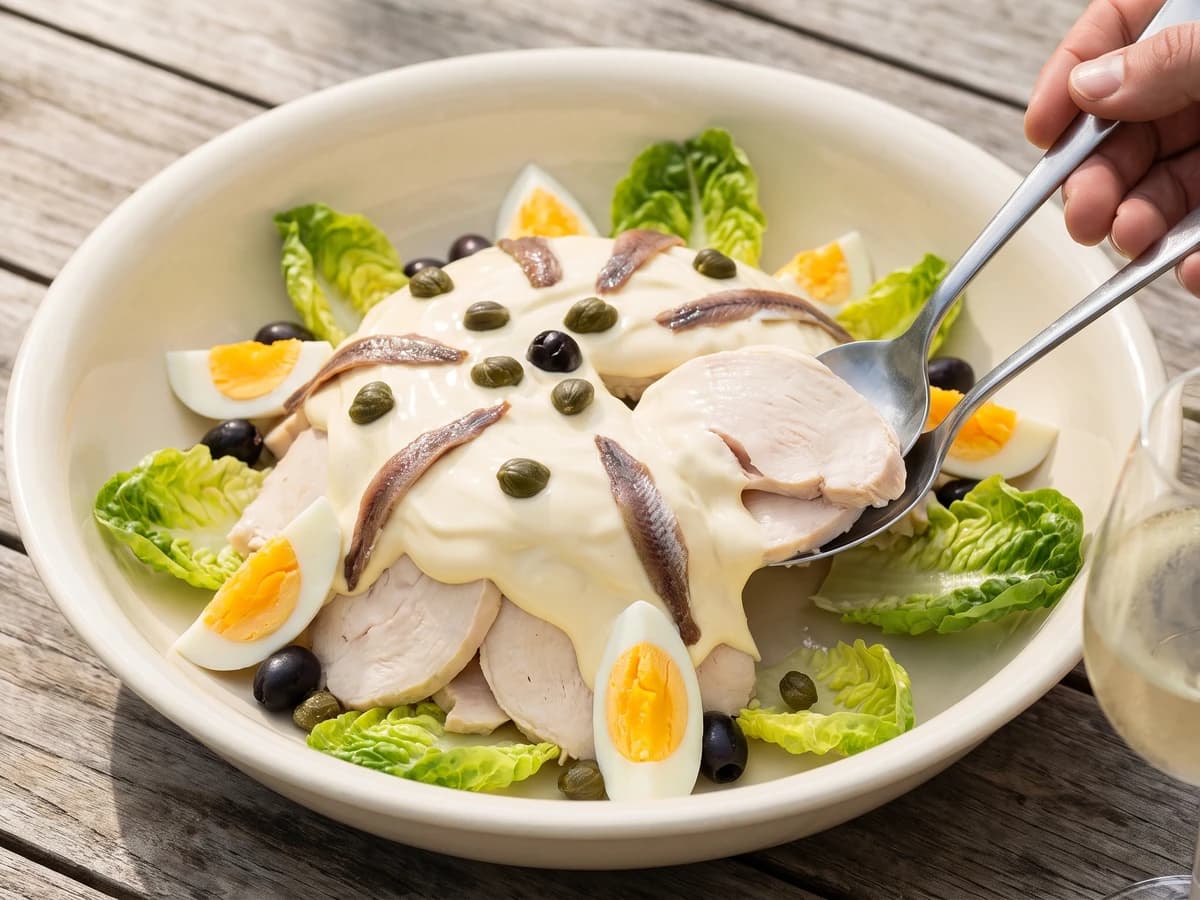
Cold roast chicken, ciseled lettuce, and a shining coat of homemade mayonnaise, arranged with capers, olives, anchovies, eggs, and lettuce hearts, then tossed at the table as the canon intends.
A cooking platform built around craft, culture, and the stories behind what we eat.
Created by Chef Juliette
Based on No. 2670a, Pine-apple à la Royale, from Le Guide Culinaire (1907) by Auguste Escoffier
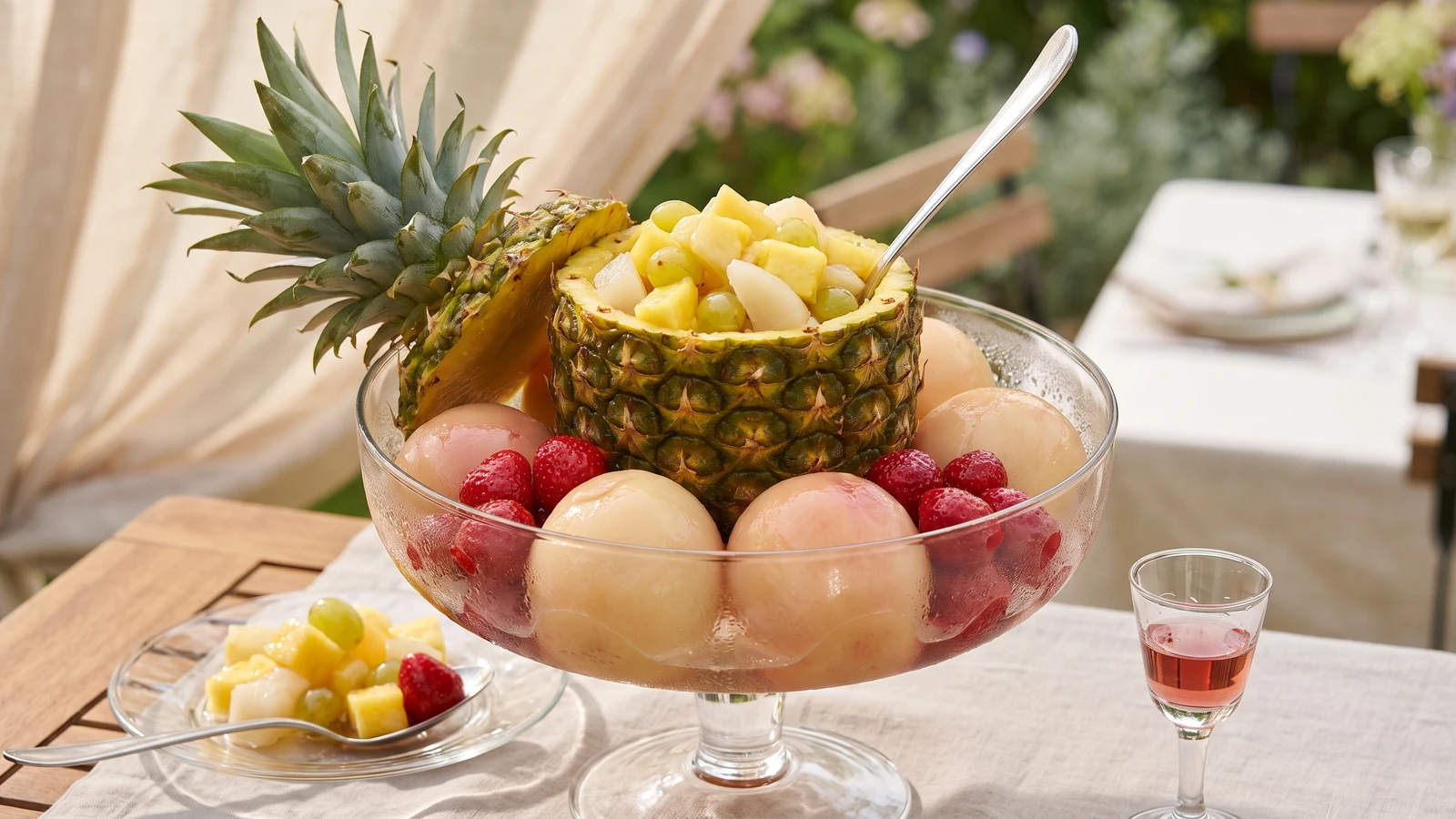
A cold, jewel-bright centerpiece: a half-inch pineapple shell filled with kirsch-scented macédoine, then crowned and ringed with vanilla-poached peaches and glossy strawberries for four generous servings.
Ananas à la Royale (a pineapple shell filled with kirsch-macerated fresh fruit) teaches the quiet architecture of a cold fruit course. Before you touch the knife, know this: the wall and bottom must remain a full 1/2 inch (1.25 cm) thick. Too thin and the Kirsch finds the table; even and sturdy, the pineapple becomes its own splendid bowl.
The original formula assumed a fruit pantry with several fruits at perfect ripeness, hands to poach peaches while another cook hollowed the pineapple, a cold room, and a crystal bowl broad enough for ceremony. Here the crown is scaled to four small peaches, one for each guest; the cold room becomes the refrigerator, and clear glass does the work of crystal. The extra hands and separate station are brigade scaffolding and can go. The half-inch shell, the evenly cut Macédoine, the Kirsch, the vanilla-poached peaches, and the leafy crown are the dish and must stay. One cook, one stove, one evening.
When it arrives, the pale peaches and red strawberries circle a gold-green pineapple heavy with cold, jewel-like fruit. It is generous without fuss and theatrical without a single pair of tweezers. The carving is the only moment that asks for nerve: mark the half-inch wall before cutting, and never chase one last spoonful from the base.
Ananas à la Royale belongs to the formal Parisian fruit course, where a whole pineapple could serve as both vessel and centerpiece and crystal displayed the colors of the Macédoine. Its ring of Montreuil peaches places the formula close to Paris: growers east of the city trained peach trees against sun-warmed plaster walls, sending exceptionally perfumed fruit to the capital's tables. Royale does not prove a palace origin; in the classical vocabulary it often signals a generous, ceremonial presentation, here made from fruit rather than rich sauce or pastry.
Quantity
1 large (about 3 lb / 1.4 kg)
leafy crown attached
Quantity
4 (about 1 lb / 450 g)
Quantity
2 cups (475 ml / 475 g)
Quantity
1 cup (240 ml / 200 g)
Quantity
1
split lengthwise
Quantity
1 small (about 3/4 cup / 130 g after coring)
cored and cut into 1/2-inch dice
Quantity
1/2 cup (120 ml / 80 g)
halved
Quantity
12 (about 1 1/2 cups / 225 g)
hulled
Quantity
7 tablespoons (105 ml / 100 g)
divided
| Ingredient | Quantity |
|---|---|
| large ripe pineappleleafy crown attached | 1 large (about 3 lb / 1.4 kg) |
| small ripe but firm peaches, Montreuil peaches if obtainable | 4 (about 1 lb / 450 g) |
| water | 2 cups (475 ml / 475 g) |
| granulated sugar | 1 cup (240 ml / 200 g) |
| vanilla beansplit lengthwise | 1 |
| small ripe but firm pearcored and cut into 1/2-inch dice | 1 small (about 3/4 cup / 130 g after coring) |
| seedless green grapeshalved | 1/2 cup (120 ml / 80 g) |
| large strawberrieshulled | 12 (about 1 1/2 cups / 225 g) |
| Kirschdivided | 7 tablespoons (105 ml / 100 g) |
Combine the water, sugar, and split vanilla bean in a narrow saucepan. Bring to a boil, stirring only until the sugar dissolves, then simmer for 5 minutes to make a clear vanilla syrup. Score a shallow cross in the base of each peach and lower them into the syrup. Hold them at the barest tremble for 8 to 15 minutes, turning gently, until a fine knife enters with slight resistance. Lift them out, slip away the skins while warm, then return the whole peaches to the syrup and chill for at least 1 hour. If a peach begins to split, remove it at once; the flesh will finish softening as it cools. If one goes a little too far, chill it untouched and place its softer side toward the pineapple when arranging the crown.
Cut a 1 1/4-inch (3 cm) slice from the top of the pineapple, keeping the leafy crown and its attached flesh intact as a lid. Mark a circle inside the shell, leaving a full 1/2-inch (1.25 cm) wall. Cut down within that line without approaching the bottom, divide the flesh into sections, and lift them out with a spoon or melon baller. Leave the same 1/2-inch thickness across the base. Trim away the hard core and reserve 1 1/2 cups (355 ml / 250 g) of good flesh, cut into even 1/2-inch dice. Chill the empty shell upright with its lid. If the wall splits or the bottom is nicked, ça se rattrape: press a thin slice of pineapple over the damaged place from inside, then stand the shell in a snug glass tumbler concealed within the serving bowl.
Combine the reserved pineapple, diced pear, and halved grapes. Their pieces should be close in size, because Macédoine is an even mixture of fresh fruit, not a heap of unrelated cuts. Fold in 5 tablespoons (75 ml / 70 g) of the Kirsch and chill for 45 minutes, turning the fruit once without crushing it. If the fruit releases enough juice to swim, drain it briefly before filling the shell and reserve the fragrant liquid; spoon back only enough to moisten the fruit.
Put the hulled strawberries in a separate shallow bowl and turn them gently with the remaining 2 tablespoons (30 ml / 30 g) of Kirsch. Chill for 15 to 20 minutes, no longer. Keeping them separate protects their shape and prevents their red juice from staining the pale Macédoine. If they soften quickly, drain them at once and hold them cold in a single layer.
Chill a wide clear glass bowl or footed compote. Drain the Macédoine for 30 seconds, spoon it generously into the pineapple shell, and add no more than 2 tablespoons of its reserved Kirsch liquid. Replace the leafy lid. Set the pineapple upright in the center of the bowl, lift the peaches from their syrup, and arrange them evenly around its base. Place three Kirsch-macerated strawberries between each peach to complete the crown. Serve at once while every fruit is deeply chilled and still holds its shape, giving each guest a peach, strawberries, and a generous spoonful of Macédoine. À table!
1 serving (about 575g)
Culinary guides, cultural storytelling, and the editorial depth that makes cooking meaningful.
Discover Culinary ExplorerChef Juliette
Cold roast chicken, ciseled lettuce, and a shining coat of homemade mayonnaise, arranged with capers, olives, anchovies, eggs, and lettuce hearts, then tossed at the table as the canon intends.

Chef Juliette
Cold roast or poached chicken with fine ribbons of lettuce, dressed at the final moment with oil and vinegar: a composed salad whose freshness depends entirely on timing.

Chef Juliette
Five leaves, one living rule: laitue, romaine, chicorée, mâche, or pissenlit must be washed, dried, and dressed only as they go to the table, while every leaf still carries its light vinaigrette.

Chef Juliette
Salade de Betteraves proves that baking, not boiling, is the whole argument: concentrated garnet sweetness, tender baked onion, sharp mustard, and herbs cut into a weeknight salad worth making ahead.