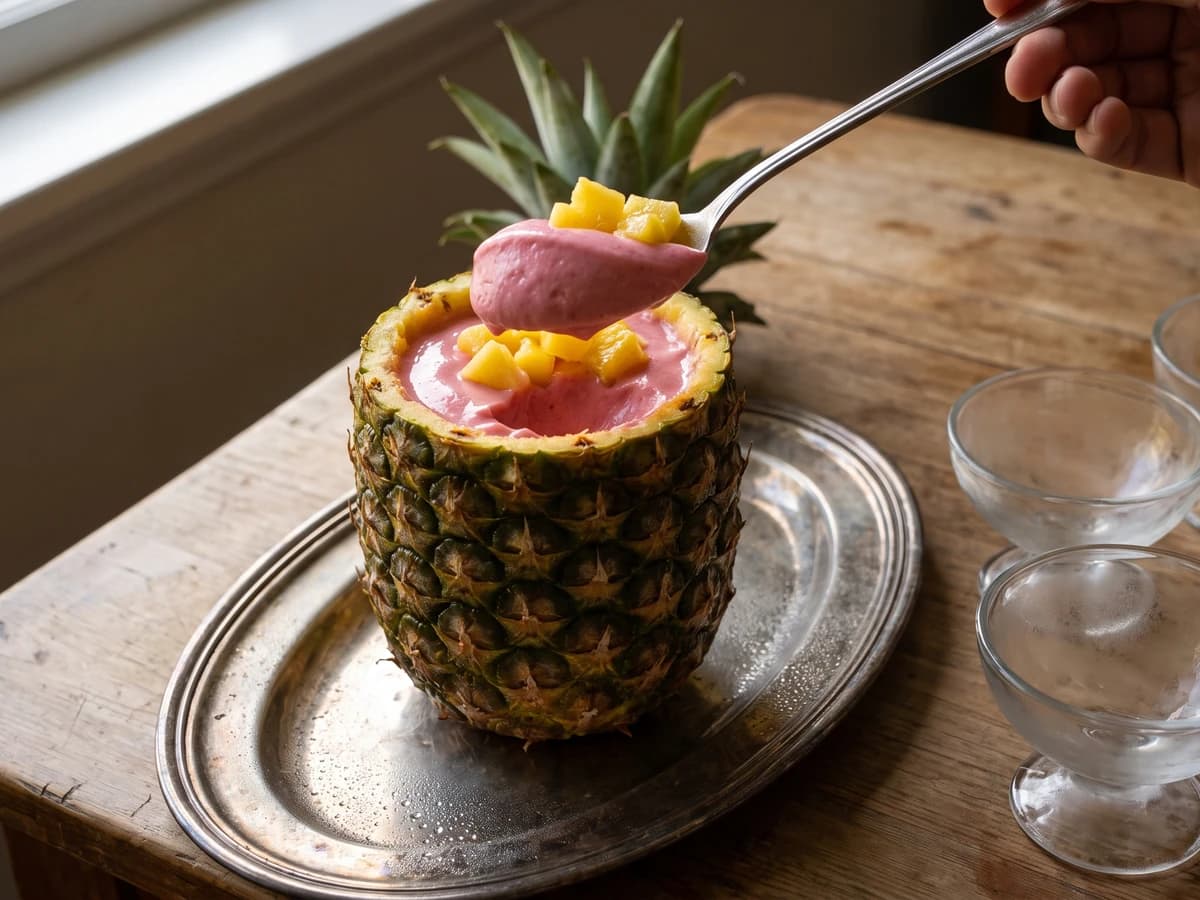
A whole pineapple becomes both dessert and dish, holding its own fruit in a cool, silken Bavarois beneath the restored leafy crown. Keep the half-inch wall intact and the illusion stands beautifully.
Desserts
French
Dinner Party
Special Occasion
Make Ahead
45 min
Active Time
10 min cook•6 hr total
Yield1 filled whole pineapple (6 to 8 servings)
Ananas Georgette (whole pineapple filled with a softly set pineapple cream) teaches containment: the fruit is ingredient, mold, and serving piece at once. Before you touch a pan, know one thing. The half-inch wall is structural, not decorative. Cut thinner and the shell buckles under the Bavarois; leave it intact at the sides and base, and the pineapple stands proudly beneath its restored crown.
The original recipe did not need a saucier, a stock never off the fire, or a salamander; its professional assumption was a pâtissier with a tamis, another pair of hands, and deep cold ready. At home, a blender and fine sieve make the purée, powdered gelatin gives an exact small quantity, and the refrigerator handles the setting. Those are brigade scaffolding and can go. The shell, the fruit folded through its own Bavarois, and the crown returned only after setting are the dish and must stay. One cook, one stove, one evening, with most of the evening belonging to the refrigerator.
When it is right, the leafy top lifts to reveal a cool ivory-gold cream holding fine slices of pineapple, soft enough for a spoon but firm enough to stand inside the fruit. Hollow slowly and check the bottom as carefully as the sides. That first cut decides the presentation before the Bavarois has even begun.
Ananas Georgette belongs to the Parisian grand-kitchen repertoire of named entremets, formal sweets presented as their own course, where pineapple served as both prized fruit and ingenious serving vessel. Its construction moves a pineapple Bavarois from the usual separate mold into the original shell, then restores the crown so the fruit appears untouched at the table. The identity behind Georgette is not securely preserved with the formula, but the name denotes this exact presentation, not simply a pineapple cream.
The technique, the tradition, and the story behind every dish.
hollowed pineapple fleshcut into thin slices and well drained
1 cup (240 ml / 165 g)
granulated sugar
½ cup (120 ml / 100 g)
cold water
¼ cup (60 ml / 60 g)
powdered gelatin
1 tablespoon (15 ml / 9 g)
heavy cream, at least 35% fatthoroughly chilled
1½ cups (360 ml / 355 g)
Equipment Needed
•Large stable cutting board
•Serrated knife and small paring knife
•Sturdy tablespoon or grapefruit spoon
•Blender or food processor
•Fine-mesh sieve
•1-quart (1-liter) stainless-steel saucepan
•Instant-read thermometer
•Large bowl or napkin-lined ring to support the pineapple
Instructions
1
Hollow the pineapple
Wash and dry the pineapple without bruising its leaves. Lay it securely on its side and cut off the crown in one level slice about 1¼ inches (3 cm) below the leaves; keep this lid intact. Stand the fruit in a bowl lined with a folded towel, score a ring exactly ½ inch (1.25 cm) inside the skin, and cut the interior into sections. Lift out the flesh with a sturdy spoon, leaving the same ½-inch thickness at the bottom. Work slowly near the base, where one deep thrust can pierce the shell. If a wall bows or develops a small nick, support the pineapple in a snug bowl or a napkin-lined ring for chilling and service. The shell need not prove anything by standing unsupported.
2
Prepare the fruit
Trim the hard core from the removed flesh. Blend enough tender flesh until completely smooth, then press it through a fine sieve and measure 1½ cups (360 ml / 375 g). Cut another 1 cup (240 ml / 165 g) into slices about ⅛ inch (3 mm) thick. Drain the slices in a sieve for 10 minutes, because loose juice thins the Bavarois and collects at the bottom of the shell. Refrigerate the slices while you make the base.
3
Cook the purée
Sprinkle the gelatin evenly over the cold water and leave it for 5 minutes, until every granule is swollen. Combine the pineapple purée and sugar in a small stainless-steel saucepan, bring them to a full simmer, and cook for 2 minutes while stirring. This heating is part of the dish: fresh pineapple contains an enzyme that prevents gelatin from setting unless the fruit is properly heated. Remove the pan from the heat and whisk in the bloomed gelatin until no grain remains. If you see gelatin threads or specks, return the pan to the gentlest heat and whisk just until smooth, then strain it. Do not boil it again after adding the gelatin.
4
Cool the base
Pour the pineapple base into a wide bowl and set it over ice water. Stir steadily until it reaches about 75°F (24°C) and begins to coat the spoon like a very thin custard. It must be cool enough not to melt the whipped cream, yet fluid enough to fold without lumps. If it catches and sets around the rim, stop. Ça se rattrape: place the bowl over lukewarm water and whisk just until the mixture becomes smooth again, then resume cooling.
5
Fold the Bavarois
Whip the cold cream to soft peaks that bend when the whisk is lifted. Fold one-third of it into the cooled pineapple base to lighten it, then fold in the remainder with broad strokes from the bottom of the bowl. Add the drained pineapple slices and fold only until evenly distributed. The Bavarois should hold a soft mound while remaining fluid enough to settle into the shell. If it turns loose because the base was still warm, set the bowl over ice and fold gently for a minute or two until it gains body. Do not add extra gelatin.
6
Fill and chill
Blot the hollow shell dry inside and out, then stand it securely in its supporting bowl. Spoon in the Bavarois, nudging it into the bottom without crushing the fruit slices, and stop about ¼ inch (6 mm) below the cut edge. Tap the bowl once or twice against the counter to release large air pockets. Refrigerate upright for at least 5 hours, preferably overnight, until the center is firmly set. Chill the crown separately with its cut surface covered; placing it on the soft filling now would leave a sunken mark.
7
Restore the crown
Arrange a clean folded napkin on an oval platter and settle the chilled pineapple upright upon it, as the original service requires. Wipe the cut edge clean and replace the leafy crown without pressing it into the Bavarois, aligning the skin so the cut nearly disappears. Present the pineapple whole, then lift the crown at the table and spoon the Bavarois into chilled dessert dishes, cutting through the fine fruit slices as you serve. À table!
Chef Tips
•Choose a broad, fragrant pineapple that stands steadily and has a firm green crown. An overripe fruit with a wet base makes a fragile shell, however sweet its flesh may be.
•Weigh the gelatin. Packets vary, and nine grams gives this quantity enough structure to stand inside the fruit without turning the Bavarois rubbery.
•Use real heavy cream and whip it only to soft peaks. A stiffly whipped cream will not fold smoothly, while a whipped substitute gives neither the clean flavor nor the supple set this dessert requires.
•No decorative garnish is needed. The restored crown is the finish, and the thin pineapple slices hidden inside provide the surprise.
•Serve within 24 hours of filling. The Bavarois remains sound beyond that, but the fresh shell gradually releases juice and loses its proud shape.
Advance Preparation
•The filled pineapple may be made the day before serving. Keep it upright and supported in the refrigerator, with the crown wrapped and chilled separately.
•The shell and fruit can be prepared up to 4 hours before the Bavarois is assembled. Refrigerate the shell, purée, slices, and crown separately, then cook the purée before proceeding.
•Do not freeze the finished dessert. Freezing weakens the gelatin structure, makes the cream grainy, and damages the pineapple shell.
Frequently Asked Questions
Nutrition Information
1 serving (about 150g)
Calories
270 calories
Total Fat
18 g
Saturated Fat
12 g
Trans Fat
1 g
Unsaturated Fat
5 g
Cholesterol
60 mg
Sodium
20 mg
Total Carbohydrates
26 g
Dietary Fiber
1 g
Sugars
23 g
Protein
3 g
Where cooking meets culture.
Culinary guides, cultural storytelling, and the editorial depth that makes cooking meaningful.