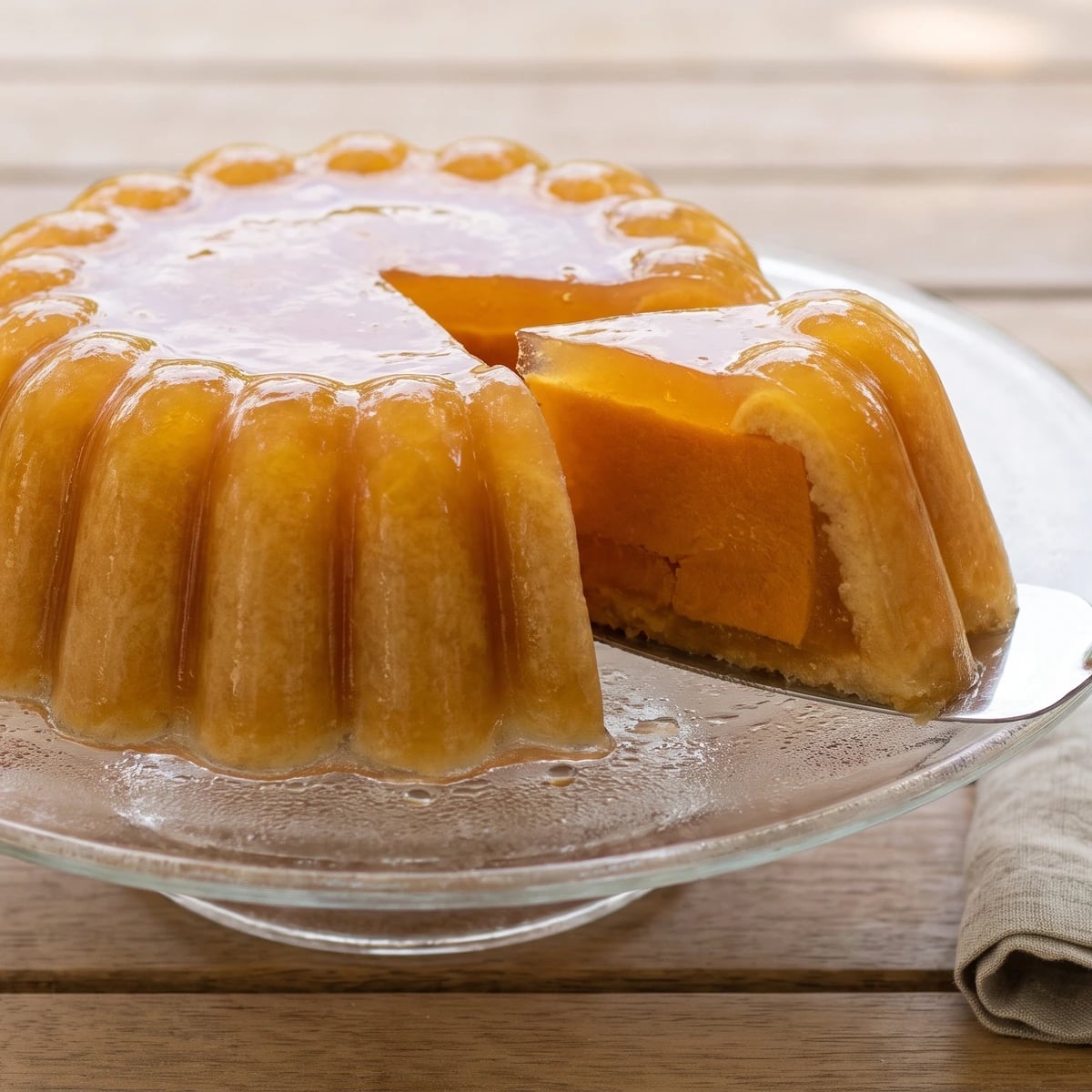
A jewel-bright apricot jelly shell around a soft, creamless fruit bavarois: cold, cleanly sliceable, and made ahead, with the old mould-clothing technique scaled to one Charlotte mould and one patient cook.
Desserts
French
Make Ahead
Outdoor Dining
Celebration
45 min
Active Time
10 min cook•8 hr 55 min total
YieldOne 1-quart (1 L) mould, 8 servings
Pains de fruits (jellied fruit moulds) teach the discipline of two related sets: a firm, gleaming jelly shell and a softer fruit bavarois without cream. The one truth to know before you begin is simple. Warm filling must never meet a fragile gelled shell. Keep the mould cold, bring the filling down until it barely begins to thicken, and the two layers will hold cleanly together.
The original preparation assumed a cold station supplied with broken ice, an entremetier coating rows of Charlotte moulds, and enough hands to keep every jelly at precisely the right point. At home, one metal mould nested in a bowl of ice does the same work. The brigade quantities and repeated service setup are scaffolding, so they go. The thick fruit-jelly clothing and the creamless, lightly gelled centre are the dish, so they stay. One cook, one stove, one evening, then the refrigerator does the waiting.
Turned out, the pain de fruits should stand clear-edged and amber-bright, with a glossy apricot shell around a centre that yields softly beneath the knife. Cool the apricot filling until it clings faintly to the spatula before it enters the mould. That single moment decides the dish.
Pains de fruits belong to the formal French entremets table, where Charlotte and border moulds served both sweet creams and elaborate savoury aspics. Clothing the mould came from this shared cold-kitchen grammar, allowing a fish aspic and a fruit pudding to rely on the same setting technique without sharing a flavour. Pain here describes the compact moulded form, not bread, while the creamless fruit centre distinguishes this preparation from an ordinary bavarois and lets the jelly jacket provide its polish and support.
The technique, the tradition, and the story behind every dish.
2 cans, 15 ounces (425 g) each; about 3 cups drained (720 ml / 480 g)
drained, juice reserved
unsweetened apricot nectar
Quantity
1½ cups (360 ml / 360 g)
divided
granulated sugar
Quantity
½ cup (120 ml / 100 g)
divided
fresh lemon juice
Quantity
2 tablespoons (30 ml / 30 g)
divided
unflavoured powdered gelatine for the jelly shell
Quantity
2¼ teaspoons (11 ml / 7 g)
unflavoured powdered gelatine for the fruit filling
Quantity
2 teaspoons (10 ml / 6 g)
reserved apricot packing juice
Quantity
⅔ cup (160 ml / 160 g)
divided
fine sea salt
Quantity
1 pinch
ice
Quantity
as needed for chilling
thick apricot-jelly mould coating
Quantity
1 coating, according to Another Method of Preparing Aspics de Filets de Soles (No. 916)
Ingredient
Quantity
apricot halves packed in juicedrained, juice reserved
2 cans, 15 ounces (425 g) each; about 3 cups drained (720 ml / 480 g)
unsweetened apricot nectardivided
1½ cups (360 ml / 360 g)
granulated sugardivided
½ cup (120 ml / 100 g)
fresh lemon juicedivided
2 tablespoons (30 ml / 30 g)
unflavoured powdered gelatine for the jelly shell
2¼ teaspoons (11 ml / 7 g)
unflavoured powdered gelatine for the fruit filling
2 teaspoons (10 ml / 6 g)
reserved apricot packing juicedivided
⅔ cup (160 ml / 160 g)
fine sea salt
1 pinch
ice
as needed for chilling
thick apricot-jelly mould coating
1 coating, according to Another Method of Preparing Aspics de Filets de Soles (No. 916)
Equipment Needed
•1-quart (1 L) metal Charlotte mould
•Large bowl for the ice bath
•Small saucepan
•Blender or food processor
•Fine-mesh sieve
•Flexible spatula
•Instant-read thermometer, optional
Instructions
1
Chill the mould
Set a clean 1-quart (1 L) metal Charlotte mould in the refrigerator for 30 minutes, or in the freezer for 15 minutes. Fill a larger bowl halfway with ice and nestle the mould upright in it. Metal responds quickly to the ice and sets the jelly where it touches, which is exactly what the old broken-ice station accomplished.
Use an unlined metal mould if possible. Silicone insulates the jelly, making an even coat more difficult, while glass warms too slowly when it is time to unmould.
2
Make apricot jelly
Pour 3 tablespoons (45 ml) of the cold apricot nectar into a small bowl and sprinkle the 7 g gelatine evenly over it. Leave it for 5 minutes, until every grain is swollen. Warm ½ cup (120 ml) of the remaining nectar with ¼ cup (50 g) of the sugar and 1 tablespoon (15 ml) of the lemon juice, stirring only until the sugar dissolves. Take it off the heat, add the bloomed gelatine, and stir until perfectly clear. Add the remaining nectar, strain into a jug, and cool until fluid but no longer warm. Never boil gelatine; hard heat weakens the set.
3
Clothe the mould
Clothe the chilled mould with the apricot jelly, following the mould-coating operation in Another Method of Preparing Aspics de Filets de Soles (No. 916). Pour in enough jelly to cover the bottom generously, then rotate and tilt the mould over the ice so the jelly travels slowly across every part of the sides. Pour any loose jelly back into the jug before it sets. Chill for 3 minutes and repeat until the shell is unbroken and about ⅛ inch (3 to 4 mm) thick. This coating is not brigade decoration that can be discarded; it supports the softer centre and is the technique of the dish. If a bare patch or thin streak appears, spoon cold fluid jelly over it and chill again. Ça se rattrape.
Keep the jug of unused jelly fluid by standing it in barely warm water. It should pour freely but feel cool against your wrist.
4
Build the bavarois
Sprinkle the remaining 6 g gelatine over 2 tablespoons (30 ml) of cold reserved apricot juice and leave it to swell for 5 minutes. Purée the drained apricots with ½ cup (120 ml) of the reserved juice, the remaining ¼ cup (50 g) sugar, the remaining 1 tablespoon (15 ml) lemon juice, and the salt. Pass the purée through a fine sieve. Warm 1 cup (240 ml) of it gently, remove it from the heat, and dissolve the bloomed gelatine in it before stirring this back into the cold purée. This is the fruit base of a bavarois, but no cream enters it. Six grams of gelatine is enough because there is no whipped cream to support and the outer jelly carries the unmoulding.
5
Cool to the edge
Set the bowl of apricot mixture over ice and stir slowly, scraping the sides, until it reaches about 68°F (20°C) and begins to cling faintly to the spatula. It must still pour in a smooth ribbon. If it becomes lumpy or sets too far, stand the bowl in tepid water and stir until smooth again. Ça se rattrape. If it still feels warm, wait; warm filling will soften the jelly clothing and blur the two layers.
6
Fill and seal
Spoon the cooled fruit mixture gently into the clothed mould, stopping about ¼ inch (6 mm) below the rim. Tap the mould once against a folded towel to release any large air pocket, but do not shake it. Chill for 15 minutes, until the surface is tacky. Pour over enough remaining apricot jelly to form a thin, complete cap, which will become the base when the pain de fruits is turned out. If the jelly has set in its jug, warm it only until fluid and cool it again before pouring.
7
Chill and unmould
Cover the mould without touching the jelly and refrigerate for at least 8 hours, preferably overnight. To unmould, dip the mould to just below its rim in hot water for 3 seconds, dry it, set a chilled serving plate over the top, and invert both together. Lift the mould straight upward. If it holds, repeat the dip for 2 seconds rather than forcing a knife around the edge, which would scar the jelly shell. Keep the pain de fruits cold until slicing, then bring it to the table whole. À table!
Chef Tips
•Good canned apricots packed in juice are the honest choice when fresh apricots are not fragrant and ripe. Drain them well and taste before setting the sugar; very sweet fruit may need a spoonful less.
•Weigh the gelatine. The firm outer jelly and softer centre depend on two different strengths, and spoon measures vary just enough to matter in a mould this size.
•The source also permits strawberries, red currants, cherries, and peaches. Keep the measured volume of purée and matching fruit jelly the same; give red currants more sugar, while peaches usually want an extra squeeze of lemon.
•For an outdoor meal, carry the dessert in its mould inside a well-iced cooler and turn it out at the table. Direct sun softens gelatine quickly, however handsome the picnic.
Advance Preparation
•Assemble the pain de fruits one or two days before serving and keep it covered in its mould. The rest gives the jelly a clean set and makes unmoulding calmer.
•The apricot jelly and fruit purée may be prepared separately a day ahead. Chill them covered, then melt the jelly gently and bring both mixtures to the temperatures specified before assembling.
•For travel, leave the dessert in its mould and keep it over ice. Unmould no more than an hour before serving and return it to the cold between slices.
Frequently Asked Questions
Nutrition Information
1 serving (about 143g)
Calories
120 calories
Total Fat
0 g
Saturated Fat
0 g
Trans Fat
0 g
Unsaturated Fat
0 g
Cholesterol
0 mg
Sodium
20 mg
Total Carbohydrates
29 g
Dietary Fiber
1 g
Sugars
27 g
Protein
2 g
Where cooking meets culture.
Culinary guides, cultural storytelling, and the editorial depth that makes cooking meaningful.