
Chef Juliette
Various Almond Preparations
Five almond preparations, one discipline: remove the skins cleanly, dry every kernel through, then cut, toast, or cloak it in pale caramel without letting its fragrant oils escape.
A cooking platform built around craft, culture, and the stories behind what we eat.
Created by Chef Juliette
Based on No. 2655, Jellies à la Russe, from Le Guide Culinaire (1907) by Auguste Escoffier
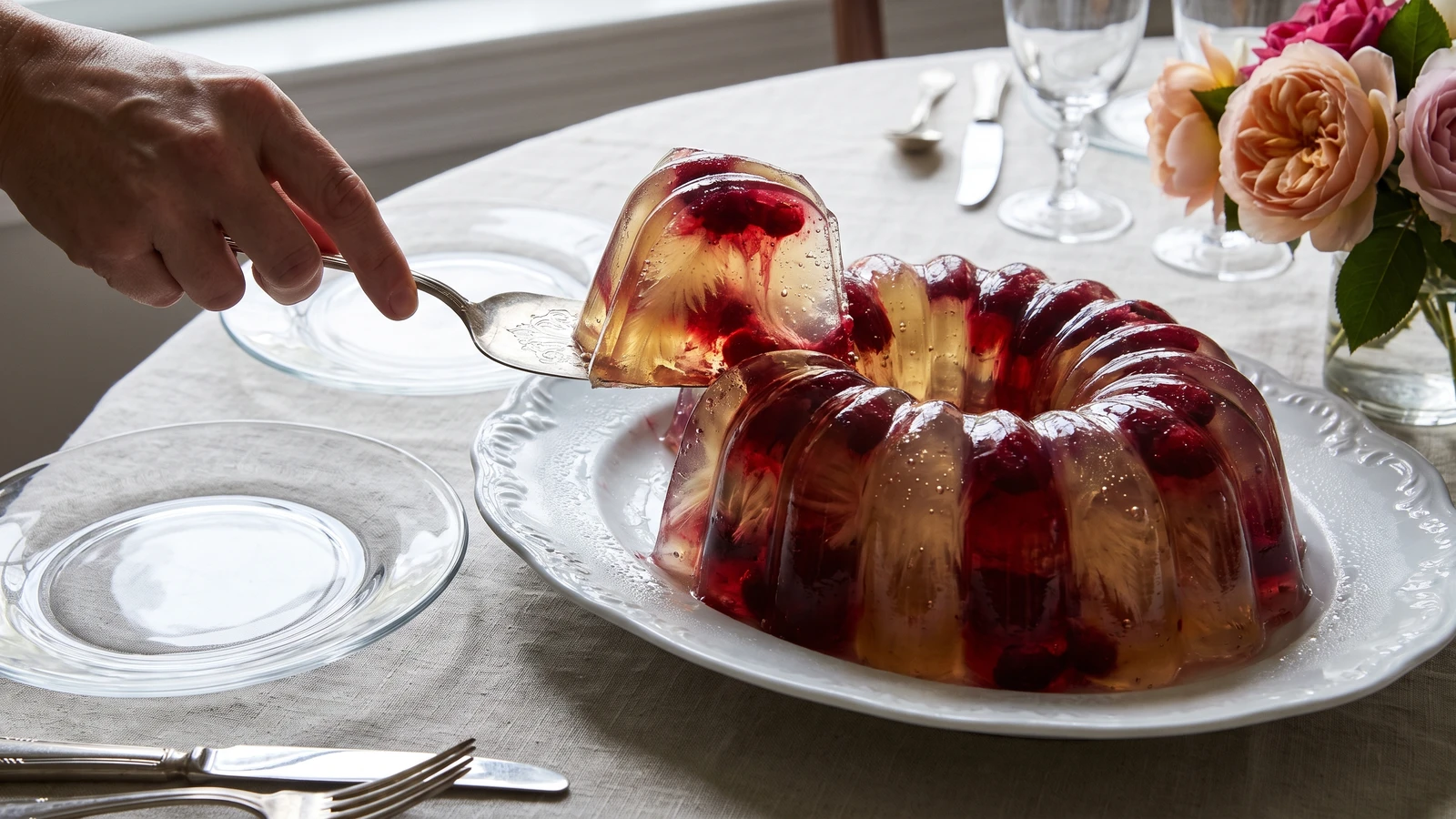
Two clear fruit jellies meet ice, the whisk, and one decisive moment, then set into pale-gold and ruby feathers whose cut face supplies all the celebration they need.
Gelées à la Russe (ice-whisked fruit jellies) teach one true thing: temperature is an ingredient. Whisk too soon and nothing happens; wait too long and the jelly breaks into little rubbery curds. Catch it at the half-set, when the whisk leaves a fleeting trail, and the clear liquid turns softly opaque while remaining fluid enough to marble.
The original entry assumed several finished jellies waiting in a cold room, a basin of chipped ice, and enough brigade hands to whisk different colours at once. For one cook, one stove, one evening, one neutral gelatin syrup is divided between two strongly flavoured juices, then the bowls share a household ice bath. Making multiple full batches was brigade scaffolding and can go. Whisking over ice and moulding at once are the dish, and they stay.
The finished jelly is cool, lightly aerated, and feathered pale gold through ruby red. Its cut face does the decorating, so leave the flowers and fussy piping elsewhere. Begin moulding the instant both jellies hold a soft trail but still fall easily from the spoon.
Gelées à la Russe belong to the Parisian grand-kitchen repertory of moulded entremets, where clear jellies were manipulated for colour, texture, and spectacle at the celebration table. The Russian label does not make this a Russian national pudding; within the French canon, it identifies the treatment of ordinary jellies whisked over ice and rapidly moulded. Combining different shades at the half-set produced decoration throughout every slice rather than merely upon its surface.
Quantity
½ cup (120 ml / 120 g)
Quantity
5 teaspoons (25 ml / 15 g)
Quantity
⅓ cup (80 ml / 65 g)
Quantity
2 tablespoons (30 ml / 30 g)
strained
Quantity
1¼ cups (300 ml / 305 g)
well chilled
Quantity
1¼ cups (300 ml / 305 g)
well chilled
| Ingredient | Quantity |
|---|---|
| cold water | ½ cup (120 ml / 120 g) |
| unflavoured powdered gelatin | 5 teaspoons (25 ml / 15 g) |
| superfine sugar | ⅓ cup (80 ml / 65 g) |
| fresh lemon juicestrained | 2 tablespoons (30 ml / 30 g) |
| clear white grape juicewell chilled | 1¼ cups (300 ml / 305 g) |
| clear cranberry juice drinkwell chilled | 1¼ cups (300 ml / 305 g) |
Rinse a 1 litre metal jelly mould with cold water, shake out the excess without drying it, and refrigerate it. Fill a wide basin halfway with equal parts ice and cold water, then set two medium stainless-steel bowls beside it. Have the juices measured and the whisk ready before you begin. Once the jellies reach the half-set, the work moves quickly.
Pour the cold water into a small saucepan and rain the gelatin evenly over its surface. Leave it undisturbed for 5 minutes, until every grain has swollen and the mixture looks like a firm sponge. Add the sugar and warm over the lowest heat, stirring gently, just until the liquid becomes perfectly clear. Remove it from the heat and stir in the lemon juice. Do not boil it. If a few gelatin grains remain, stand the saucepan in a bowl of warm water and stir until they disappear; fierce heat isn't the answer.
Divide the warm gelatin syrup equally between the two stainless-steel bowls, about 115 g in each. Stir the chilled white grape juice into one bowl and the chilled cranberry juice into the other. Taste a cold spoonful of each. They should seem slightly sweeter and more strongly flavoured than you ultimately want, because chilling and aeration soften both sweetness and aroma.
Set both bowls in the ice bath and stir them alternately, scraping around the sides where setting begins first. After 6 to 10 minutes, each jelly should resemble unbeaten egg white: thickened, cold, and able to leave a momentary line behind the spoon. If nothing happens after 10 minutes, refrigerate the bowls for 5 minutes and return them to the ice. If the edges turn lumpy before the centre thickens, ça se rattrape: lift that bowl from the ice, stand it briefly in lukewarm water, and stir just until smooth before chilling again.
Whisk the grape jelly briskly for 30 to 60 seconds, until it turns softly cloudy with fine bubbles and the whisk leaves a fleeting trail. Lift it from the ice, then whisk the cranberry jelly to the same consistency. Working immediately, alternate generous spoonfuls of the two jellies in the chilled mould. Pass a thin skewer through the mixture once in a loose S shape, then stop. One movement makes feathers; repeated stirring makes a muddle. Tap the mould once against a folded towel to settle any large pockets.
Cover the mould and refrigerate it for at least 4 hours, until completely firm. To unmould, dip the outside in warm water for 5 to 8 seconds, wipe it dry, place a chilled serving plate over it, and invert both together. If the jelly refuses to release, return only the mould to the water for another 2 seconds. Longer soaking melts the patterned surface. Cut with a knife dipped in cold water and serve at once. À table!
1 serving (about 105g)
Culinary guides, cultural storytelling, and the editorial depth that makes cooking meaningful.
Discover Culinary ExplorerChef Juliette
Five almond preparations, one discipline: remove the skins cleanly, dry every kernel through, then cut, toast, or cloak it in pale caramel without letting its fragrant oils escape.

Chef Juliette
A pastry pantry lesson in one tray: filberts warmed only until their red skins release, rubbed clean, cooled, and chopped into a fragrant mise-en-place for cakes, creams, pralines, and petits fours.

Chef Juliette
The smallest pâtisserie discipline decides whether a cake leaves its mould intact: clarified butter in every corner, followed by the lightest veil of dry flour or fécule.

Chef Juliette
Four whites, one spotless bowl, and a patient change of speed: whisk gently until loosened, then briskly to glossy stiffness, with powdered sugar waiting if the foam begins to granulate.