
Chef Juliette
Various Almond Preparations
Five almond preparations, one discipline: remove the skins cleanly, dry every kernel through, then cut, toast, or cloak it in pale caramel without letting its fragrant oils escape.
A cooking platform built around craft, culture, and the stories behind what we eat.
Created by Chef Juliette
Based on No. 2649, Flamri, from Le Guide Culinaire (1907) by Auguste Escoffier
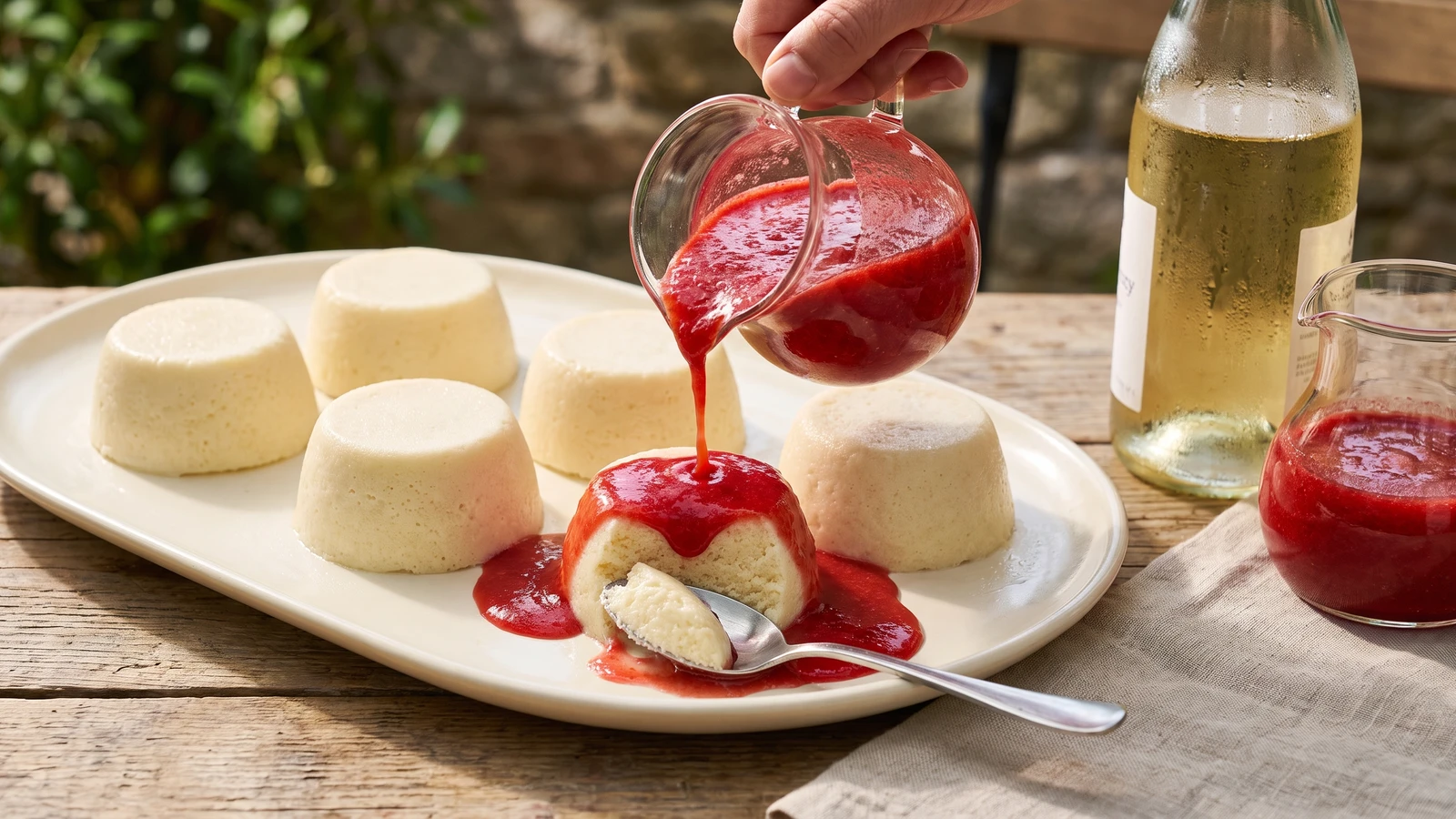
Flamri is the cold pudding that proves restraint can still feel generous: wine-scented semolina, folded with stiff whites, poached gently, then turned out beneath a bright raw strawberry purée.
Flamri (a cold wine-semolina pudding) teaches one uncompromising thing: the semolina must swell completely before sugar touches it. Sugar added early slows hydration and leaves a grainy center; cooked in equal measures of white wine and water for the full twenty-five minutes, the grain becomes tender enough to hold eggs and stiff whites without turning heavy. The reward is a pale, softly aerated pudding under a brilliant coat of raw fruit.
The source assumed a pastry station with a row of small molds, a capacious Bain-Marie, and enough cold space to leave everything undisturbed. Here the quantity is halved exactly because the eggs divide cleanly, giving six home servings from one saucepan, six ramekins, and a roasting tin in a low oven. Purpose-made molds and brigade volume are scaffolding. The equal wine and water, the twenty-five-minute cook, the stiff whites, gentle poach, and uncooked fruit purée are the dish, so none of those changes.
Cook the semolina until no chalky point remains before you add the sugar. That is the step that decides Flamri. Everything afterward is gentle handling, and if the base lumps or the egg catches, ça se rattrape at the stove before the whites go in.
Flamri sits among the cold entremets of the French classical table, but its name follows the German Flammeri, a molded grain or starch pudding from German-speaking household kitchens near France's eastern border. French cooks brought the form into the grand repertoire with equal measures of white wine and water, beaten whites for lift, and a raw red-fruit purée, making it a border-crossing pudding rather than a native specialty of Lyon, Normandy, or Provence.
Quantity
1 cup plus 3 tablespoons (285 ml / about 282 g)
dry and unoaked
Quantity
1 cup plus 3 tablespoons (285 ml / 285 g)
Quantity
2/3 cup (160 ml / 113 g)
Quantity
3/4 cup (180 ml / 151 g)
Quantity
1 pinch (about 1/16 teaspoon / 0.3 g)
Quantity
1
Quantity
3
at room temperature
Quantity
1 teaspoon (5 ml / 5 g)
softened, for the molds
Quantity
2 cups (480 ml / 300 g)
hulled
Quantity
2 to 4 tablespoons (30 to 60 ml / 25 to 50 g)
| Ingredient | Quantity |
|---|---|
| dry white winedry and unoaked | 1 cup plus 3 tablespoons (285 ml / about 282 g) |
| water | 1 cup plus 3 tablespoons (285 ml / 285 g) |
| fine semolina | 2/3 cup (160 ml / 113 g) |
| superfine sugar, the modern equivalent of the source's powdered sugar | 3/4 cup (180 ml / 151 g) |
| fine salt | 1 pinch (about 1/16 teaspoon / 0.3 g) |
| large egg | 1 |
| large egg whitesat room temperature | 3 |
| unsalted buttersoftened, for the molds | 1 teaspoon (5 ml / 5 g) |
| ripe strawberrieshulled | 2 cups (480 ml / 300 g) |
| superfine sugar for the fruit purée | 2 to 4 tablespoons (30 to 60 ml / 25 to 50 g) |
Heat the oven to 300°F (150°C). Brush six straight-sided 6-ounce (180 ml) metal molds or ramekins with a thin, complete coat of softened butter, paying particular attention to the rims. Set them in a deep roasting tin and bring a kettle of water nearly to the boil. The butter is practical here: an uncoated patch is where a cold pudding chooses to cling.
Bring the wine and water to a full boil in a heavy saucepan. Reduce the heat slightly and rain in the semolina with one hand while whisking steadily with the other. Lower the heat and cook very gently for the full 25 minutes, stirring often at first and almost continuously as it thickens. The grains must swell until completely tender, with no chalky point when tasted. If lumps form, lift the pan from the heat and whisk hard; stubborn ones can be pressed through a fine sieve while the base is warm. Ça se rattrape.
Take the pan off the heat and stir in the superfine sugar and salt until the crystals dissolve. The mixture will loosen slightly. Beat the whole egg in a bowl, whisk in three generous spoonfuls of the hot semolina to temper it, then whisk that mixture back into the saucepan. If the egg forms a few fine threads, pass the base through the sieve immediately; do this before the whites enter, and nothing is lost. Transfer the base to a wide bowl and cool for 10 to 15 minutes, until warm rather than searing.
Beat the egg whites in a clean, grease-free bowl until they hold stiff, glossy peaks. They should stand upright without looking dry or clotted. Stir one-quarter of the whites firmly into the warm semolina to lighten it, then fold in the remainder in two additions with broad strokes from the bottom of the bowl. Stop when only a few pale ribbons remain. If the semolina has cooled into a tight mass, warm the bowl briefly over barely warm water and stir until pliable before folding; forcing whites into a rigid base only knocks out their lift.
Divide the mixture among the molds, filling each to about 1/2 inch (1 cm) below its rim. Pour the hot water into the roasting tin until it reaches halfway up the molds, forming the Bain-Marie, or hot-water bath. Poach in the oven for 30 to 40 minutes, until the tops are set and the centers retain only a faint tremble. The water should remain calm, never boil hard. If it begins bubbling vigorously, remove a little hot water and replace it with cool water; violent heat makes the pudding coarse at the edges.
Lift the molds from the Bain-Marie and leave them on a rack for about 30 minutes. Cover once they are no longer hot, then refrigerate for at least 4 hours. Cooling is part of the setting, not merely a pause before service. Unmolding a warm Flamri gives you a slump, while a properly chilled one holds its soft, aerated shape.
Blend the strawberries with 2 tablespoons of the superfine sugar until completely smooth. Taste before adding more sugar, since ripe fruit may need very little and red currants would need considerably more. Pass the purée through a fine sieve for the classical smooth finish. Do not cook it. Its fresh acidity and vivid color are the counterpoint to the sweet, wine-scented semolina.
Run a thin knife around the upper edge of each pudding. Dip the base and sides of a mold in warm water for 5 seconds, dry it, then invert it firmly onto a chilled plate. If it clings, warm the mold once more rather than shaking it apart. Spoon the raw strawberry purée generously over the tops and let it pool around each pudding. Serve cold. À table!
1 serving (about 210g)
Culinary guides, cultural storytelling, and the editorial depth that makes cooking meaningful.
Discover Culinary ExplorerChef Juliette
Five almond preparations, one discipline: remove the skins cleanly, dry every kernel through, then cut, toast, or cloak it in pale caramel without letting its fragrant oils escape.

Chef Juliette
A pastry pantry lesson in one tray: filberts warmed only until their red skins release, rubbed clean, cooled, and chopped into a fragrant mise-en-place for cakes, creams, pralines, and petits fours.

Chef Juliette
The smallest pâtisserie discipline decides whether a cake leaves its mould intact: clarified butter in every corner, followed by the lightest veil of dry flour or fécule.

Chef Juliette
Four whites, one spotless bowl, and a patient change of speed: whisk gently until loosened, then briskly to glossy stiffness, with powdered sugar waiting if the foam begins to granulate.