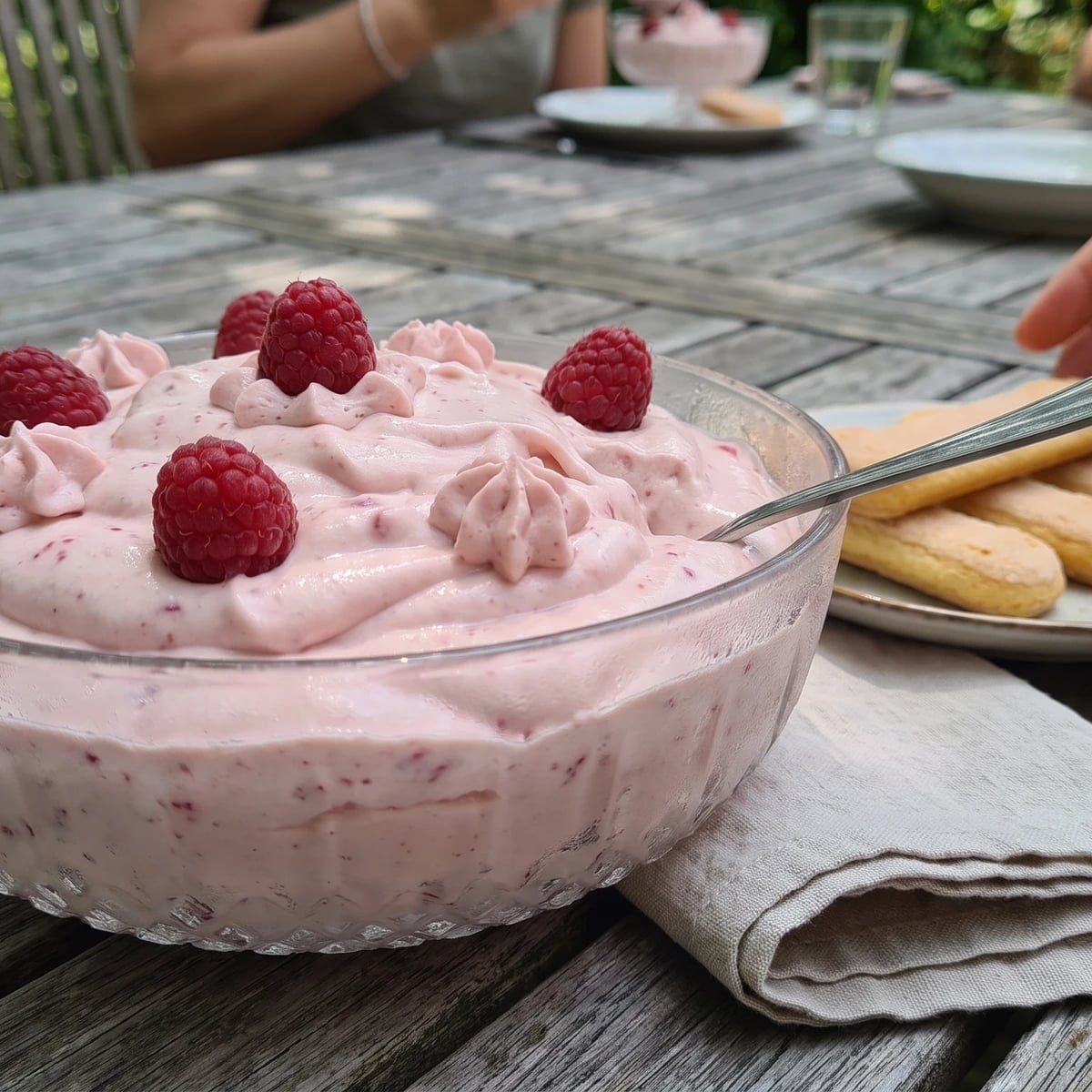
Crème aux Fruits à la Chantilly folds tart raspberry purée into twice its volume of softly whipped Chantilly, then brings the pale rose cream to the table with crisp ladyfingers alongside.
Desserts
French
Outdoor Dining
Picnic
Quick Meal
25 min
Active Time
0 min cook•55 min total
Yield4 servings
Crème aux Fruits à la Chantilly (fruit purée folded with sweetened whipped cream) teaches the gentlest rule in the dessert kitchen: measure the finished components, one part purée to two parts Chantilly, and fold without knocking the life from either. The fruit gives clarity, the cream gives volume, and neither should bully the other.
The brigade formula assumed that strained fruit purée and a bowl of Chantilly were already waiting in the cold room, with a piping bag close at hand. For one cook, one stove, one evening, raspberries make the formula concrete: a blender replaces the fruit station, a sieve removes the seeds, and a hand mixer supplies the whisking arm. The quantity is reduced to four generous portions, but the book’s one-to-two proportion remains exact.
The piping is decorative scaffolding and may become spooned curls without harm. The cold cream, the measured ratio, and the careful folding are the dish itself, so they stay. The one step that matters most is the fold: lighten the purée with a quarter of the Chantilly, then turn in the rest with a broad spatula only until the last white streak disappears.
Crèmes aux fruits à la Chantilly belong to the Parisian entremets repertoire, where fruit purées and sweetened whipped cream were kept as separate preparations and combined for garnishes or served by the bowl with biscuits. Chantilly became the French service name for sweetened whipped cream associated with the domain north of Paris, although the tale that the cream itself was invented there is legend rather than settled culinary history. The formula moved easily from grand kitchens to bourgeois tables because its luxury lies in fresh fruit, good cream, and exact proportion, not elaborate equipment.
The technique, the tradition, and the story behind every dish.
additional superfine sugar (optional)if the fruit demands it
Up to 2 tablespoons (30 ml / 25 g)
fresh lemon juice
1 teaspoon (5 ml / 5 g)
heavy cream with at least 35 percent milk fatvery cold
1 cup (240 ml / 240 g)
heavy cream (optional)reserved only for rescuing overwhipped Chantilly
1 tablespoon (15 ml / 15 g)
pure vanilla extract
½ teaspoon (2.5 ml / 2.5 g)
lady’s-finger biscuits
12
Equipment Needed
•Blender or food processor
•Fine-mesh sieve
•Medium chilled metal mixing bowl
•Electric hand mixer or balloon whisk
•Broad flexible spatula
•1½-quart chilled serving bowl
•Piping bag with a small plain or grooved tip, optional
•Insulated carrier and ice packs for outdoor service
Instructions
1
Chill the working set
Put a medium mixing bowl, the whisk or mixer beaters, the serving bowl, and the cream in the refrigerator for at least 15 minutes. Chantilly gains its volume from cold fat holding air, so begin cold and keep everything cold. Set the eight garnish berries aside in the refrigerator.
A metal bowl chills fastest, but glass works if given enough time. Avoid a warm ceramic mixing bowl, which holds heat precisely when the cream needs none.
2
Make the fruit purée
Blend the remaining raspberries until completely smooth, then press them through a fine-mesh sieve with a flexible spatula. Press the pulp firmly but don't grind the seeds against the mesh, which can lend bitterness. Stir in 2 tablespoons (30 ml / 25 g) of the measured sugar and the lemon juice. Taste it cold. If the berries remain fiercely tart, dissolve in the optional sugar a teaspoon at a time until the purée tastes vivid rather than sour. Measure exactly 1 cup (240 ml / about 250 g) of finished purée and chill it again if the blender has warmed it.
3
Whip the Chantilly
Pour the 1 cup (240 ml / 240 g) of cold cream into the chilled bowl. Add the remaining 2 tablespoons (30 ml / 25 g) of measured sugar and the vanilla. Whip slowly until the sugar dissolves, then at medium speed until the cream holds clear trails and a lifted peak bends gently at its tip. You need exactly 2 cups (480 ml) of finished Chantilly, measured without pressing out its air. Stop before the surface looks grainy. If it does turn rough, don't throw it out. Ça se rattrape: fold in the reserved cold cream one teaspoon at a time until the Chantilly becomes smooth again, then remeasure it before proceeding.
Stiff Chantilly may look impressive in the bowl, but it folds badly and leaves buttery flecks through the fruit. Medium peaks give the finished crème its soft, generous body.
4
Fold one to two
Put the exact 1 cup of cold raspberry purée in a wide chilled bowl. Stir in ½ cup (120 ml) of the measured Chantilly to lighten the purée and bring the two mixtures closer in texture. Add the remaining 1½ cups (360 ml) of Chantilly in two additions, cutting down through the centre with a broad spatula, sweeping along the bottom, and turning the mixture over itself. Stop as soon as the colour is evenly pale rose with no white streaks. If the crème slumps because the purée was too warm, set the bowl over ice for 10 minutes and give it two gentle folds. Ça se rattrape. Don't add gelatin, which would turn this soft cream into a different dessert.
5
Bowl and decorate
Spoon most of the crème into the chilled serving bowl, letting it settle in generous folds rather than smoothing it flat. Transfer the final ⅓ cup (80 ml) to a piping bag fitted with a small plain or grooved tip and pipe modest rosettes over the surface. The piping is presentation scaffolding, not the dish; if you don't own a bag, use the back of a spoon to make a few deep curls. Chill for 30 minutes so the crème settles without becoming firm.
6
Serve well chilled
Arrange the eight reserved raspberries among the piped rosettes just before serving. Send the lady’s-finger biscuits separately so they remain crisp and let everyone help themselves. For outdoor dining, carry the covered bowl in an insulated container with ice packs and keep it cold until the spoons come out. Return leftovers to the cold within two hours, or within one hour in very hot weather. À table!
Chef Tips
•The one-to-two proportion is measured after the fruit has been strained and the cream has been whipped. Raw berries and liquid cream don't carry the same volume once prepared, so weighing the starting ingredients cannot replace this final measurement.
•Raspberries give a tart, fragrant purée with enough character to remain distinct after folding. Strawberries, peeled peaches, apricots, or blackcurrants may replace them, but always strain and measure 1 cup (240 ml) of finished purée, then adjust the sugar to that fruit.
•When raspberries are out of season, use unsweetened frozen fruit picked ripe. Thaw it in a sieve, purée it, and add back only enough of the drained juice to reach a smooth, spoon-coating consistency. An honest frozen berry is better than a pale fresh one.
•Use real heavy cream with at least 35 percent milk fat. Light cream cannot hold the air this preparation requires, and changing the cream changes the structure as plainly as it changes the taste.
•Keep the lady’s-finger biscuits in their own airtight container until service. Put them beside the bowl, never into it, or their crisp edges surrender before anyone reaches the table.
Advance Preparation
•The raspberry purée can be strained, sweetened, covered, and refrigerated up to 24 hours ahead. Stir it before measuring because a little juice may settle at the bottom.
•The completed crème may be assembled and chilled up to 4 hours before serving. Longer storage gradually deflates the Chantilly and encourages the fruit to release liquid, so this is not an overnight dessert.
•For a picnic, chill the covered serving bowl until the last moment, transport it against ice packs, and carry the lady’s-finger biscuits separately in an airtight tin.
Frequently Asked Questions
Nutrition Information
1 serving (about 180g)
Calories
410 calories
Total Fat
25 g
Saturated Fat
15 g
Trans Fat
1 g
Unsaturated Fat
9 g
Cholesterol
120 mg
Sodium
50 mg
Total Carbohydrates
42 g
Dietary Fiber
5 g
Sugars
29 g
Protein
5 g
Where cooking meets culture.
Culinary guides, cultural storytelling, and the editorial depth that makes cooking meaningful.