
Chef Juliette
Various Almond Preparations
Five almond preparations, one discipline: remove the skins cleanly, dry every kernel through, then cut, toast, or cloak it in pale caramel without letting its fragrant oils escape.
A cooking platform built around craft, culture, and the stories behind what we eat.
Created by Chef Juliette
Based on No. 2638, Creams, from Le Guide Culinaire (1907) by Auguste Escoffier
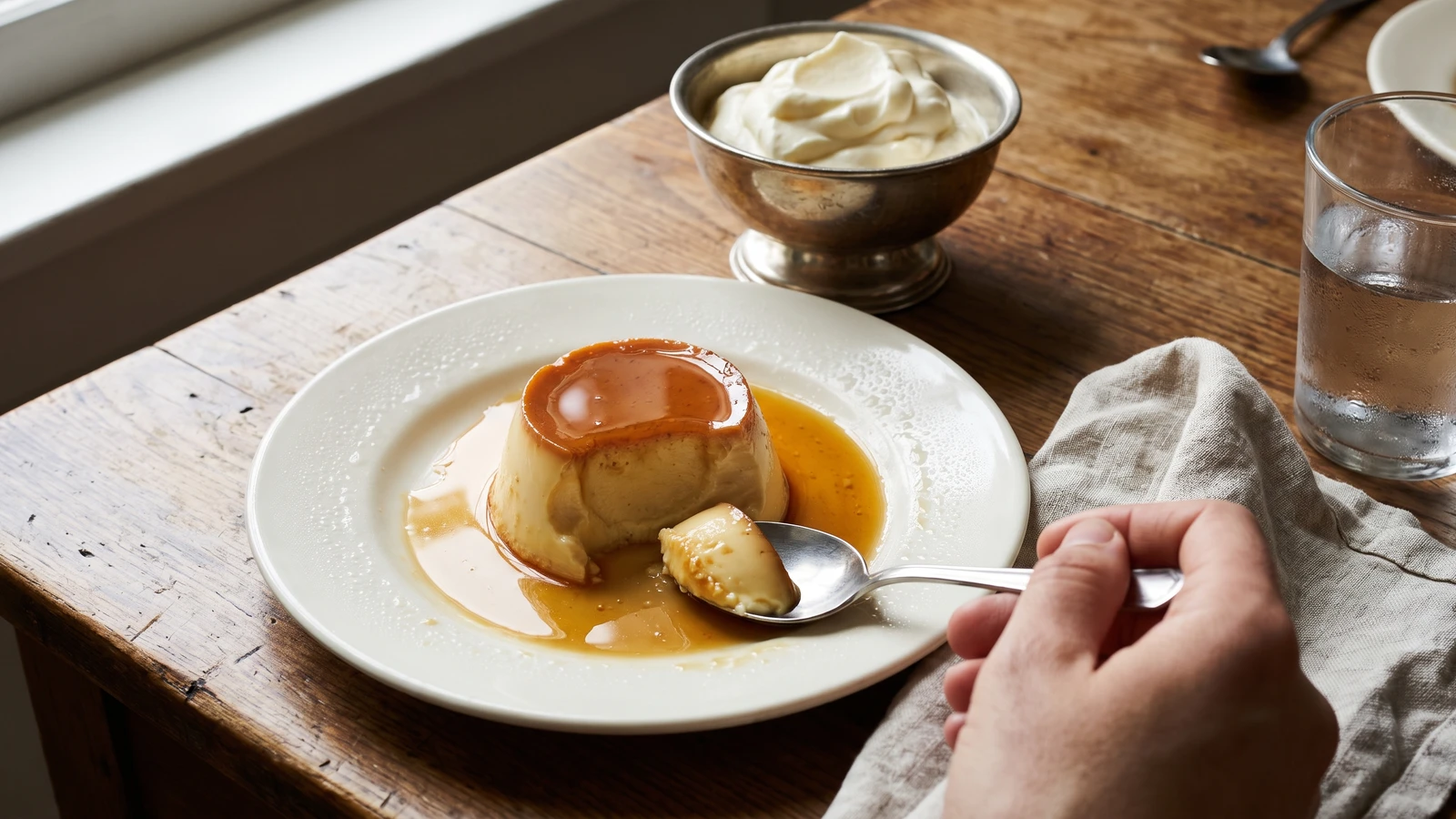
One family, two techniques: a crème moulée held by gentle egg coagulation, and crème Chantilly held by air, each cold, delicate, and made for tonight’s home table.
Crèmes froides teach one true principle: temperature decides what holds. A crème moulée sets because eggs meet gentle heat without boiling; crème Chantilly gains its body because cold cream traps air without turning grainy. C’est la même grammaire, control the structure and the cream stays delicate.
The source entry is a map of these two families rather than a formula with proportions, so nothing can be scaled mechanically. This version gives one canonical specimen of each: six crèmes moulées au caramel and a home bowl of Chantilly. The original service assumed ranks of special pots and moulds, a dedicated bain-marie, and pastry hands available to whip cream close to the table. Six ramekins, a roasting tin, and a hand mixer do the same work for one cook, one stove, one evening.
Rows of silver bowls were brigade scaffolding and can go. The gentle water bath for the crème moulée and the thoroughly chilled bowl for Chantilly are the dishes themselves, and they stay. Before you touch the pan, arrange the water bath and chill the whipping bowl; temperature is the step that decides both.
At the French classical table, cold creams appeared among the entremets in two distinct families: cooked custards and preparations made from fresh cream whipped with sugar. Delicate custards containing fewer eggs remained in their porcelain pots, while firmer crèmes moulées were turned out for formal service, with crème au caramel becoming the defining example; the older name crème renversée still describes the action but not the preferred classical term. Crème Chantilly carries the name of Chantilly in Picardy, although tales assigning its invention to one château kitchen are less certain than the long practice of serving sweetened whipped cream at French tables.
Quantity
½ cup (120 ml / 100 g)
Quantity
2 tablespoons (30 ml / 30 g)
Quantity
2 cups (475 ml / 490 g)
Quantity
1
split lengthwise
Quantity
3
Quantity
2
Quantity
⅓ cup (80 ml / 67 g)
Quantity
1 pinch
Quantity
1 cup (240 ml / 240 g)
thoroughly chilled
Quantity
2 tablespoons (30 ml / 15 g)
sifted
Quantity
1 teaspoon (5 ml / 4 g)
Quantity
2 tablespoons (30 ml / 30 g)
thoroughly chilled
| Ingredient | Quantity |
|---|---|
| granulated sugar, for the caramel | ½ cup (120 ml / 100 g) |
| water, for the caramel | 2 tablespoons (30 ml / 30 g) |
| whole milk | 2 cups (475 ml / 490 g) |
| vanilla beansplit lengthwise | 1 |
| large eggs | 3 |
| large egg yolks | 2 |
| granulated sugar, for the custard | ⅓ cup (80 ml / 67 g) |
| fine sea salt | 1 pinch |
| heavy cream with at least 35 percent milk fatthoroughly chilled | 1 cup (240 ml / 240 g) |
| confectioners’ sugarsifted | 2 tablespoons (30 ml / 15 g) |
| pure vanilla extract | 1 teaspoon (5 ml / 4 g) |
| heavy cream, for rescuing the Chantilly (optional)thoroughly chilled | 2 tablespoons (30 ml / 30 g) |
Heat the oven to 300°F (150°C). Set six straight-sided 4-ounce (120 ml) ramekins in a deep roasting tin and bring a kettle of water nearly to the boil. Put a clean mixing bowl and the mixer beaters in the refrigerator for the Chantilly. This preparation looks modest, but it protects both creams before the delicate work begins.
Put the caramel sugar and water in a small pale-lined saucepan. Heat gently until the sugar dissolves, then raise the heat and let it boil without stirring. Swirl the pan only when the syrup begins to colour, and remove it at a deep amber, before it smells burnt. If crystals gather on the sides while the syrup is still pale, cover the pan for thirty seconds so condensation washes them down, then continue uncovered. Ça se rattrape. Divide the caramel among the ramekins at once, tilting each carefully to coat its base. Hot caramel burns fiercely, so use a dry towel and keep your fingers above the rims.
Put the milk in a saucepan. Scrape in the vanilla seeds, add the pod, and heat until small bubbles gather around the edge, about 180°F (82°C), without letting the milk boil. Take it off the heat, cover, and infuse for ten minutes. Gentle heat draws out the vanilla while keeping the milk sweet and clean-tasting.
Whisk the eggs, yolks, custard sugar, and salt only until evenly blended, not pale or foamy. Remove the vanilla pod, then pour the warm milk into the eggs in a slow stream while whisking constantly. Strain through a fine sieve into a jug and skim away surface bubbles. If the heat catches a few threads of egg, don’t discard the mixture; the sieve removes them, and the custard can proceed. Pour it gently over the hardened caramel in the ramekins.
Pour the hot kettle water into the roasting tin until it reaches halfway up the ramekins. This bain-marie, a water bath, softens the oven’s heat so the eggs set without curdling. Bake for 30 to 40 minutes, until the edges are set and the centre trembles in one small circle when nudged; a thermometer should read 175 to 180°F (79 to 82°C). If the bath begins bubbling, add a little cool water and lower the oven slightly. Tiny bubbles around an overcooked edge are not a catastrophe, but a hard-set centre cannot be made delicate again, so pull the custards while they still quiver.
Lift the ramekins from the bath and cool them for 30 minutes, then cover and refrigerate for at least 4 hours. To serve, run a thin knife only around the upper edge, dip the base of each ramekin in warm water for 8 to 10 seconds, place a chilled plate on top, and invert decisively. If the crème moulée stays put, return the base to the water for another 5 seconds. Don’t prolong the dip or the custard will melt at the edge. Lift the mould straight up and let the amber caramel pool naturally.
Pour the thoroughly chilled cream into the chilled bowl. Whip at low speed until frothy, then at medium speed until the whisk begins leaving soft tracks. Add the confectioners’ sugar and vanilla, then continue only until smooth medium peaks hold their curve. Stop and check often. If the Chantilly turns slightly grainy, fold in the optional cold cream one spoonful at a time by hand until it becomes smooth again. Once yellow beads and liquid appear it has crossed into butter, so keep that for breakfast and begin again with cold cream.
Serve the crème moulée cold on its own plate, surrounded by its caramel. Spoon the Chantilly into small chilled bowls close to serving time, or offer it with ripe fruit, poached fruit, or a simple chocolate dessert. These are two branches of the same family, not layers that must be piled together. One is held by eggs, the other by air. À table!
1 serving (about 175g)
Culinary guides, cultural storytelling, and the editorial depth that makes cooking meaningful.
Discover Culinary ExplorerChef Juliette
Five almond preparations, one discipline: remove the skins cleanly, dry every kernel through, then cut, toast, or cloak it in pale caramel without letting its fragrant oils escape.

Chef Juliette
A pastry pantry lesson in one tray: filberts warmed only until their red skins release, rubbed clean, cooled, and chopped into a fragrant mise-en-place for cakes, creams, pralines, and petits fours.

Chef Juliette
The smallest pâtisserie discipline decides whether a cake leaves its mould intact: clarified butter in every corner, followed by the lightest veil of dry flour or fécule.

Chef Juliette
Four whites, one spotless bowl, and a patient change of speed: whisk gently until loosened, then briskly to glossy stiffness, with powdered sugar waiting if the foam begins to granulate.