
Chef Juliette
Various Almond Preparations
Five almond preparations, one discipline: remove the skins cleanly, dry every kernel through, then cut, toast, or cloak it in pale caramel without letting its fragrant oils escape.
A cooking platform built around craft, culture, and the stories behind what we eat.
Created by Chef Juliette
Based on No. 2634, Opera Charlotte, from Le Guide Culinaire (1907) by Auguste Escoffier
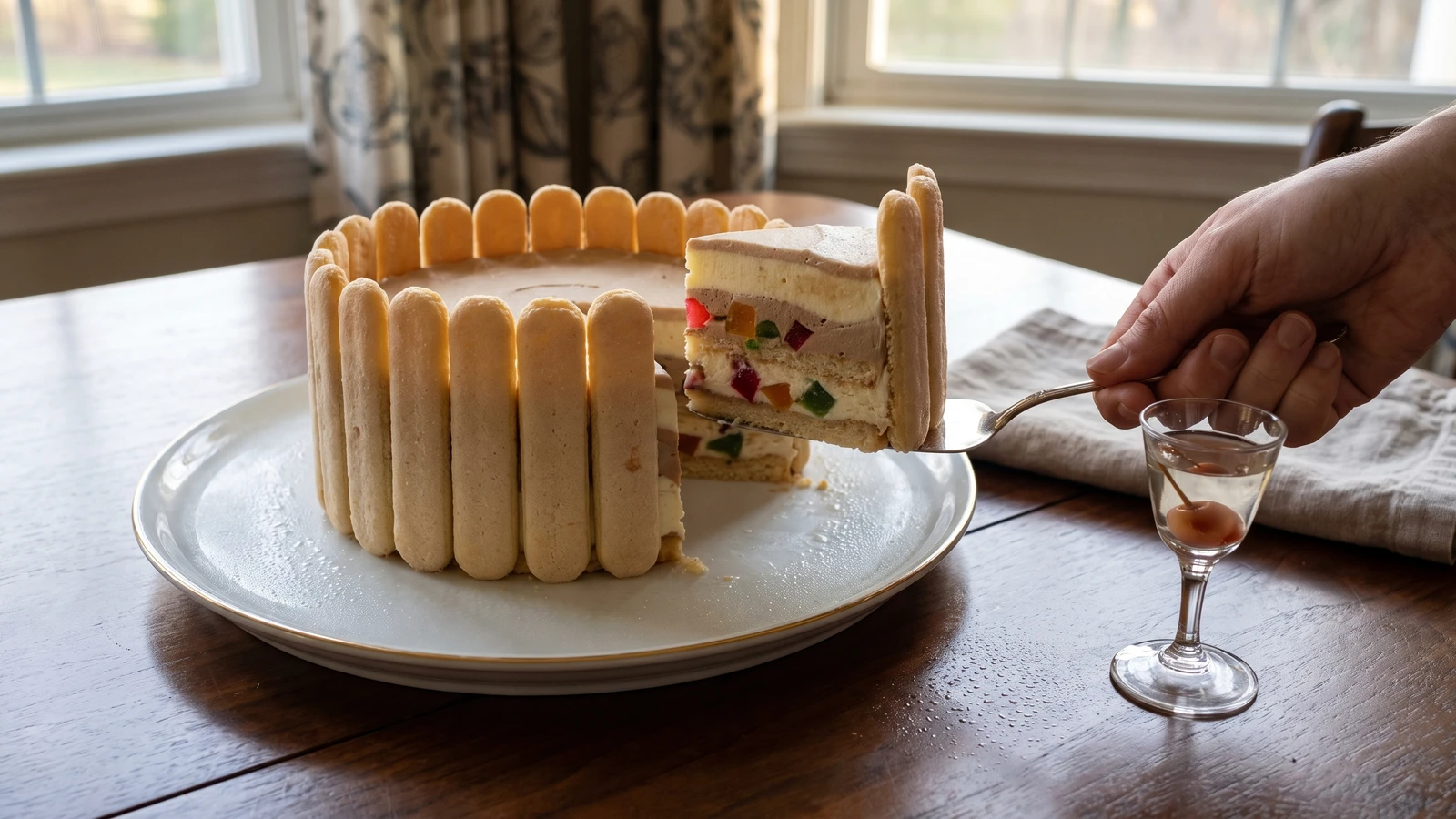
Charlotte Opéra sets vanilla Bavarois with candied chestnut purée and a well-drained Maraschino fruit salpicon inside crisp sugar wafers, proving that a clean cold set depends as much on drainage as gelatin.
Charlotte Opéra (a sugar-wafer charlotte with chestnut Bavarois and Maraschino fruit) teaches one hard, useful truth: a cold dessert is only as stable as its wettest inclusion. Here that inclusion is the salpicon, candied fruit cut into a fine, even dice and macerated in Maraschino. Drain it until it looks almost too dry. Loose syrup slackens the gelatin, softens the wafers, and steals the clean slice.
The original is a brief assembly instruction because it assumed vanilla Bavarois, a set custard lightened with whipped cream, already waiting at the pastry station, along with brigade quantities of candied chestnut purée. At home, you make one small crème anglaise, fold in cream, and measure exactly one quarter of its finished bulk in chestnut purée. The source names Huntley and Palmer’s sugar wafers; when they can't be found, a plain, crisp, unfilled sugar wafer is the honest equivalent. Batchwork is scaffolding and can go. The quarter-bulk ratio, vanilla, dry salpicon, Maraschino, and wafer shell are the dish and must stay. One cook, one stove, one evening.
Once unmoulded, the wafers form a pale-gold palisade around an ivory and chestnut-beige centre, with small pieces of candied fruit showing through each slice. It should stand softly, not bounce like jelly. Your one decisive task comes before the mould is filled: drain and blot the salpicon hard.
Charlotte Opéra belongs to the Parisian grand-kitchen repertoire, where moulded Bavarois desserts traveled from formal dining rooms to ambitious home tables. It is not gâteau Opéra in another shape: this charlotte is defined by its sugar-wafer lining, vanilla Bavarois, candied chestnut purée at one quarter of the Bavarois bulk, and Maraschino fruit salpicon. The call for Huntley and Palmer’s wafers shows how readily the French canon adopted a dependable English commercial biscuit when its crispness suited the construction.
Quantity
1/2 cup (120 ml / 90 g)
cut into 1/4-inch (6 mm) dice
Quantity
3 tablespoons (45 ml / 42 g)
Quantity
20 to 24 wafers (about 6 oz / 170 g)
Quantity
2 1/2 teaspoons (12.5 ml / 8 g)
Quantity
3 tablespoons (45 ml / 45 g)
Quantity
1 cup (240 ml / 245 g)
Quantity
1
split lengthwise and scraped
Quantity
3 (about 3 tablespoons / 45 ml / 54 g)
Quantity
1/3 cup (80 ml / 67 g)
Quantity
1/8 teaspoon (0.6 ml / 0.75 g)
Quantity
1 cup (240 ml / 240 g)
Quantity
3/4 cup (180 ml / 225 g)
| Ingredient | Quantity |
|---|---|
| mixed candied fruitcut into 1/4-inch (6 mm) dice | 1/2 cup (120 ml / 90 g) |
| Maraschino liqueur | 3 tablespoons (45 ml / 42 g) |
| Huntley and Palmer’s sugar wafers, or plain crisp unfilled sugar wafers if unavailable | 20 to 24 wafers (about 6 oz / 170 g) |
| powdered gelatin | 2 1/2 teaspoons (12.5 ml / 8 g) |
| cold water | 3 tablespoons (45 ml / 45 g) |
| whole milk | 1 cup (240 ml / 245 g) |
| vanilla beansplit lengthwise and scraped | 1 |
| large egg yolks | 3 (about 3 tablespoons / 45 ml / 54 g) |
| caster sugar | 1/3 cup (80 ml / 67 g) |
| fine salt | 1/8 teaspoon (0.6 ml / 0.75 g) |
| cold heavy cream, at least 35 percent fat | 1 cup (240 ml / 240 g) |
| smooth sweetened purée of candied chestnuts | 3/4 cup (180 ml / 225 g) |
Combine the candied fruit salpicon with the Maraschino and leave it for 30 minutes, stirring once so every piece is scented. Tip it into a fine sieve and drain for at least 10 minutes, pressing gently with the back of a spoon. Spread the fruit on a clean towel and blot it firmly. If it still glistens with loose syrup, drain and blot again. Ça se rattrape now; once that syrup reaches the Bavarois, it slackens the entire set.
Fit sugar wafers across the bottom of a 1.2-litre charlotte mould, cutting neat pieces to close the gaps. Trim enough wafers to the mould’s height and stand them tightly around the side, edge to edge rather than overlapping; reserve the remaining wafers to cover the filled mould. Do not soak or brush them with liqueur. The salpicon alone is macerated, and the dry wafer shell provides the contrast the dish needs.
Sprinkle the powdered gelatin evenly over the cold water and leave it undisturbed for 10 minutes. Every grain must absorb water before heating; dry islands of gelatin become rubbery specks that no whisk can smooth later.
Put the milk, vanilla seeds, and pod in a small saucepan. Bring the milk just to the first movement below a simmer, cover, and infuse for 10 minutes, then remove the pod. Whisk the yolks with the sugar and salt until smooth, pour in the hot milk gradually while whisking, and return everything to low heat. Stir constantly with a flexible spatula until the crème anglaise, the stirred custard base, reaches 180 to 183°F (82 to 84°C) and coats the spatula in a thin, even film. Never let it boil. If a few fine curds appear, remove it from the heat immediately, blend briefly, and strain; large scrambled pieces mean the custard went too far and must be remade.
Take the custard off the heat, add the bloomed gelatin, and stir until completely dissolved. Strain it into a clean bowl, then set that bowl over ice water and stir until the custard cools to about 77°F (25°C), thickening just enough to leave a soft trace. Do not let it set solid. If gelatin catches around the bowl’s edge, set the bowl briefly over lukewarm water and whisk until smooth again.
Whip the cold cream to soft peaks that bend at their tips. Fold one third into the cooled custard to lighten it, then fold in the remainder gently. Measure 3 cups (720 ml) of this vanilla Bavarois into a clean bowl, setting any small excess in a ramekin. Stir a spoonful of Bavarois into the chestnut purée until smooth, then fold that mixture into the measured Bavarois. This keeps the source’s exact proportion: one part candied chestnut purée to four parts Bavarois by volume. Fold in the dry salpicon last. If the fruit sinks at once, chill the bowl for 5 minutes and fold once more when the mixture holds a ribbon.
Spoon the mixture into the wafer-lined mould in three additions, pressing it carefully toward the edges without crushing the wafers. Level the surface and cover it with the reserved wafers; this becomes the base after unmoulding. Cover and refrigerate for at least 4 1/2 hours, until the centre remains still when the mould is gently tilted. Keep it in the cold until serving.
Set a chilled serving plate over the mould and invert both together. Lift the mould straight up. If it refuses, press a warm, well-wrung towel against the outside for 5 seconds and try again; too much warmth melts the outer Bavarois and softens the wafers. If the charlotte feels too soft to stand, return it to the mould and chill for another hour. Cut with a thin knife dipped in hot water and wiped dry between slices. Serve cold. À table!
1 serving (about 150g)
Culinary guides, cultural storytelling, and the editorial depth that makes cooking meaningful.
Discover Culinary ExplorerChef Juliette
Five almond preparations, one discipline: remove the skins cleanly, dry every kernel through, then cut, toast, or cloak it in pale caramel without letting its fragrant oils escape.

Chef Juliette
A pastry pantry lesson in one tray: filberts warmed only until their red skins release, rubbed clean, cooled, and chopped into a fragrant mise-en-place for cakes, creams, pralines, and petits fours.

Chef Juliette
The smallest pâtisserie discipline decides whether a cake leaves its mould intact: clarified butter in every corner, followed by the lightest veil of dry flour or fécule.

Chef Juliette
Four whites, one spotless bowl, and a patient change of speed: whisk gently until loosened, then briskly to glossy stiffness, with powdered sugar waiting if the foam begins to granulate.