
Chef Juliette
Various Almond Preparations
Five almond preparations, one discipline: remove the skins cleanly, dry every kernel through, then cut, toast, or cloak it in pale caramel without letting its fragrant oils escape.
A cooking platform built around craft, culture, and the stories behind what we eat.
Created by Chef Juliette
Based on No. 2633, Charlotte Montreuil, from Le Guide Culinaire (1907) by Auguste Escoffier
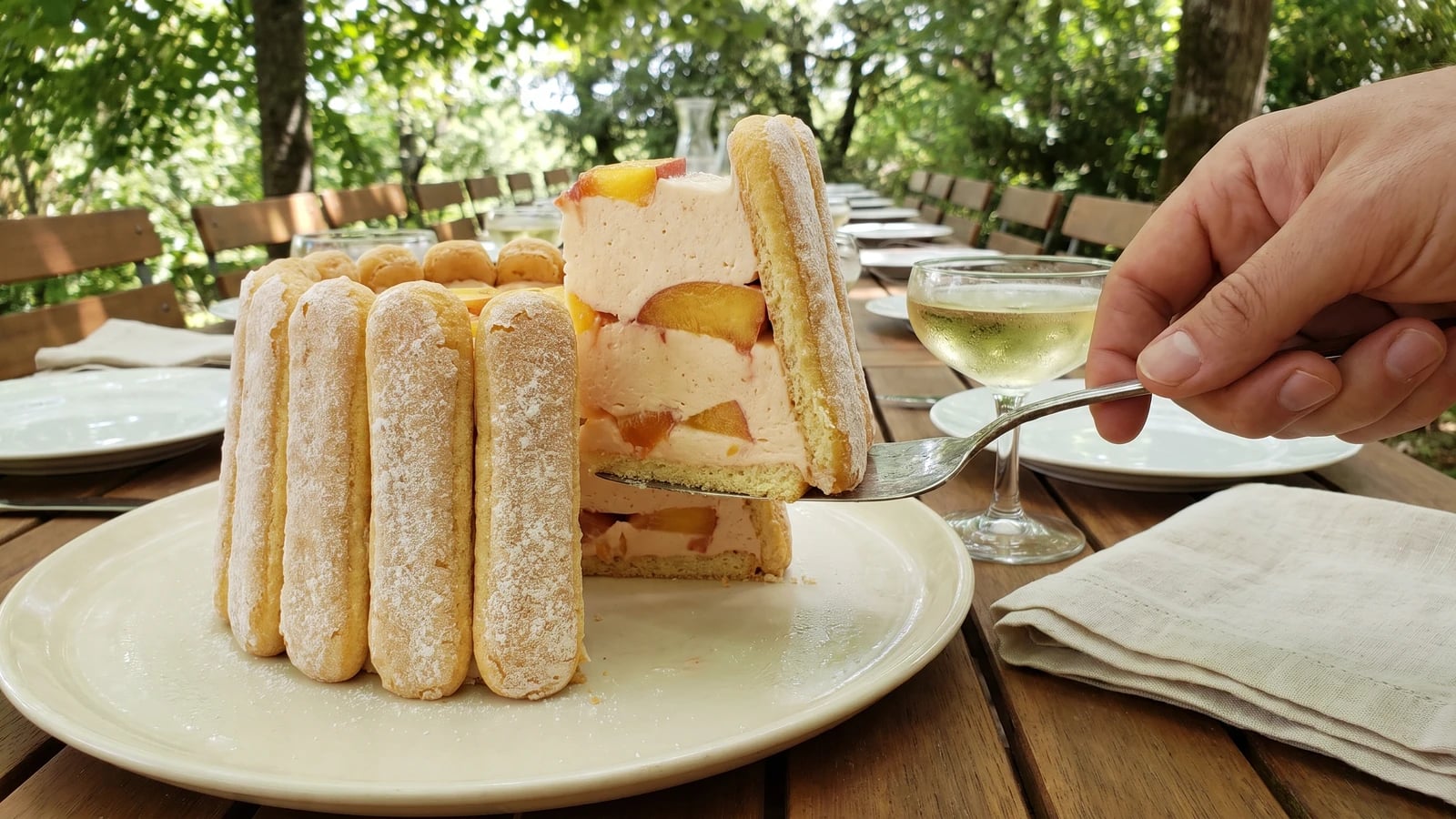
A cold peach bavarois held in a palisade of biscuits à la cuillère, with ripe sugared slices tucked through the cream: Montreuil's famous fruit made into a generous charlotte.
Charlotte Montreuil (peach bavarois in a ladyfinger case) teaches the quiet discipline behind every fruit-set dessert: control the water before you ask cream and gelatin to hold it. Very ripe peaches belong here, but their juice does not. Sugar the slices, let them surrender that excess liquid, then drain them thoroughly before they enter the mould.
The formula assumes a pastry brigade with trays of biscuits à la cuillère (ladyfingers), finished crème anglaise (English custard), sieved fruit purée, and whipped cream waiting in separate bowls. At home, packaged dry ladyfingers replace the biscuit station, a springform pan replaces the tall charlotte mould, and one saucepan carries the custard from stove to mixing bowl. That separate production is brigade scaffolding. The structure stays untouched: one measure peach purée to two measures finished crème anglaise, followed by an equal measure of cream before whipping. One cook, one stove, one evening, then a good rest in the cold.
When it is ready, the Charlotte Montreuil cuts into pale peach cream threaded with soft slices, while its close ring of biscuits holds everything upright. The finish is generous, not fussy, and it belongs at the end of a long summer table. Sugar and drain the sliced peaches before they enter the mould. That is the step that decides the Charlotte.
Montreuil, immediately east of Paris, became celebrated for its murs à pêches, long plastered walls that trapped warmth and sheltered peach trees trained carefully against them. The Charlotte Montreuil carried that prized local fruit into the classical pastry repertoire by setting peach purée and sliced peaches inside a biscuit-lined mould. Its formal silhouette can mislead: at heart, this is an orchard dessert built to preserve the perfume and softness of ripe fruit.
Quantity
30 to 34, about 7 oz (200 g)
Quantity
3 medium, about 1 lb (450 g) whole, yielding exactly 1 cup (240 ml / 245 g)
peeled, pitted, puréed, and passed through a fine sieve
Quantity
4 medium, about 1 1/3 lb (600 g) whole
peeled, pitted, and cut into 1/4-inch (6 mm) slices
Quantity
2 tablespoons (30 ml / 25 g)
Quantity
1 1/2 cups (360 ml / 370 g)
Quantity
1/2 bean
split lengthwise and scraped
Quantity
5
Quantity
1/2 cup (120 ml / 100 g)
Quantity
4 teaspoons (20 ml / 12 g)
Quantity
3 tablespoons (45 ml / 45 g)
Quantity
2 cups (480 ml / 475 g)
thoroughly chilled
| Ingredient | Quantity |
|---|---|
| biscuits à la cuillère (dry ladyfingers) | 30 to 34, about 7 oz (200 g) |
| very ripe yellow peachespeeled, pitted, puréed, and passed through a fine sieve | 3 medium, about 1 lb (450 g) whole, yielding exactly 1 cup (240 ml / 245 g) |
| ripe but firm yellow peachespeeled, pitted, and cut into 1/4-inch (6 mm) slices | 4 medium, about 1 1/3 lb (600 g) whole |
| caster sugar for the sliced peaches | 2 tablespoons (30 ml / 25 g) |
| whole milk | 1 1/2 cups (360 ml / 370 g) |
| vanilla beansplit lengthwise and scraped | 1/2 bean |
| large egg yolks | 5 |
| caster sugar for the crème anglaise | 1/2 cup (120 ml / 100 g) |
| powdered gelatin | 4 teaspoons (20 ml / 12 g) |
| cold water | 3 tablespoons (45 ml / 45 g) |
| heavy cream containing at least 35 percent fatthoroughly chilled | 2 cups (480 ml / 475 g) |
Toss the sliced peaches gently with the 2 tablespoons of sugar and place them in a sieve over a bowl for 30 minutes. The sugar draws out the loose juice that would otherwise dilute the bavarois and make the finished charlotte weep. Let the slices drain without pressing, then blot any visibly wet surfaces with a clean cloth or paper towel. They should remain supple and glossy, but they must not drip.
Arrange the ladyfingers snugly across the bottom of an 8-inch (20 cm) springform pan, trimming pieces only where needed to close the gaps. Stand more biscuits around the sides with their rounded ends pointing upward and their sugared faces toward the pan wall. Pack them closely enough to form a palisade, but do not crush them. The bought biscuits are the honest home equivalent of a brigade's freshly baked trays, and their dry texture will soften properly against the bavarois.
Sprinkle the powdered gelatin evenly over the cold water in a small bowl. Leave it untouched for 10 minutes, until every grain has absorbed water and the mixture resembles a firm translucent sponge. Dry pockets of gelatin become hard pellets later, so sprinkle broadly rather than dropping the powder in one heap.
Heat the milk with the vanilla pod and seeds until bubbles gather at the edge, then remove it from the heat and cover for 5 minutes. Whisk the yolks with the 1/2 cup of sugar until smooth and slightly pale. Pour in the hot milk gradually while whisking, return everything to the saucepan, and cook over low heat with constant stirring until the crème anglaise reaches 180 to 183°F (82 to 84°C) and holds a clean line drawn through it on the back of the spoon. Do not let it boil. At the first sign of graininess, pull the pan from the heat and blend briefly before straining. Ça se rattrape when the curds are tiny; fully scrambled custard must be remade. Strain immediately and measure exactly 2 cups (480 ml), reserving any spoonful left over. Stir the bloomed gelatin into the hot measured custard until completely dissolved.
Whisk the exactly measured peach purée into the warm crème anglaise. Set the bowl over a larger bowl of ice water and stir slowly until the mixture feels cool and begins to hold the faint trace of the whisk, about 72 to 75°F (22 to 24°C). This slight thickening suspends the cream instead of letting it sink. If the gelatin sets around the rim before the centre is ready, lift the bowl from the ice and set it briefly over barely warm water, stirring until smooth again. Do not heat it beyond fluidity.
Whip the cold cream to soft peaks, the crème fouettée (softly whipped cream) that bends at the tip rather than standing stiff. Fold one quarter into the peach base to lighten it, then fold in the remainder with broad strokes from the bottom of the bowl. Stop as soon as the colour is even. If the base feels warm enough to melt the cream, set it over the ice for another minute before folding; cream lost to warmth cannot give the bavarois its lightness.
Spoon one third of the peach bavarois into the biscuit-lined pan and spread it into every gap without disturbing the biscuits. Lay over half the drained peach slices, keeping them just inside the biscuit wall. Repeat with another third of bavarois and the remaining slices, then cover with the final third. Smooth the top and tap the pan once, gently, against a folded cloth to settle hidden air pockets. Do not keep tapping or the fruit will fall to the bottom.
Cover the pan without touching the surface and chill for at least 6 hours, preferably overnight. Release the springform ring only when the centre feels firmly set; if one section clings, press a cloth wrung out in warm water against that spot for 3 seconds and try again. Transfer the charlotte to a serving platter and cut it with a thin knife wiped clean between slices. Keep it cold until serving, especially outdoors. À table!
1 serving (about 230g)
Culinary guides, cultural storytelling, and the editorial depth that makes cooking meaningful.
Discover Culinary ExplorerChef Juliette
Five almond preparations, one discipline: remove the skins cleanly, dry every kernel through, then cut, toast, or cloak it in pale caramel without letting its fragrant oils escape.

Chef Juliette
A pastry pantry lesson in one tray: filberts warmed only until their red skins release, rubbed clean, cooled, and chopped into a fragrant mise-en-place for cakes, creams, pralines, and petits fours.

Chef Juliette
The smallest pâtisserie discipline decides whether a cake leaves its mould intact: clarified butter in every corner, followed by the lightest veil of dry flour or fécule.

Chef Juliette
Four whites, one spotless bowl, and a patient change of speed: whisk gently until loosened, then briskly to glossy stiffness, with powdered sugar waiting if the foam begins to granulate.