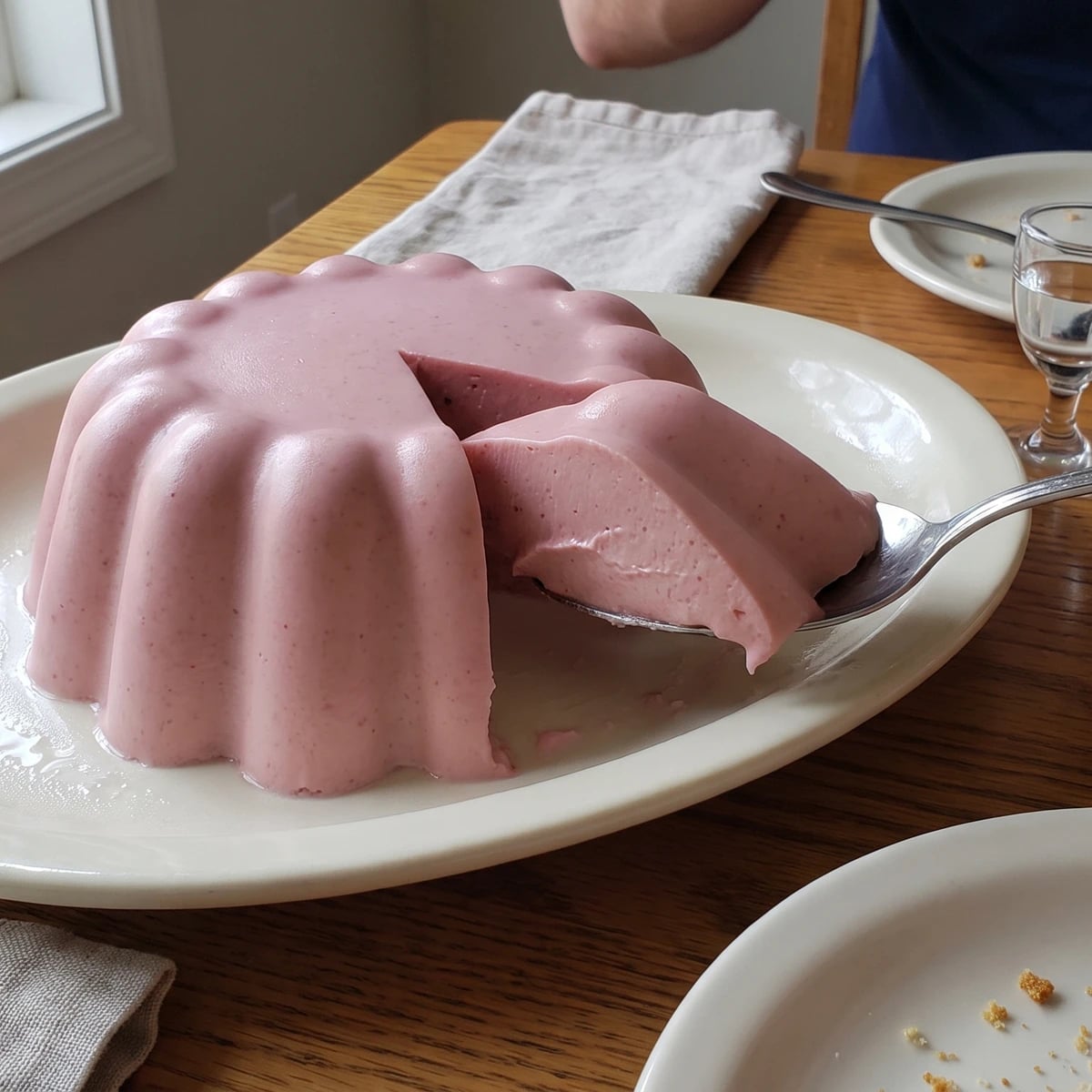
Blanc-manger is a lesson in balance: equal measures of vivid raspberry purée and almond base, held by just enough gelatine to turn out cleanly and still tremble on the spoon.
Desserts
French
Make Ahead
Comfort Food
Celebration
35 min
Active Time
15 min cook•6 hr 50 min total
YieldOne 1-quart fruit mold (6 to 8 servings), or one 2-cup liqueur mold (4 servings)
Blanc-manger aux fruits ou aux liqueurs (set almond cream with fruit or liqueur) teaches proportion. The one thing to know before touching a pan is this: the gelatine must support the finished mixture, not merely the almond base. For the fruit version, equal measures of raspberry purée and almond preparation meet in the bowl, and the full measure of gelatine stays because the fruit doubles the volume.
The original formula assumed a pastry station grinding almonds, sieving several fruit purées, and filling ranks of molds for service. Here a blender, a fine sieve, and one modest mold do the work. The large batch and the parade of flavors were brigade scaffolding, so they go. The almond extraction, equal measure, and restrained setting remain because they are the dish. A vague liqueur glass is standardized to 1 fluid ounce, then scaled to half that amount for this two-cup home batch. One cook, one stove, one evening.
When it is right, the blanc-manger turns out with a pale rose satin surface and yields under the spoon with a quiet tremble. Cool the almond preparation until it has the weight of pouring cream before the fruit goes in. That is the step that keeps the purée suspended and the texture even.
Blanc-manger found its French home at the grand service tables of Paris, where pastry kitchens turned a family of pale almond preparations into a cold entremets shaped in decorative molds. Its name has also covered savory mixtures of pounded poultry, rice, and almond milk, a surprising relation of the sweet cream known now. Across generations, fruit purées gave the formula a seasonal family, while Kirsch, Maraschino, and rum carried the same almond base through the liqueur cabinet.
The technique, the tradition, and the story behind every dish.
powdered gelatine for the fruit version (optional)
Quantity
1 tablespoon plus 1 teaspoon (20 ml / 12 g)
powdered gelatine for the liqueur version (optional)
Quantity
2 teaspoons (10 ml / 6 g)
cold water for the fruit version (optional)
Quantity
¼ cup (60 ml / 60 g)
cold water for the liqueur version (optional)
Quantity
2 tablespoons (30 ml / 30 g)
cold heavy cream
Quantity
Up to ½ cup (120 ml / 119 g)
softly whipped; use enough to bring the almond base to exactly 2 cups
food-safe pure almond extract
Quantity
⅛ teaspoon (0.6 ml / 0.6 g)
fresh or frozen raspberries for the fruit version (optional)
Quantity
About 5 cups (1.2 liters / 625 g)
puréed and sieved to yield exactly 2 cups (480 ml / 500 g)
Kirsch, dry Maraschino, or rum for the liqueur version (optional)
Quantity
1 tablespoon (15 ml / 14 g)
Ingredient
Quantity
blanched whole almonds
¾ cup (180 ml / 105 g)
whole milkdivided
1 cup (240 ml / 247 g)
granulated sugar
½ cup (120 ml / 100 g)
powdered gelatine for the fruit version (optional)
1 tablespoon plus 1 teaspoon (20 ml / 12 g)
powdered gelatine for the liqueur version (optional)
2 teaspoons (10 ml / 6 g)
cold water for the fruit version (optional)
¼ cup (60 ml / 60 g)
cold water for the liqueur version (optional)
2 tablespoons (30 ml / 30 g)
cold heavy creamsoftly whipped; use enough to bring the almond base to exactly 2 cups
Up to ½ cup (120 ml / 119 g)
food-safe pure almond extract
⅛ teaspoon (0.6 ml / 0.6 g)
fresh or frozen raspberries for the fruit version (optional)puréed and sieved to yield exactly 2 cups (480 ml / 500 g)
About 5 cups (1.2 liters / 625 g)
Kirsch, dry Maraschino, or rum for the liqueur version (optional)
1 tablespoon (15 ml / 14 g)
Equipment Needed
•Blender or food processor
•Small heavy saucepan
•Fine-mesh sieve
•Damp muslin or a clean thin kitchen cloth
•Large bowl and a second bowl for an ice-water bath
•1-quart decorative mold for fruit, or 2-cup mold for liqueur
Instructions
1
Prepare the purée
For the fruit version, purée the raspberries until completely smooth, then work them through a fine sieve to remove every seed. Measure exactly 2 cups (480 ml / 500 g) and keep the purée cool. If you are short, purée more fruit rather than filling the measure with water. For the liqueur version, omit the fruit and begin with the almonds.
Frozen raspberries picked ripe are an honest choice when fresh ones are pale or expensive. Thaw them completely before puréeing, and include their juice.
2
Extract the almonds
Pulse the almonds with ¼ cup (60 ml) of the milk until they form a very fine, wet paste. Heat the remaining milk until tiny bubbles gather at the edge, then stir in the almond paste, cover, and leave it to infuse for 20 minutes. Pass it through a fine sieve lined with damp muslin, pressing firmly to recover every drop. This extraction is not brigade scaffolding. It is where the blanc-manger acquires its almond body, so press patiently.
3
Dissolve the gelatine
Choose the gelatine quantity for your variation. For fruit, bloom the full 12 g in ¼ cup (60 ml) cold water; for liqueur, bloom 6 g in 2 tablespoons (30 ml) cold water. Leave it for 5 minutes. Warm the strained almond milk with the sugar just until the grains disappear, then remove it from the heat and stir in the bloomed gelatine and almond extract. Never let the gelatine boil. If a few grains remain, set the bowl over warm water and stir until the mixture is clear. Ça se rattrape.
4
Cool the base
Set the bowl of almond mixture inside a larger bowl of ice water and stir until it reaches about 24°C / 75°F and gains the consistency of light pouring cream. Whip the heavy cream only to soft folds, then add it gradually until the finished almond base measures exactly 2 cups (480 ml). If the gelatine firms around the edge before the center thickens, lift the bowl from the ice and stir it briefly over lukewarm water. Do not beat at the set pieces; soften them gently and the base will become smooth again.
5
Flavor by proportion
For the fruit version, make sure the raspberry purée and almond base are similarly cool. Stir one-quarter of the base into exactly 2 cups (480 ml) of purée, then fold in the rest. Equal quantities are the rule. If the mixture begins setting in pale streaks, place the bowl over lukewarm water for a few seconds and whisk gently until even, then return it to the cold. For the liqueur version, omit the fruit and stir 1 tablespoon (15 ml) of Kirsch, dry Maraschino, or rum into the 2 cups of almond base. This is the scaled equivalent of one 1-fluid-ounce liqueur glass per quart of preparation.
6
Mold and chill
Rinse a 1-quart mold with very cold water for the fruit version, or use a 2-cup mold for the liqueur version. Do not dry it. Pour in the blanc-manger, tap the mold lightly against a folded towel to release hidden air pockets, cover, and chill for at least 6 hours, preferably overnight. It should feel firmly set at the edge but retain a slight tremble at the center. Do not freeze it, because freezing damages the gel and makes it weep.
7
Turn out gently
Chill the serving plate. Dip the mold into warm water for 5 seconds, dry the outside, and loosen one edge with a fingertip to admit air. Invert it onto the plate and lift straight upward. If it resists, wrap the mold in a warm damp towel for another 3 seconds rather than soaking it longer. If the edge softens too much, return the whole plate to the cold for 15 minutes. Serve chilled, in generous spoonfuls. À table!
Chef Tips
•Measure fruit purée and finished almond base in the same jug. Equal quantity means equal volume here. Estimating by eye is how a delicate mold becomes either rubbery or unable to stand.
•Strawberries and raspberries may be puréed raw. Apricots and peaches give a smoother result when gently poached before sieving. Outside their season, use good fruit preserved in juice or frozen at ripeness rather than tired fresh fruit.
•A liqueur glass varies from cupboard to cupboard, so this formula fixes it at 1 fluid ounce (30 ml) per quart. For this two-cup batch, use 1 tablespoon (15 ml). Kirsch is the cleanest partner, dry Maraschino is rounder, and rum is the deepest.
•Professional formulas could call for bitter almonds, which are not a sensible home ingredient. A measured ⅛ teaspoon of food-safe almond extract supplies their aromatic edge without turning the pudding into almond perfume.
•Chocolate sits comfortably with almond. Coffee does not. If you make a coffee blanc-manger, send that flavor alone rather than asking it to share the table with the almond or fruit versions.
Advance Preparation
•The raspberry purée can be made one day ahead and kept covered in the cold. Stir it before measuring because the thicker pulp settles.
•Make the finished blanc-manger the evening before service. A full night in the cold gives the gel an even set and makes unmolding calmer.
•Keep it covered and chilled for up to two days, then turn it out shortly before serving. Do not freeze it.
Frequently Asked Questions
Nutrition Information
1 serving (about 125g)
Calories
170 calories
Total Fat
8 g
Saturated Fat
4 g
Trans Fat
0 g
Unsaturated Fat
3 g
Cholesterol
20 mg
Sodium
25 mg
Total Carbohydrates
21 g
Dietary Fiber
2 g
Sugars
18 g
Protein
4 g
Where cooking meets culture.
Culinary guides, cultural storytelling, and the editorial depth that makes cooking meaningful.