
Chef Juliette
Various Almond Preparations
Five almond preparations, one discipline: remove the skins cleanly, dry every kernel through, then cut, toast, or cloak it in pale caramel without letting its fragrant oils escape.
A cooking platform built around craft, culture, and the stories behind what we eat.
Created by Chef Juliette
Based on No. 2621, Bavarois Rubanné, from Le Guide Culinaire (1907) by Auguste Escoffier
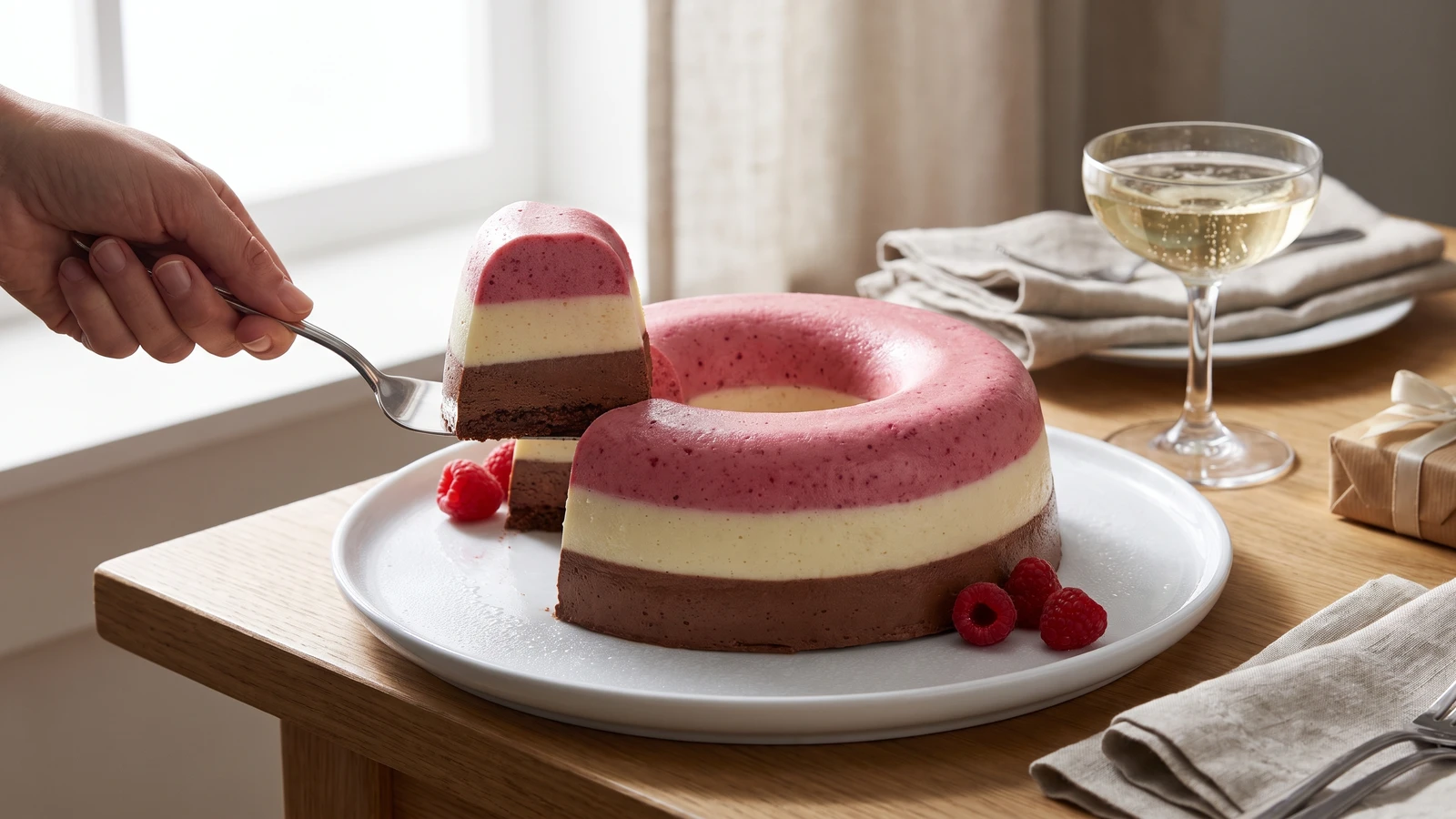
Six clean ribbons of vanilla, raspberry, and dark chocolate bavarois turn a single molded cream into celebration food, with every beautiful slice earned by patience between layers.
Bavarois rubanné (ribboned Bavarian cream) teaches one true thing: a layer must support the next without becoming so firm that the two refuse to join. The cut face should show six clean bands of ivory vanilla, soft raspberry pink, and deep chocolate, while every spoonful remains light, creamy, and unmistakably part of one dessert.
The grand kitchen assumed a pastry brigade making several complete bavarois preparations in parallel, then filling rows of molds in a cold room. For one cook, that is scaffolding and it can go. Here, one crème anglaise is set with gelatin, divided into three flavors, and lightened with one bowl of whipped cream. The source gives no fixed palette, so vanilla, raspberry, and dark chocolate supply honest contrast without changing its intent. One cook, one stove, one evening.
The alternating preparations are the dish, and the pause between them must stay. Chill each ribbon only until it no longer marks a fingertip, then pour the next gently over the back of a spoon. Too soft and the colors mingle; completely firm and the finished bavarois may separate at the bands. That small interval decides everything.
Bavarois belongs to the classical entremets of Parisian grand kitchens, despite a name that gestures toward Bavaria; its familiar molded form is French, built from crème anglaise, gelatin, and whipped cream. Bavarois rubanné is an ornamental variation rather than a fixed flavor formula, with contrasting preparations arranged in alternate bands according to the cook's palette. Its decoration is structural, revealed only when the mold is cut, which allowed the grand-kitchen entremets to travel naturally onto celebration tables at home.
Quantity
1/2 teaspoon (2.5 ml / 2 g)
for the mold
Quantity
1 tablespoon plus 1 teaspoon (20 ml / 12 g)
Quantity
1/4 cup (60 ml / 60 g)
Quantity
1 1/2 cups (360 ml / 370 g)
Quantity
5 (about 90 g)
Quantity
2/3 cup (160 ml / 135 g)
Quantity
1/8 teaspoon (0.6 ml / 0.8 g)
Quantity
1 1/2 teaspoons (7.5 ml / 7.5 g)
Quantity
1/2 cup (120 ml / 70 g)
finely chopped and melted
Quantity
1/3 cup (80 ml / 80 g)
at room temperature
Quantity
1 teaspoon (5 ml / 5 g)
Quantity
2 cups (480 ml / 475 g)
thoroughly chilled
Quantity
8 (about 30 g)
for serving
| Ingredient | Quantity |
|---|---|
| neutral oilfor the mold | 1/2 teaspoon (2.5 ml / 2 g) |
| powdered gelatin | 1 tablespoon plus 1 teaspoon (20 ml / 12 g) |
| cold water | 1/4 cup (60 ml / 60 g) |
| whole milk | 1 1/2 cups (360 ml / 370 g) |
| large egg yolks | 5 (about 90 g) |
| granulated sugar | 2/3 cup (160 ml / 135 g) |
| fine sea salt | 1/8 teaspoon (0.6 ml / 0.8 g) |
| pure vanilla extract | 1 1/2 teaspoons (7.5 ml / 7.5 g) |
| dark chocolate, 64 to 70 percent cocoafinely chopped and melted | 1/2 cup (120 ml / 70 g) |
| seedless raspberry puréeat room temperature | 1/3 cup (80 ml / 80 g) |
| fresh lemon juice | 1 teaspoon (5 ml / 5 g) |
| heavy creamthoroughly chilled | 2 cups (480 ml / 475 g) |
| fresh raspberries (optional)for serving | 8 (about 30 g) |
Brush a 2-quart (1.9-liter) ring or fluted mold with the neutral oil, then blot it thoroughly with a clean cloth until no visible droplets remain. The film should be almost imperceptible; too much oil leaves a slick surface. Chill the mold while you prepare the three bavarois mixtures.
Sprinkle the powdered gelatin evenly over the cold water and leave it undisturbed for 10 minutes. Every granule must absorb water before it meets the custard, or dry grains can survive as rubbery specks. The bloomed gelatin should look swollen and uniformly translucent.
Warm the milk in a saucepan until bubbles gather around the edge. Whisk the yolks, sugar, and salt in a bowl just until smooth, then pour in the milk gradually while whisking. Return everything to the saucepan and cook over gentle heat, stirring constantly with a flexible spatula, until the crème anglaise coats the spatula and reaches 180 to 183°F (82 to 84°C). Do not let it boil. Remove it from the heat, add the bloomed gelatin, and stir until completely dissolved, then pass the custard through a fine sieve. If the yolks begin to form tiny curds, take the pan off the heat, blend briefly, and strain at once. Ça se rattrape.
Divide the warm custard equally among three bowls, using a scale if you have one. Stir the vanilla extract into the first. Gradually stir the melted chocolate into the second, beginning with a spoonful of custard to bring the two together. Mix the raspberry purée and lemon juice into the third. Let all three cool to about 77°F (25°C), fluid but no longer warm. If the chocolate forms small firm flecks, set its bowl over barely warm water and fold gently until smooth.
Whip the chilled cream to soft peaks that bend at the tip; stiff cream makes a coarse, heavy bavarois. Weigh or divide it into three equal portions, about 158 g each, and fold one portion into each flavored custard. Begin with a third of the cream to loosen the base, then fold in the rest with broad strokes until no white streaks remain. Keep the bowls at cool room temperature. If one mixture begins setting before its turn, stand it briefly over lukewarm water and fold only until fluid again.
Pour half the raspberry bavarois into the chilled mold and refrigerate for 25 to 35 minutes, or place it in the freezer for 10 to 15 minutes, until the surface no longer comes away on a fingertip but remains faintly tacky. Hold a large spoon close above the surface and pour half the vanilla bavarois over its back so the new mixture spreads without striking through. Set it the same way, then add half the chocolate. Repeat with the remaining raspberry, vanilla, and chocolate mixtures to make six bands. If a new layer breaks into the one below, stop pouring immediately, chill the mold until firm enough, and resume over the spoon. A small ripple will disappear into the pattern when sliced.
Cover the mold only after the final surface has set, then refrigerate for at least 6 hours, preferably overnight. This rest sets the gelatin throughout and lets the three flavors settle into one another without losing their clean bands. Do not freeze the finished bavarois; freezing damages the cream's fine texture.
Dip the mold in warm water for 5 to 8 seconds, keeping the water below the rim, then dry the outside. Loosen the upper edge delicately with a fingertip, place a chilled serving plate over the mold, and invert decisively. If it refuses to release, wrap the mold in a warm damp towel for a few seconds rather than dipping it repeatedly. Chill the unmolded bavarois for 15 minutes if its surface has softened, then cut with a thin knife dipped in warm water and wiped dry between slices. Add the fresh raspberries, if using. À table!
1 serving (about 130g)
Culinary guides, cultural storytelling, and the editorial depth that makes cooking meaningful.
Discover Culinary ExplorerChef Juliette
Five almond preparations, one discipline: remove the skins cleanly, dry every kernel through, then cut, toast, or cloak it in pale caramel without letting its fragrant oils escape.

Chef Juliette
A pastry pantry lesson in one tray: filberts warmed only until their red skins release, rubbed clean, cooled, and chopped into a fragrant mise-en-place for cakes, creams, pralines, and petits fours.

Chef Juliette
The smallest pâtisserie discipline decides whether a cake leaves its mould intact: clarified butter in every corner, followed by the lightest veil of dry flour or fécule.

Chef Juliette
Four whites, one spotless bowl, and a patient change of speed: whisk gently until loosened, then briskly to glossy stiffness, with powdered sugar waiting if the foam begins to granulate.