
Chef Juliette
Flan aux Carottes
A pale short-paste shell holds silken, lightly sweet carrot purée beneath neat glazed half-discs, their butter syrup catching the light: a classical tart poised between vegetable course and sweet.
A cooking platform built around craft, culture, and the stories behind what we eat.
Created by Chef Juliette
Based on No. 2610, Schaleth à la Juive, from Le Guide Culinaire (1907) by Auguste Escoffier
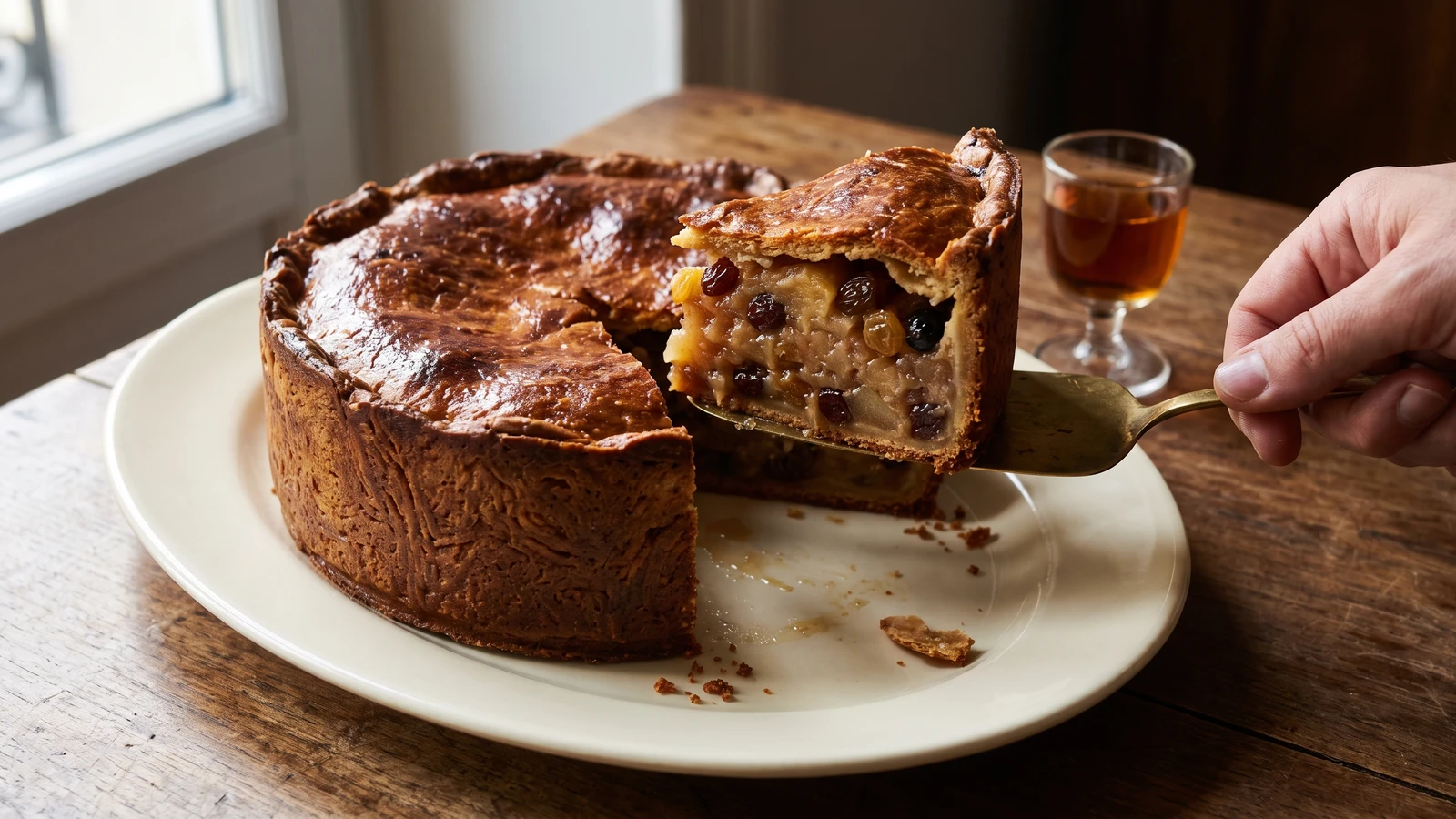
An Alsatian Sabbath sweet made generous: spiced stewed apples, three dried fruits and Malaga wine sealed in thin pâte à nouilles, baked to a gilded crust, then rested just long enough to turn out cleanly.
Schaleth à la Juive (an Alsatian Jewish Sabbath apple and dried-fruit pie) teaches one discipline above all: a sealed pie can only hold what the cook has first taught to behave. The filling must be cold and the stewed apples truly stiff before either meets the pâte à nouilles. Get that right and the cut wedge shows amber apple, dark raisins, currants, and gold sultanas held beneath a burnished lid instead of spilling across the plate.
The original formula assumed a greased iron saucepan or a special Pommes Anna mould, a quantity suited to professional service, and stewed fruit already waiting in the kitchen. Here the filling is reduced by exactly half, while a deep 6-inch metal cake mould stands in for the old pan and a rolling pin handles the thin noodle paste. The pre-prepared fruit was brigade scaffolding, so one cook can stew, soak, and cool it in a single orderly sequence. One cook, one stove, one evening.
What stays is the dish itself: equal quantities of three dried fruits, Malaga wine, finely cut zest, a firmly sealed lid, gilding, the central slit, and the ten-minute rest before turning out. Do not rush the apples. Their final spoon track, dry enough to remain open across the pan, decides everything that follows.
Schaleth belongs to the Jewish Sabbath table of Alsace, where dishes were assembled before the day of rest and entrusted to a household or communal oven without last-minute tending. Its name is related to the better-known savoury cholent, but this French canonical rendering is a sweet moulded bake of apples, dried grapes, eggs, and Malaga wine sealed in noodle paste. The grand kitchen refined its gilding and clean turning-out while preserving the essential Sabbath logic: prepare ahead, bake steadily, and bring one generous piece to the table.
Quantity
1 cup (240 ml / 120 g)
Quantity
1/4 teaspoon (1.25 ml / 1.5 g)
Quantity
1
for the pâte à nouilles
Quantity
1 to 3 teaspoons (5 to 15 ml / 5 to 15 g)
as needed
Quantity
1 tablespoon (15 ml / 14 g)
softened, for the mould
Quantity
About 4 medium (1 1/4 pounds / 570 g), yielding 1 2/3 cups (400 ml / 397 g) after stewing
peeled, cored, sliced, and stiffly stewed
Quantity
2/3 cup (160 ml / 94 g)
Quantity
2/3 cup (160 ml / 94 g)
Quantity
2/3 cup (160 ml / 94 g)
Quantity
4 cups (960 ml / 960 g)
for swelling the dried fruit
Quantity
1/2 teaspoon (2.5 ml / 1 g)
finely grated from about 1/4 orange
Quantity
1/4 teaspoon (1.25 ml / 0.5 g)
finely grated from about 1/4 lemon
Quantity
1 small pinch (less than 1/16 teaspoon / 0.1 g)
Quantity
1/4 cup plus 1 teaspoon (65 ml / 57 g)
Quantity
2
Quantity
3
Quantity
1/4 cup plus 2 teaspoons (70 ml / 70 g)
Quantity
1
beaten, for gilding
| Ingredient | Quantity |
|---|---|
| all-purpose flour | 1 cup (240 ml / 120 g) |
| fine salt | 1/4 teaspoon (1.25 ml / 1.5 g) |
| large eggfor the pâte à nouilles | 1 |
| cool wateras needed | 1 to 3 teaspoons (5 to 15 ml / 5 to 15 g) |
| unsalted buttersoftened, for the mould | 1 tablespoon (15 ml / 14 g) |
| russet applespeeled, cored, sliced, and stiffly stewed | About 4 medium (1 1/4 pounds / 570 g), yielding 1 2/3 cups (400 ml / 397 g) after stewing |
| pipped Malaga raisins | 2/3 cup (160 ml / 94 g) |
| dried currants | 2/3 cup (160 ml / 94 g) |
| sultanas | 2/3 cup (160 ml / 94 g) |
| tepid waterfor swelling the dried fruit | 4 cups (960 ml / 960 g) |
| orange zestfinely grated from about 1/4 orange | 1/2 teaspoon (2.5 ml / 1 g) |
| lemon zestfinely grated from about 1/4 lemon | 1/4 teaspoon (1.25 ml / 0.5 g) |
| freshly grated nutmeg | 1 small pinch (less than 1/16 teaspoon / 0.1 g) |
| superfine sugar | 1/4 cup plus 1 teaspoon (65 ml / 57 g) |
| large eggs | 2 |
| large egg yolks | 3 |
| Malaga wine | 1/4 cup plus 2 teaspoons (70 ml / 70 g) |
| large eggbeaten, for gilding | 1 |
Mix the flour and salt, make a well, and add the egg. Draw the flour inward with a fork, then knead until the pâte à nouilles, the plain noodle paste, becomes smooth, firm, and elastic, about 8 minutes. Add cool water only a teaspoon at a time if dry crumbs refuse to join. If it turns sticky, dust the board lightly with flour and keep kneading. Ça se rattrape. Wrap the dough and rest it for 30 minutes so it rolls thin without springing back.
Put the Malaga raisins, currants, and sultanas in separate bowls so their equal quantities remain clear, then cover them with tepid water. Leave them for 20 minutes, just until plump, not waterlogged. Drain thoroughly and spread them on a clean towel to dry. Pipped means that any seeds have been removed from the large Malaga raisins. Water clinging to the fruit will loosen the filling, so give this small step its full attention.
Put the sliced apples in a wide saucepan with no added water. Cover and cook over medium-low heat for 6 to 8 minutes, stirring once or twice, until their own juice begins to run. Uncover and continue cooking for 12 to 18 minutes, stirring and crushing only the largest pieces, until the apples are tender and dense enough that a spoon drawn across the pan leaves a track that stays open. Weigh out 1 2/3 cups (400 ml / 397 g). If the apples look wet, keep them uncovered over gentle heat until the excess liquid is gone; this dryness is the foundation of the pie. Cool completely.
Combine the cold stewed apples with the drained Malaga raisins, currants, and sultanas. Add the orange and lemon zest, taking only the outermost coloured, glossy film and none of the bitter white pith, then add the nutmeg and sugar. Beat the 2 whole eggs and 3 yolks only until blended, stir in the Malaga wine, and fold this into the fruit. Cover and chill for at least 30 minutes, or up to 12 hours. If the apples are still warm, stop and cool them before adding the eggs; warm filling softens the paste before the oven can set it.
Heat the oven to 350°F (175°C) with a rack in the middle. Butter a 6-inch by 2 1/2-inch-deep (15 by 6 cm) straight-sided metal mould generously. Roll two-thirds of the rested dough into an 11-inch (28 cm) round about 1/16 inch (1.5 mm) thick. Ease it into the mould without stretching, press it into the base and sides, and leave about 1 inch (2.5 cm) hanging over the rim. Patch any tear with a scrap of dampened dough. Spoon in the filling, pressing gently so no large air pockets remain.
Roll the remaining dough into an 8-inch (20 cm) round. Moisten the lined rim very lightly with water, lay on the lid, and press the two layers firmly together. Trim the excess to 1/2 inch (1 cm), fold the edge inward, and pinch it closed all around. Gild the lid by brushing it thinly with beaten egg, which gives the paste its golden sheen in the oven. Cut a 1-inch (2.5 cm) slit through the centre so steam can escape. The seal and slit are the dish, not decoration; keep both.
Set the mould on a baking sheet and bake for 50 minutes. The lid should be deeply golden, the edges firm, and a thin skewer passed through the vent should emerge hot and damp but not coated with liquid egg. If the top darkens before the centre is ready, cover it loosely with foil and continue baking. If the filling remains fluid at 50 minutes, give it another 5 to 10 minutes. A steady oven matters more than the clock.
Set the mould on a rack and rest the Schaleth for exactly 10 minutes before turning it out. The pause lets the egg-bound fruit settle while the butter around the crust remains warm enough to release. Run a thin knife around the rim, cover the mould with a serving plate, and invert both together in one confident movement. If it clings, return it upright, set the base on a warm damp towel for 30 seconds, loosen the edge again, and retry. Serve warm or at room temperature, cut into generous wedges. À table!
1 serving (about 200g)
Culinary guides, cultural storytelling, and the editorial depth that makes cooking meaningful.
Discover Culinary ExplorerChef Juliette
A pale short-paste shell holds silken, lightly sweet carrot purée beneath neat glazed half-discs, their butter syrup catching the light: a classical tart poised between vegetable course and sweet.
Chef Juliette
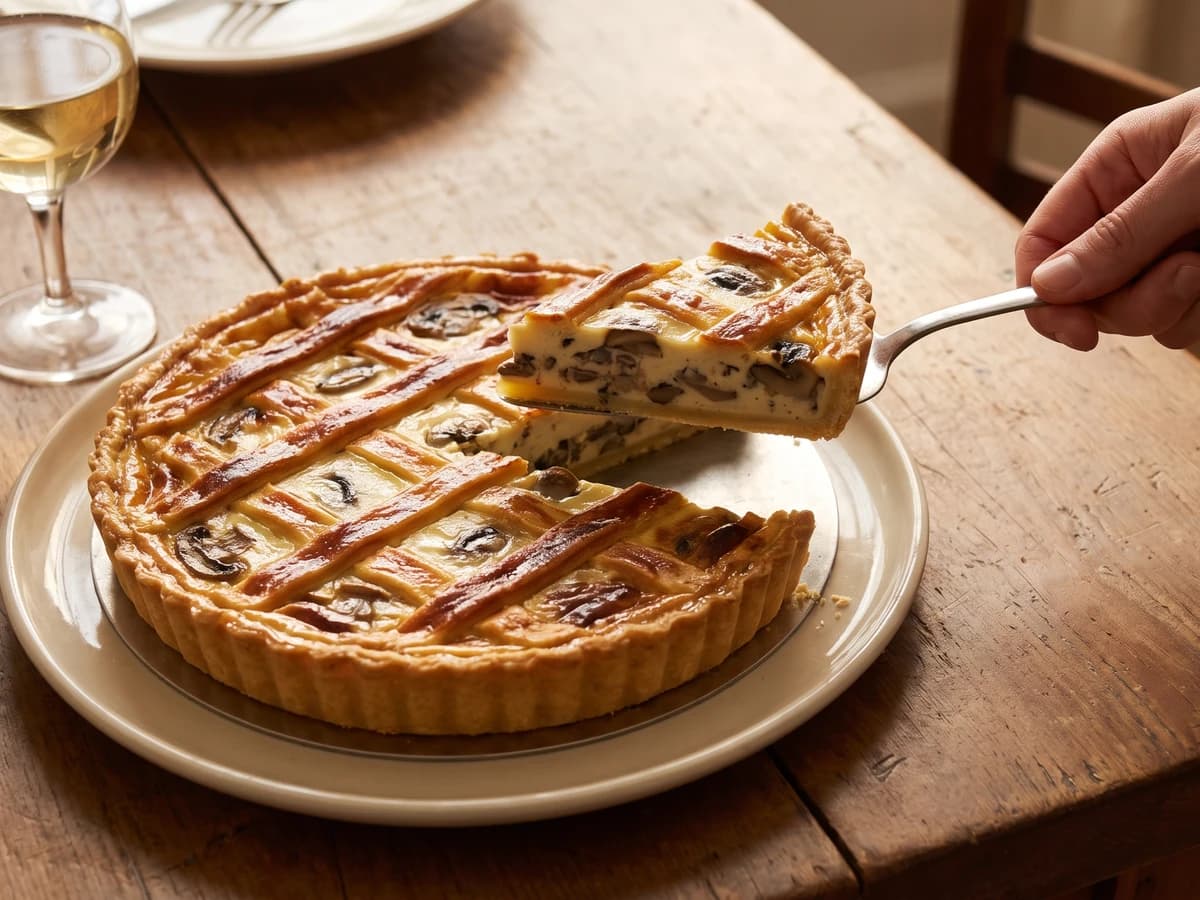
A hot mushroom flan under a butter-gold lattice, with cream reduced close around barely opened caps and a crisp short-paste base protected by one discipline: cool the filling completely.

Chef Juliette
Four little mushroom flans, latticed and gilded, baked hard and fast until butter-gold: a classical garnish scaled to the meat it accompanies and served before its crispness has time to fade.
Chef Juliette
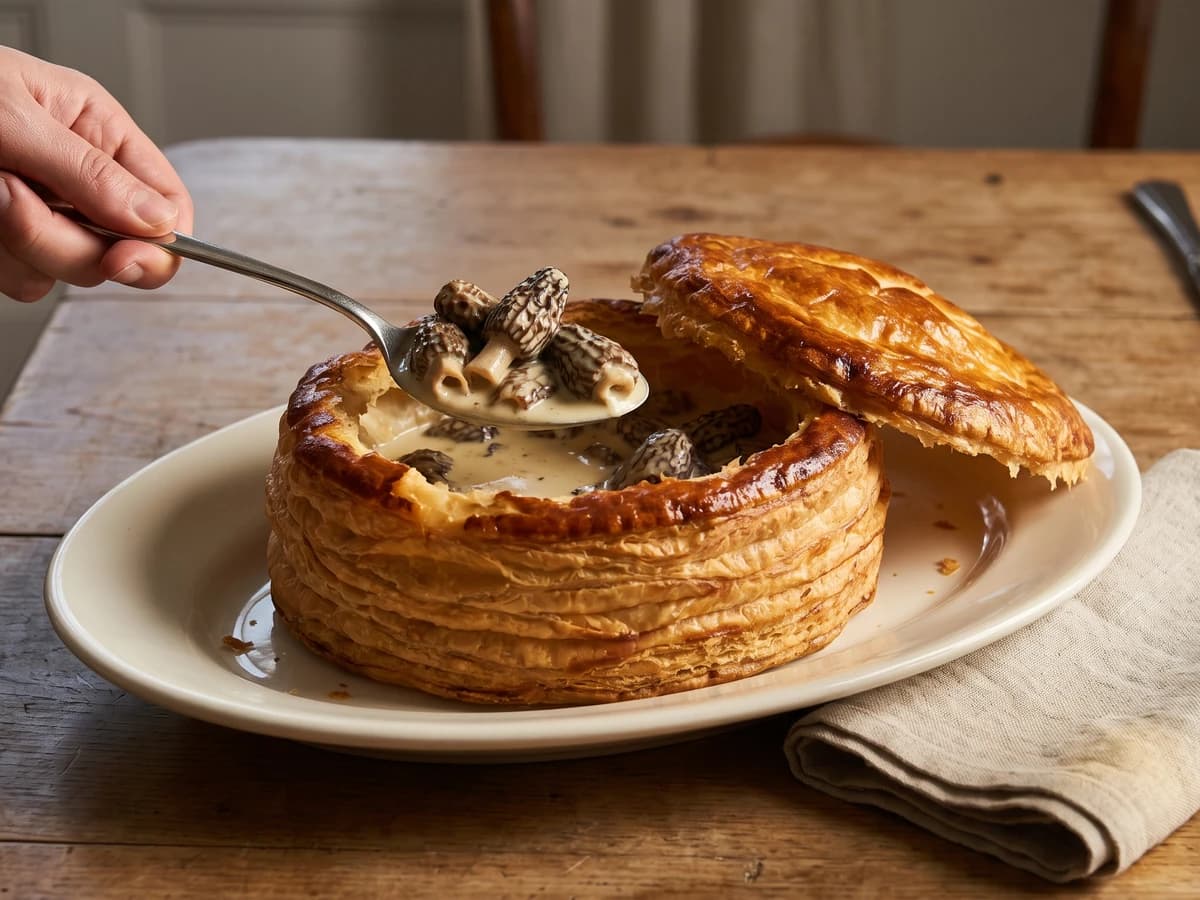
Morels surrender their liquor, then take it back as a glossy cream-and-butter sauce inside burnished puff pastry. The lesson is simple and absolute: reduce with patience, then heat gently and never boil.