
Chef Juliette
Various Almond Preparations
Five almond preparations, one discipline: remove the skins cleanly, dry every kernel through, then cut, toast, or cloak it in pale caramel without letting its fragrant oils escape.
A cooking platform built around craft, culture, and the stories behind what we eat.
Created by Chef Juliette
Based on No. 2585, Poires à la Sultane, from Le Guide Culinaire (1907) by Auguste Escoffier
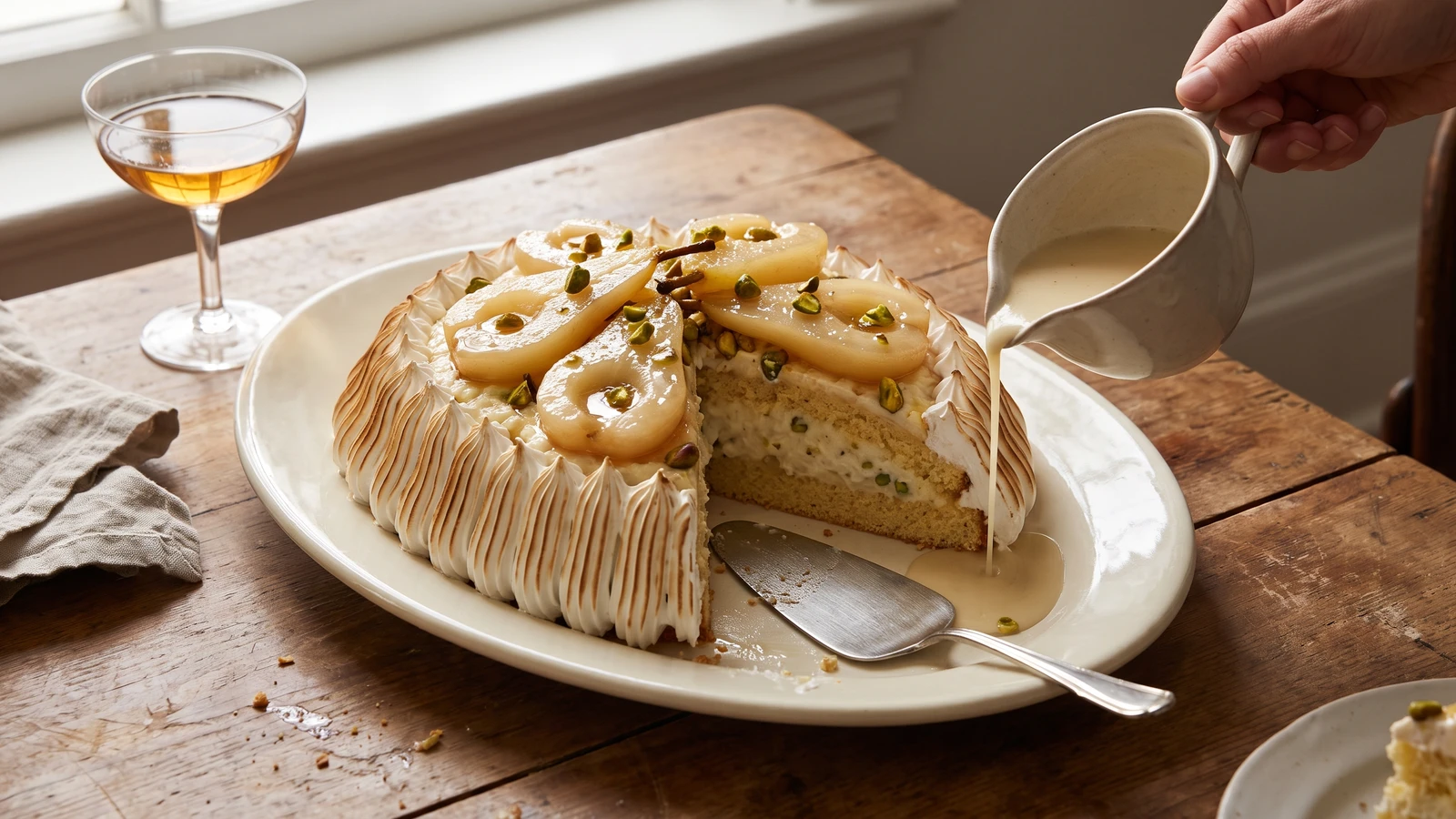
Poires à la Sultane crowns pistachio-flecked vanilla rice with syrup-poached pears inside a bronzed meringued Génoise border, then sends warm almond-milk butter syrup to the table apart, exactly where it belongs.
Poires à la Sultane (vanilla-poached pears over pistachio rice in a meringued Génoise sponge border) teaches composure: every element may be tender, but none may be slack. Before you touch a pan, know this one thing. The pears must yield to a knife while still holding the clean geometry of a half or quarter. Their poach decides whether the finished crown looks generous or collapses into compote.
The original assumed a pastry station, a somewhat deep border mould, apricot glaze already at the small-thread stage, and enough hands to make Génoise, dry-paste base, meringue, rice, and sauce together. At home, make one 8-inch (20 cm) border for six, use a conventional oven and a small saucepan, then work in sequence through Apricots à la Sultane (No. 2557), the named foundation the book itself requires. Separate cooks and service quantities are scaffolding and can go. The meringued ring, vanilla rice bound with crème frangipane (almond pastry cream), pistachios, pears, and butter-finished almond-milk syrup are the dish and stay. One cook, one stove, one evening.
When it is right, the meringue is lightly bronzed, the rice holds a soft dome, and the vanilla pears shine against green pistachios. The warm sauce comes separately so each guest decides how much to pour. Watch the knife during the poach. That quiet resistance is the step that matters most.
Poires à la Sultane belongs to the Parisian grand-kitchen repertoire of composed entremets; à la Sultane is not a regional pear preparation, but a named architecture of rice, almonds, pistachios, meringue, and arranged fruit. The formula's brevity is revealing: it sends the cook to Apricots à la Sultane (No. 2557) and changes only the vanilla-poached fruit, leaving the construction intact. This modular grammar allowed elaborate preparations to pass from brigade manuals to bourgeois celebration tables without losing their identity.
Quantity
1 finished 8-inch (20 cm) Apricots à la Sultane (No. 2557) preparation, apricot garnish omitted; chopped pistachios and almond-milk syrup reserved
Quantity
3 medium (about 1¼ lb / 570 g)
Quantity
3 cups (710 ml / 710 g)
Quantity
1½ cups (360 ml / 300 g)
Quantity
1
| Ingredient | Quantity |
|---|---|
| finished foundation from Apricots à la Sultane | 1 finished 8-inch (20 cm) Apricots à la Sultane (No. 2557) preparation, apricot garnish omitted; chopped pistachios and almond-milk syrup reserved |
| firm-ripe Bosc or Conference pears | 3 medium (about 1¼ lb / 570 g) |
| water | 3 cups (710 ml / 710 g) |
| granulated sugar | 1½ cups (360 ml / 300 g) |
| vanilla bean | 1 |
Prepare Apricots à la Sultane (No. 2557) as the separate finished foundation required by the book, scaled to one 8-inch (20 cm) border. Complete its browned meringued Génoise border and domed vanilla rice bound with frangipane and pistachios, but omit the apricot garnish; reserve its chopped pistachios and almond-milk syrup for the finish. The cross-reference is the architecture of this dish and remains whole. Only the fruit changes. Let the filled border cool completely.
Split the vanilla bean lengthwise and scrape out the seeds. Put the seeds, pod, water, and sugar in a saucepan, then bring them slowly to a boil while stirring just until the sugar dissolves. Once the syrup is clear, stop stirring and simmer gently for 5 minutes. If crystals form along the pan, cover it for 1 minute so condensation washes them down; if they persist, add 2 tablespoons of the measured water and dissolve them over low heat.
Peel the pears and halve them lengthwise, cutting through the stem if it divides neatly. Quarter very large pears so every serving remains graceful rather than formidable. Scoop out each core with a melon baller, cut away the narrow fibrous line running toward the stem, and trim the pieces evenly. Lower each piece into the warm syrup as soon as it is ready so the flesh stays pale.
Lay a cartouche (parchment lid) directly over the pears to keep them beneath the syrup. Return the pan to the barest simmer and poach for 15 to 25 minutes, turning the fruit once, until a thin knife enters the thickest part with only faint resistance. Pull the pan from the heat and leave the pears in the syrup for 15 minutes so carryover heat finishes them. If they remain hard, return them to low heat. If they have softened too far, lift them out immediately, chill them on a tray, and arrange them later as overlapping thick slices. Ça se rattrape.
Lift the pears onto a wire rack set over a tray and let them drain for at least 15 minutes, then cool them completely. Blot the cut surfaces if they remain wet; syrup running into the rice will loosen the dome and soften the Génoise. Strain the poaching syrup and brush only a thin film over the pears to restore their gloss.
Set the pear halves over the rice dome supplied by Apricots à la Sultane (No. 2557), arranging them radially with their tapered ends toward the centre. If you quartered or sliced the fruit, overlap the pieces evenly while preserving the rounded form of the dome. Sprinkle with the chopped pistachios reserved from Apricots à la Sultane (No. 2557). Use a generous hand, but add nothing else.
Reserve 1 tablespoon of the almond-milk syrup from Apricots à la Sultane (No. 2557) while cold, then warm the remainder gently in a small saucepan. Off the heat, monter au beurre (whisk in butter) with the hazelnut-sized piece specified by that preparation until the syrup gleams. If the butter separates into oily specks, whisk in the reserved cold syrup drop by drop until smooth. Serve this sauce warm and apart in a small sauceboat, then cut the Sultane at the table. À table!
1 serving (about 240g)
Culinary guides, cultural storytelling, and the editorial depth that makes cooking meaningful.
Discover Culinary ExplorerChef Juliette
Five almond preparations, one discipline: remove the skins cleanly, dry every kernel through, then cut, toast, or cloak it in pale caramel without letting its fragrant oils escape.

Chef Juliette
A pastry pantry lesson in one tray: filberts warmed only until their red skins release, rubbed clean, cooled, and chopped into a fragrant mise-en-place for cakes, creams, pralines, and petits fours.

Chef Juliette
The smallest pâtisserie discipline decides whether a cake leaves its mould intact: clarified butter in every corner, followed by the lightest veil of dry flour or fécule.

Chef Juliette
Four whites, one spotless bowl, and a patient change of speed: whisk gently until loosened, then briskly to glossy stiffness, with powdered sugar waiting if the foam begins to granulate.