Culinary Explorer

A cooking platform built around craft, culture, and the stories behind what we eat.
Discover Culinary Explorer
Pêches à la Vanille

Pêches à la Vanille

Created by Chef Juliette

Based on No. 2580, Pêches à la Vanille, from Le Guide Culinaire (1907) by Auguste Escoffier

Pêches à la Vanille turn ripe fruit, a clear vanilla syrup, and cold cream into a poised make-ahead dessert, with arrowroot giving the pale pink sauce just enough body to cling.

Desserts
French
Dinner Party
Romantic
Make Ahead
25 min
Active Time
20 min cook3 hr 45 min total
Yield4 servings

Pêches à la Vanille (peaches poached in vanilla syrup) teach the restraint behind all good poached fruit. The syrup must perfume rather than candy, the arrowroot must bind without turning pasty, and the finished sauce must rise only halfway up the peaches. Begin with fruit ripe enough to scent the room but still firm around the stone. Poaching can finish a peach; it cannot rebuild one.

The original formula assumed a pastry station with syrup, vanilla cream, coloring, and a formal timbale ready for service in large quantities. At home, one saucepan prepares the syrup and its arrowroot liaison, a whisk handles the cream, and a deep glass serving bowl replaces the silver vessel. Scaling the dish to four removes the brigade staging, which was scaffolding. The poaching, the restrained pink tint, the vanilla cream, and the half-height dressing are the dish itself, and they stay. One cook, one stove, one evening.

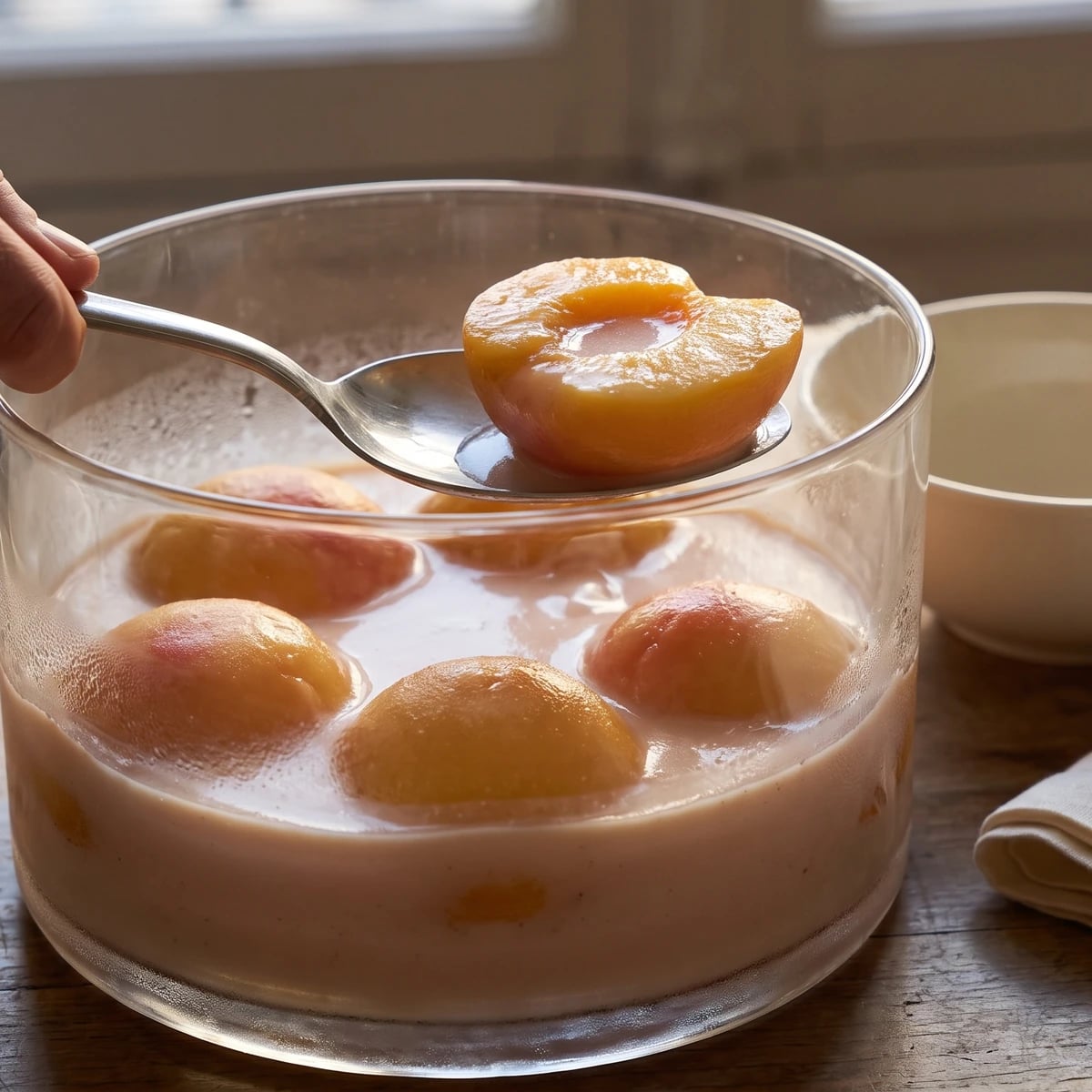
When it is right, the peaches remain whole and satin-soft, their golden curves rising from a cool, shell-pink sauce with a clean vanilla fragrance. The moment that matters most is the poach: lift each peach as soon as a knife meets only faint resistance, because the hot syrup keeps working after the pan is off the fire.

Pêches à la Vanille belongs to the Parisian grand-kitchen repertory of fruit entremets, where carefully poached fruit was arranged communally and finished with its own lightly bound syrup. The method passed readily from formal dining rooms to bourgeois tables because it rewards advance preparation and needs no oven. Here timbale means the deep serving vessel, not a molded custard, and the half-height sauce is deliberate: it displays the peaches instead of drowning them.

The technique, the tradition, and the story behind every dish.

Discover Culinary Explorer

Ingredients

ripe but firm peaches

Quantity

4 medium (about 24 oz / 680 g)

preferably freestone

water

Quantity

3 cups (710 ml / 710 g)

granulated sugar

Quantity

1½ cups (355 ml / 300 g)

vanilla bean

Quantity

1

split lengthwise, seeds scraped

arrowroot starch

Quantity

1 tablespoon plus 1 teaspoon (20 ml / 10 g)

heavy cream

Quantity

½ cup (120 ml / 120 g)

well chilled

pure vanilla extract

Quantity

1 teaspoon (5 ml / 4 g)

red liquid food coloring

Quantity

1 drop

used sparingly

Equipment Needed

  • 3-quart (2.8-liter) stainless-steel saucepan
  • 1½-quart (1.4-liter) deep glass timbale or serving bowl
  • Fine-mesh sieve
  • Round of baking parchment
  • Slotted spoon
  • Small hand whisk

Instructions

  1. 1

    Build the vanilla syrup

    Combine the water, sugar, vanilla seeds, and empty pod in a 3-quart saucepan. Bring slowly to a simmer, stirring only until the sugar dissolves, then simmer for 3 minutes so the vanilla opens into the syrup. Halve the peaches along their seams and remove the stones. Leave the skins on during poaching because they protect the delicate flesh and lend the syrup a faint natural blush.

  2. 2

    Poach the peaches gently

    Lower the peach halves into the syrup and place a round of baking parchment directly on the surface to keep them evenly covered. Hold the syrup at the barest tremble for 4 to 8 minutes, turning the fruit once, until a small knife enters near the stem end with only faint resistance. Lift each half out immediately and slip off its skin while warm. If the edges begin to slump, stop the cooking at once and chill the fruit on a cold plate; ça se rattrape, though no syrup can rebuild an overcooked peach. Strain and reserve the poaching syrup.

    Judge the fruit, not the clock. A fully ripe peach may need only 4 minutes, while firmer fruit can take twice that.
  3. 3

    Bind and tint syrup

    Measure 1¼ cups (300 ml) of the cooled poaching syrup. Whisk the arrowroot with 3 tablespoons of that cold syrup until completely smooth, then bring the remainder just to a simmer. Whisk in the slurry and cook for 30 to 45 seconds at the gentlest simmer, stirring constantly, until the syrup turns glossy and lightly coats a spoon. Do not boil it hard or keep cooking once it clears, because prolonged heat weakens arrowroot. If it lumps, strain it while warm; if it tightens too far, loosen it with reserved poaching syrup, one spoonful at a time. Stir in one drop of coloring. The syrup should look only slightly deeper than shell pink because the cream will soften it.

  4. 4

    Fold in vanilla cream

    Set the bowl of pink syrup over ice and stir until completely cold. Reserve 2 tablespoons of the cream, then whisk the remainder with the vanilla extract only until it thickens slightly and leaves a brief trail. Fold the cream into the cold syrup in three additions, then stir in the reserved cream. The finished sauce should flow slowly and leave a thin, glossy film on the spoon. If it looks grainy because the cream was taken too far, whisk in the reserved cream before adding the last of the syrup; ça se rattrape.

  5. 5

    Dress the timbale halfway

    Arrange the chilled peach halves snugly in a 1½-quart deep serving bowl, cut sides down and rounded sides visible. Pour the pink vanilla sauce around them, stopping when it reaches exactly halfway up the fruit. Do not submerge the peaches. That half-height dressing is part of the preparation, keeping the fruit visible and the proportion of sauce to peach properly balanced. Cover and chill for at least 2 hours.

  6. 6

    Serve cool and generous

    Take the timbale from the cold 10 minutes before serving so the vanilla can speak clearly. Spoon two peach halves into each dish and give each serving a generous pool of the pink cream beneath them. No garnish is needed. À table!

Chef Tips

  • This dish needs peaches in their proper season because the fruit is the dessert. If they smell of nothing, don't force the matter; make poires à la vanille with firm pears and give them a longer poach.
  • Choose freestone peaches if you can. Their stones release cleanly, which leaves the halves handsome and intact; a clingstone peach may be poached whole, peeled, and carefully halved afterward.
  • Arrowroot is the correct liaison here because it leaves the syrup clear and glossy before the cream is added. Flour makes it dull, and cornstarch gives the sauce a heavier set.
  • Keep the pink tint restrained. A modern coloring bottle replaces the pastry kitchen's larger supply, but one drop is already plenty; the sauce should resemble the inside of a seashell, not confectionery.
  • The unused vanilla poaching syrup keeps for a week in the cold. Spoon it over berries, use it to moisten a sponge cake, or add a little to a fruit compote.

Advance Preparation

  • Poach the peaches up to one day ahead. Chill them in a shallow container with enough strained poaching syrup to keep their surfaces moist, then drain before arranging.
  • The arrowroot-bound pink syrup can be prepared one day ahead and kept covered in the cold. Whisk it smooth before folding in the vanilla cream.
  • Assemble the timbale 2 to 6 hours before dinner. Leftovers keep for 2 days in the cold, though the peaches gradually soften and color the sauce.

Frequently Asked Questions

Nutrition Information

1 serving (about 420g)

Calories
465 calories
Total Fat
11 g
Saturated Fat
7 g
Trans Fat
0 g
Unsaturated Fat
4 g
Cholesterol
35 mg
Sodium
10 mg
Total Carbohydrates
93 g
Dietary Fiber
2 g
Sugars
89 g
Protein
2 g

Note: Chef personas and recipes are created with AI assistance. Cook with care: follow safe food-handling practices, check doneness with a thermometer when needed, and adapt for allergies and your kitchen.

Where cooking meets culture.

Culinary guides, cultural storytelling, and the editorial depth that makes cooking meaningful.

Discover Culinary Explorer

More from Entremets (Sweets) - Hot Fruit Entremets

Browse the full collection